
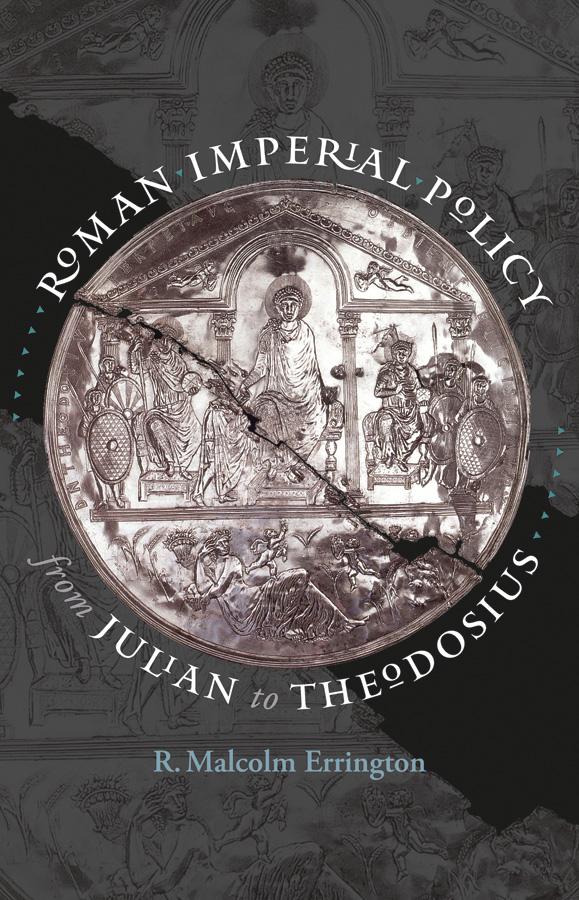
The division of the late Roman Empire into two theoretically cooperating parts by the brothers Valentinian and Valens in 364 deeply influenced many aspects of government in each of the divisions. Although the imperial policies during this well-documented and formative period are generally understood to have been driven by the religious and ideological aims of the emperors, R. Malcolm Errington argues that the emperors were actually much more pragmatic in their decision making than has previously been assumed.
The division of responsibilities between the emperors inevitably encouraged separate developments and allowed locally varying and often changing imperial attitudes toward different forms of religious belief. Errington demonstrates that the main stimulus for action in this period nearly always came from below the level of the imperial government, and not from an imperial initiative. Extending the theory of Fergus Millar into the later empire, Errington argues that the emperors were fundamentally reactive to regionally supplied information, as Millar has asserted was the case for the High Empire. Thus, despite significant structural changes, the empire remained broadly traditional in its operations.
The division of responsibilities between the emperors inevitably encouraged separate developments and allowed locally varying and often changing imperial attitudes toward different forms of religious belief. Errington demonstrates that the main stimulus for action in this period nearly always came from below the level of the imperial government, and not from an imperial initiative. Extending the theory of Fergus Millar into the later empire, Errington argues that the emperors were fundamentally reactive to regionally supplied information, as Millar has asserted was the case for the High Empire. Thus, despite significant structural changes, the empire remained broadly traditional in its operations.
Payez facilement par carte, Klarna, Apple Pay ou Google Pay. Pas satisfait ? Vous avez toujours une garantie de remboursement de 14 jours. En savoir plus dans nos conditions. Si vous avez des questions, envoyez-nous un e-mail à hello@memmo.org.
Memmo facilite tes études, où que tu sois dans le monde. On rassemble tes manuels de cours et des outils d'étude intelligents au même endroit : résumés, quiz, podcasts et flashcards. Et il y a Ted, ton compagnon d'étude qui répond à toutes tes questions. Plus de 50 000 étudiants étudient déjà ici – conçu pour t'aider à apprendre plus vite et à moins stresser.
Tu pourrais aussi aimer
Acheter le livre0