
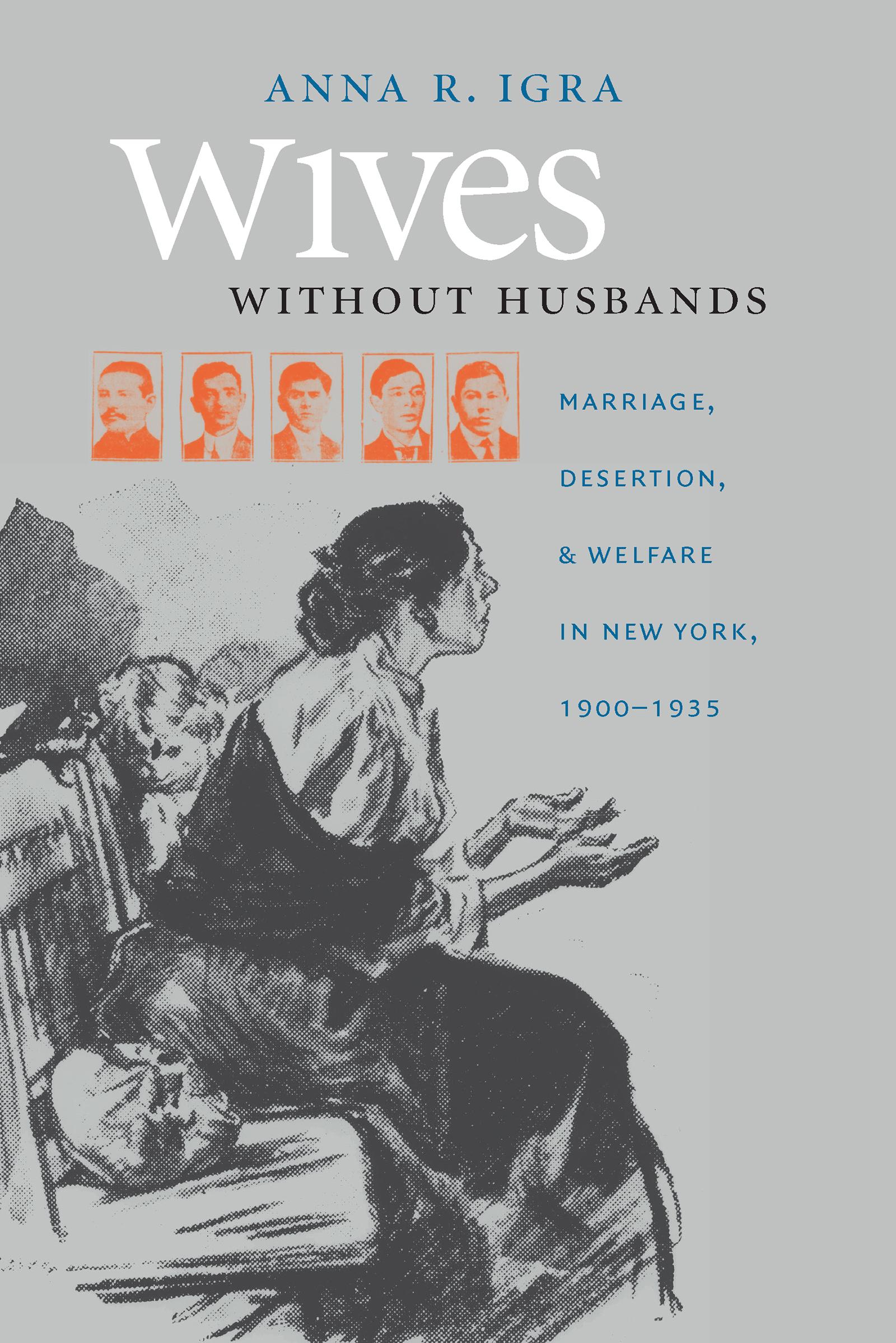
Shedding new light on contemporary campaigns to encourage marriage among welfare recipients and to prosecute “deadbeat dads,” Wives without Husbands traces the efforts of Progressive reformers to make “runaway husbands” support their families. Anna R. Igra investigates the interrelated histories of marriage and welfare policy in the early 1900s, revealing how reformers sought to make marriage the solution to women’s and children’s poverty.
Igra taps a rich trove of case files from the National Desertion Bureau, a Jewish husband-location agency, and follows hundreds of deserted women through the welfare and legal systems of early twentieth-century New York City. She integrates a broad range of topics, including Americanization as a gendered process, breadwinning as a measure of manhood, the relationship between consumer culture and social policy formation, the class dimensions of family law, and the Jewish community as a source of welfare policy innovation. Igra analyzes the history of antidesertion reform from its emergence in social policy debates, through the establishment of domestic relations courts, to Depression relief programs. She shows that early twentieth-century reformers, by attempting to make instrumental use of poor people’s intimate relations, anticipated welfare policies in our own time that promote marriage as an answer to poverty.
Igra taps a rich trove of case files from the National Desertion Bureau, a Jewish husband-location agency, and follows hundreds of deserted women through the welfare and legal systems of early twentieth-century New York City. She integrates a broad range of topics, including Americanization as a gendered process, breadwinning as a measure of manhood, the relationship between consumer culture and social policy formation, the class dimensions of family law, and the Jewish community as a source of welfare policy innovation. Igra analyzes the history of antidesertion reform from its emergence in social policy debates, through the establishment of domestic relations courts, to Depression relief programs. She shows that early twentieth-century reformers, by attempting to make instrumental use of poor people’s intimate relations, anticipated welfare policies in our own time that promote marriage as an answer to poverty.
Payez facilement par carte, Klarna, Apple Pay ou Google Pay. Pas satisfait ? Vous avez toujours une garantie de remboursement de 14 jours. En savoir plus dans nos conditions. Si vous avez des questions, envoyez-nous un e-mail à hello@memmo.org.
Memmo facilite tes études, où que tu sois dans le monde. On rassemble tes manuels de cours et des outils d'étude intelligents au même endroit : résumés, quiz, podcasts et flashcards. Et il y a Ted, ton compagnon d'étude qui répond à toutes tes questions. Plus de 50 000 étudiants étudient déjà ici – conçu pour t'aider à apprendre plus vite et à moins stresser.
Tu pourrais aussi aimer
Acheter le livre0