
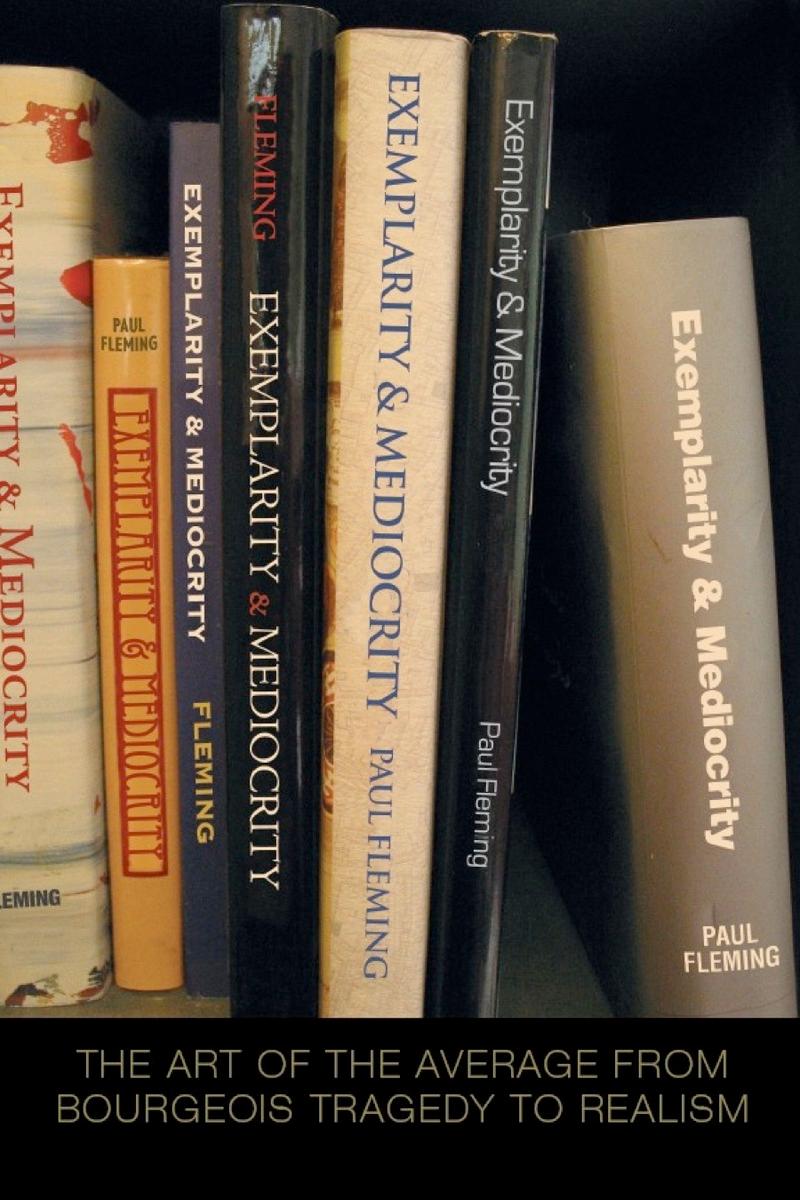
Following Hegel's analysis of art's increasing difficulty to both engage and extricate itself from prosaic reality, Paul Fleming investigates the strategies employed by German literature from 1750 to 1850 for increasingly attuning itself to quotidian life—common heroes, everyday life, non-extraordinary events—while also avoiding all notions of mediocrity. He focuses on three sites of this tension: the average audience (Lessing), the average artist (Goethe and Schiller), and the everyday, or average life (Grillparzer and Stifter).
The book's title, Exemplarity and Mediocrity, describes both a disjunctive and a conjunctive relation. Read disjunctively, modern art must display the "exemplary originality" (Kant) that only genius can provide and is thus fundamentally opposed to mediocrity as that which does not stand out or lacks distinctiveness; in the conjunctive sense, modern art turns to non-exceptional life in order to transform it—without forsaking its commonness—thereby producing exemplary forms of mediocrity that both represent the non-exceptional and, insofar as they stand outside the group they represent, are something other than mediocre.
Payez facilement par carte, Klarna, Apple Pay ou Google Pay. Pas satisfait ? Vous avez toujours une garantie de remboursement de 14 jours. En savoir plus dans nos conditions. Si vous avez des questions, envoyez-nous un e-mail à hello@memmo.org.
Memmo facilite tes études, où que tu sois dans le monde. On rassemble tes manuels de cours et des outils d'étude intelligents au même endroit : résumés, quiz, podcasts et flashcards. Et il y a Ted, ton compagnon d'étude qui répond à toutes tes questions. Plus de 50 000 étudiants étudient déjà ici – conçu pour t'aider à apprendre plus vite et à moins stresser.