
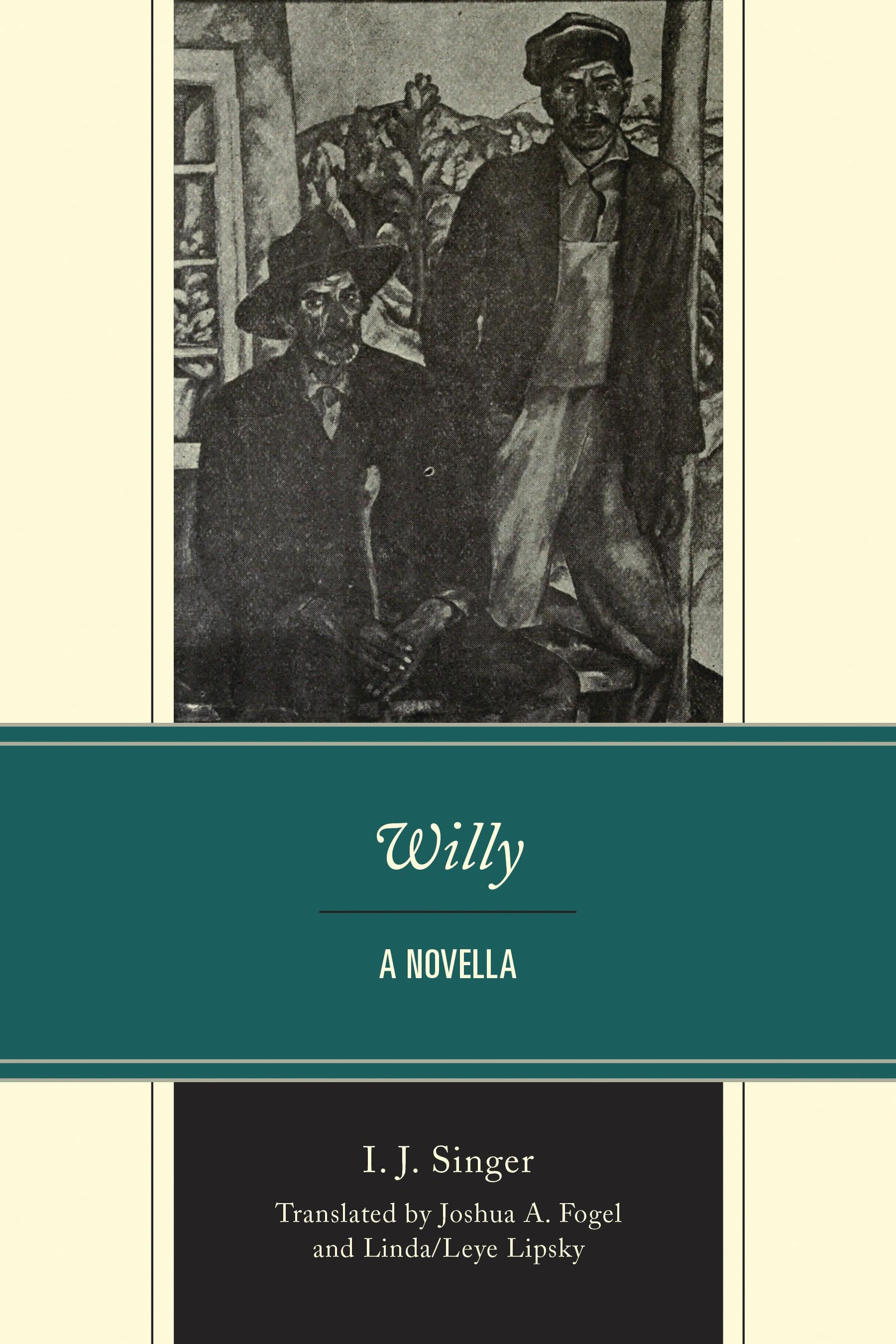
While Willy has neither the multi-generational sweep nor the moral gravitas of I. J. Singer’s family sagas, its themes are nonetheless timeless, its struggles archetypal. A father and son quarrel, and, in the process, a richly compact narrative emerges. Their respective stories define what is lost and what is gained in immigrant passage to the new world. The eponymous hero, Volf Rubin—Willy (Vili) Robin in America—is the rare agon who shares center stage with his antagonist, that is, his more voluble paterfamilias. The sententious Hirsh—modeled on the chief rabbi of Nyesheve and Singer's own painful childhood encounters with his savage brutality—tenaciously holds on to some of the more merciless pronouncements derived from a literalist reading and application of Jewish law. Such is the heavy baggage which, according to Volf, should have been left behind in steerage.
Volf's lapsed Judaism is his father’s dystopian nightmare: a collection of Halakhic transgressions, and worse, his renunciation of study. Volf’s school is the meadow, the farm, and the stable: all comprise an idyllic revision of the scene of instruction. He is a devotee of nature, its flora and especially its fauna. Volf’s love for his horses is steadfast and “unbridled”: he holds on to their manes without the mediation of man-made straps of leather. Through an unforeseen turn of events and peripety, Hirsh finds undeserved recompense. Volf, on the other hand, has subverted his own life-long effort to spurn his father's spiritual patrimony. Hence the dual narrative of father and son, deriving from orthodox observance and heterodox dissent respectively, has been lifted wholesale from Europe to America and obtains with equal force on both sides of the Atlantic.
Volf's lapsed Judaism is his father’s dystopian nightmare: a collection of Halakhic transgressions, and worse, his renunciation of study. Volf’s school is the meadow, the farm, and the stable: all comprise an idyllic revision of the scene of instruction. He is a devotee of nature, its flora and especially its fauna. Volf’s love for his horses is steadfast and “unbridled”: he holds on to their manes without the mediation of man-made straps of leather. Through an unforeseen turn of events and peripety, Hirsh finds undeserved recompense. Volf, on the other hand, has subverted his own life-long effort to spurn his father's spiritual patrimony. Hence the dual narrative of father and son, deriving from orthodox observance and heterodox dissent respectively, has been lifted wholesale from Europe to America and obtains with equal force on both sides of the Atlantic.
Payez facilement par carte, Klarna, Apple Pay ou Google Pay. Pas satisfait ? Vous avez toujours une garantie de remboursement de 14 jours. En savoir plus dans nos conditions. Si vous avez des questions, envoyez-nous un e-mail à hello@memmo.org.
Memmo facilite tes études, où que tu sois dans le monde. On rassemble tes manuels de cours et des outils d'étude intelligents au même endroit : résumés, quiz, podcasts et flashcards. Et il y a Ted, ton compagnon d'étude qui répond à toutes tes questions. Plus de 50 000 étudiants étudient déjà ici – conçu pour t'aider à apprendre plus vite et à moins stresser.