
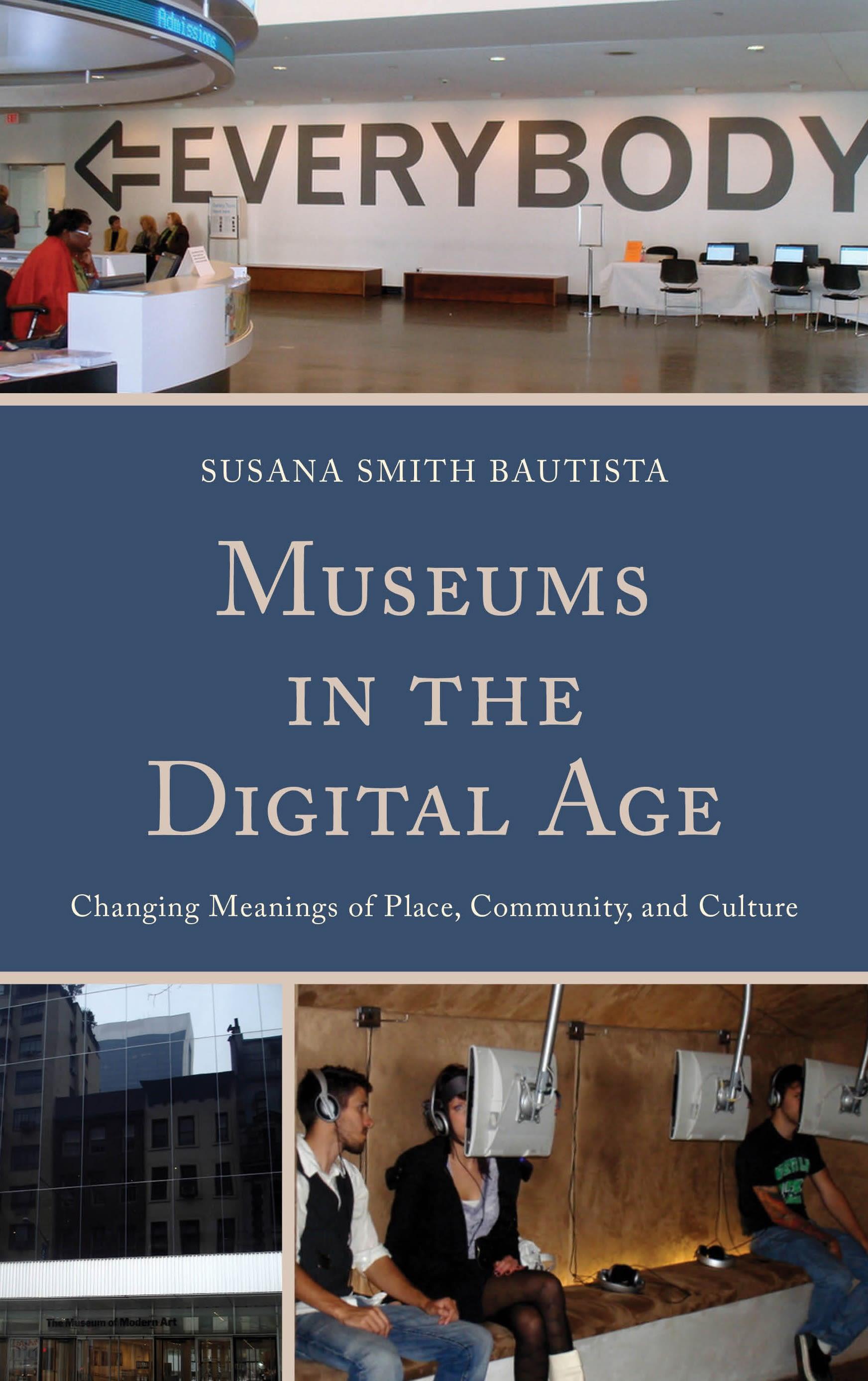
Museums in the Digital Age: Changing Meanings of Place, Community, and Culture showcases how the use of technology in museums should be understood as factors directly related to the museums’ notion of community, local culture, and place, whether these places are in mid-America, urban metropolises, or ethnically diverse and underserved communities.
Here, museum expert Susana Smith Bautista brings more than twenty years of experience in cultural institutes in Los Angeles, New York, and Greece to propose a social understanding of why museums should be adopting technology, and how it should be adapted based on their particular missions, communities, and places. This book is timely because we are in the midst of the digital age, which is rapidly changing due to rapidly changing developments in technology and society as well, with social adaptations of technology. Theory is always racing to catch up with practice in the digital age, but theory remains a critical - and often neglected - component to accompany the practical application of technology in museums.
In order to illustrate these points, the book presents five case studies of the most technologically advanced art museums in the United States today:
The Indianapolis Museum of ArtThe Walker Art CenterThe San Francisco Museum of Modern ArtThe Museum of Modern ArtThe Brooklyn Museum
Each case study ends with a Lessons Learned section to bring these points home.
While the case studies focus on museums in the United States, and also on art museums, this book is relevant to all types of museums and to museums all over the world, as they equally face the challenge of incorporating technology into their institutions. Although these case studies are all well-established and well-endowed museums, Bautista reveals valuable insight into the difficulties they face and the questions they are asking which are relevant to even the smallest museum or community cultural center.
Here, museum expert Susana Smith Bautista brings more than twenty years of experience in cultural institutes in Los Angeles, New York, and Greece to propose a social understanding of why museums should be adopting technology, and how it should be adapted based on their particular missions, communities, and places. This book is timely because we are in the midst of the digital age, which is rapidly changing due to rapidly changing developments in technology and society as well, with social adaptations of technology. Theory is always racing to catch up with practice in the digital age, but theory remains a critical - and often neglected - component to accompany the practical application of technology in museums.
In order to illustrate these points, the book presents five case studies of the most technologically advanced art museums in the United States today:
The Indianapolis Museum of ArtThe Walker Art CenterThe San Francisco Museum of Modern ArtThe Museum of Modern ArtThe Brooklyn Museum
Each case study ends with a Lessons Learned section to bring these points home.
While the case studies focus on museums in the United States, and also on art museums, this book is relevant to all types of museums and to museums all over the world, as they equally face the challenge of incorporating technology into their institutions. Although these case studies are all well-established and well-endowed museums, Bautista reveals valuable insight into the difficulties they face and the questions they are asking which are relevant to even the smallest museum or community cultural center.
Payez facilement par carte, Klarna, Apple Pay ou Google Pay. Pas satisfait ? Vous avez toujours une garantie de remboursement de 14 jours. En savoir plus dans nos conditions. Si vous avez des questions, envoyez-nous un e-mail à hello@memmo.org.
Memmo facilite tes études, où que tu sois dans le monde. On rassemble tes manuels de cours et des outils d'étude intelligents au même endroit : résumés, quiz, podcasts et flashcards. Et il y a Ted, ton compagnon d'étude qui répond à toutes tes questions. Plus de 50 000 étudiants étudient déjà ici – conçu pour t'aider à apprendre plus vite et à moins stresser.