
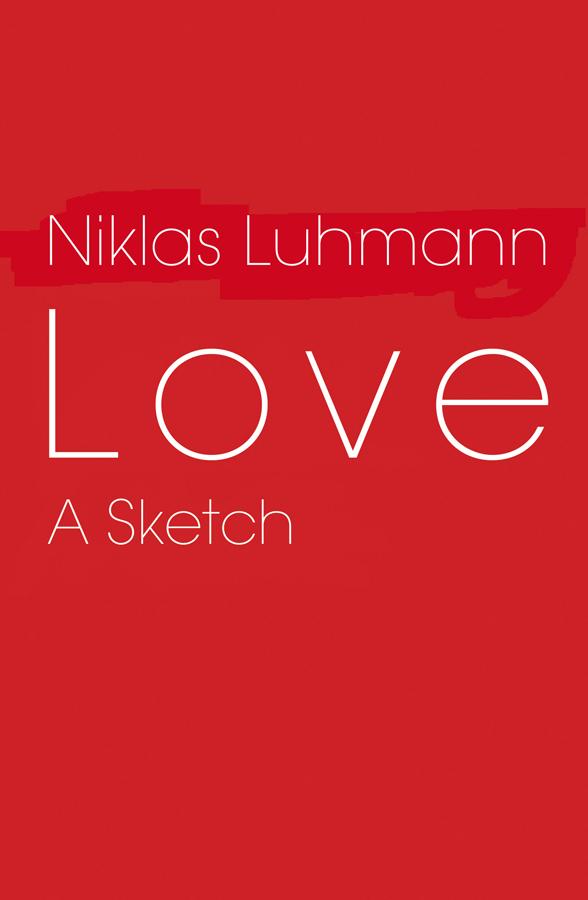
Love seems like the most personal experience, one that touches each of us in a unique way that is more personal than social, and hence it is not surprising that it has been largely neglected by sociologists and social theorists. While it has long been a central preoccupation of writers and novelists, love has rarely attracted anything more than the most cursory attention of social scientists.
This short text, originally written in 1969 by the eminent German social theorist Niklas Luhmann, goes a long way to redressing this neglect. Rather than seeing love as a unique and ineffable personal experience, Luhmann treats love as a solution to a problem that depends on a wider range of social structures and forms. Human beings are faced with a world of enormous complexity and they have to find ways to order and make sense of this world. In other words, they need certain facilities for action Ð what Luhmann calls ‘media of communication’ Ð that enable them to select from a host of alternatives in ways that will be understood as meaningful by others. Love is one of these media; truth, power, money and art are others. With the development of modern societies, greater demands are made on this medium of love, altering the relationship between love and sexuality and giving rise to the distinctive difficulties we associate with love today.
This short text by one of the most brilliant social theorists of the 20th century will be of great interest to students and scholars throughout the social sciences and humanities. It is a concise and pithy statement of what is still the only sociological theory of love we have.
This short text, originally written in 1969 by the eminent German social theorist Niklas Luhmann, goes a long way to redressing this neglect. Rather than seeing love as a unique and ineffable personal experience, Luhmann treats love as a solution to a problem that depends on a wider range of social structures and forms. Human beings are faced with a world of enormous complexity and they have to find ways to order and make sense of this world. In other words, they need certain facilities for action Ð what Luhmann calls ‘media of communication’ Ð that enable them to select from a host of alternatives in ways that will be understood as meaningful by others. Love is one of these media; truth, power, money and art are others. With the development of modern societies, greater demands are made on this medium of love, altering the relationship between love and sexuality and giving rise to the distinctive difficulties we associate with love today.
This short text by one of the most brilliant social theorists of the 20th century will be of great interest to students and scholars throughout the social sciences and humanities. It is a concise and pithy statement of what is still the only sociological theory of love we have.
Payez facilement par carte, Klarna, Apple Pay ou Google Pay. Pas satisfait ? Vous avez toujours une garantie de remboursement de 14 jours. En savoir plus dans nos conditions. Si vous avez des questions, envoyez-nous un e-mail à hello@memmo.org.
Memmo facilite tes études, où que tu sois dans le monde. On rassemble tes manuels de cours et des outils d'étude intelligents au même endroit : résumés, quiz, podcasts et flashcards. Et il y a Ted, ton compagnon d'étude qui répond à toutes tes questions. Plus de 50 000 étudiants étudient déjà ici – conçu pour t'aider à apprendre plus vite et à moins stresser.
Tu pourrais aussi aimer
Acheter le livre0