
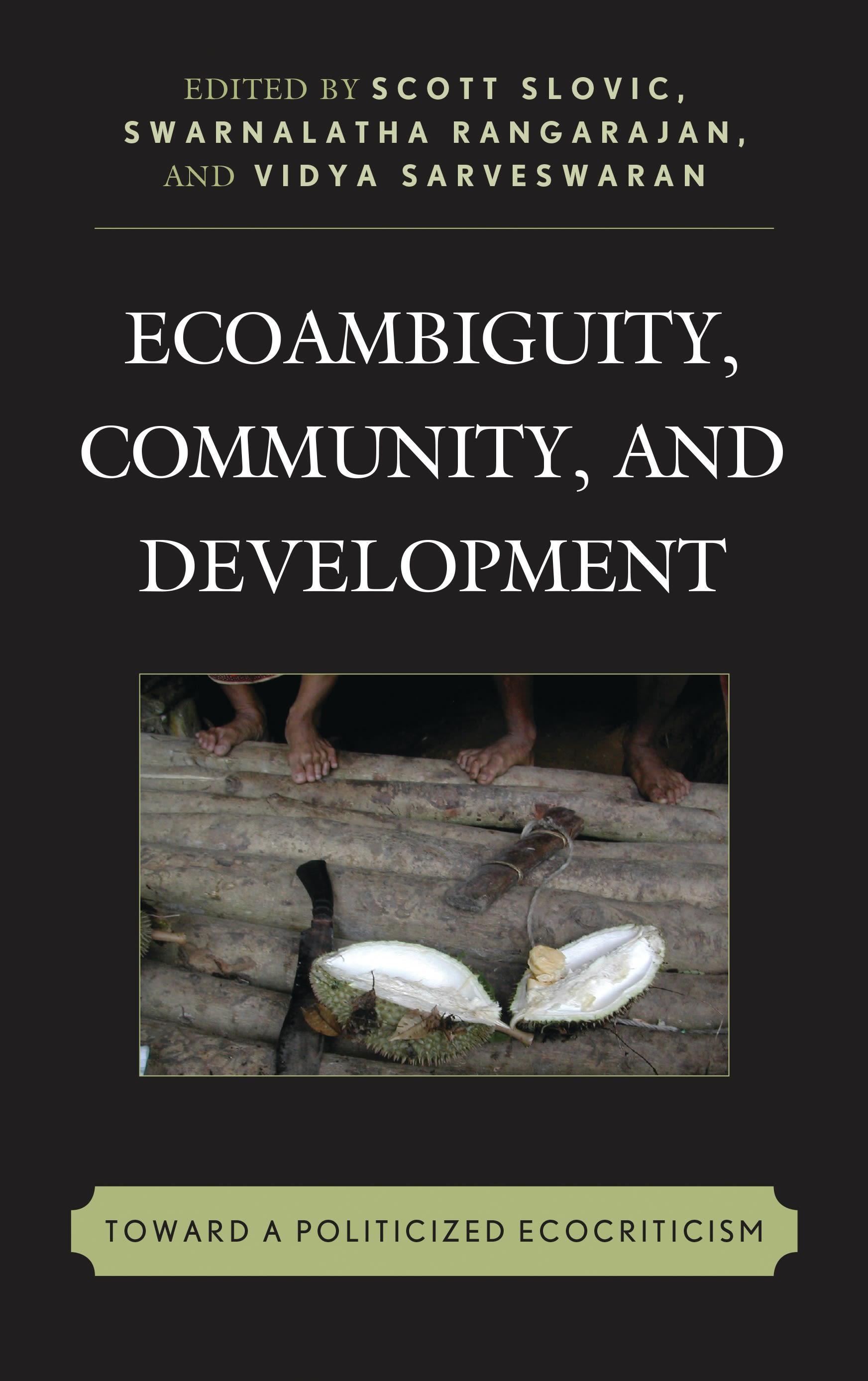
Ecoambiguity, Community, and Development
Auteur: Scott Slovic, George B. Handley, Cheng Li, Karen Thornber, Gang Yue, Yanjun Liu, Tsutomu Takahashi, Jyotirmaya Tripathy, Pamod Nayar, Laura A. White, Inna Sukhenko, Salma Monani, Dora Alicia Ramírez, Aarti Madan, Swarnalatha Rangarajan, Vidya Sarveswaran
Éditeur: Bloomsbury Publishing
Édition: 1
Année de publication: 2014
ISBN: 9780739189085
Ecoambiguity, Community, and Development takes stock of cultural and environmental contexts in many different regions of the world by exploring literature and film. Artists and scholars working in the social ecology, environmental justice, and postcolonial arenas have long recognized that as soon as we tug on a thread of “ecodegradation,” we generally find it linked to some form of cultural oppression. The reverse is also often true. In the spirit of postcolonial ecocriticism, the studies collected by Scott Slovic, R. Swarnalatha, and Vidya Sarveswaran emphasize the impossibility of disentangling environmental and cultural problems.
While not all the authors explicitly invoke Karen Thornber’s term “ecoambiguity” or the concepts and terminology of postcolonial ecocriticism, their articles frequently bring to light various ironies. For example, the fact that Ukrainian environmental experience in the twenty-first century is defined by one of the world’s most infamous industrial disasters, the Chernobyl nuclear accident of 1986, yet Ukrainian culture, like many throughout the world, actually cherishes a profound, even animistic, attachment to the wonders of nature. The repetition of this and other paradoxes in human cultural responses to the more-than-human world reinforces our sense of the congruities and idiosyncrasies of human culture. Every human culture, regardless of its condition of economic and industrial development, has produced its own version of “environmental literature and art”—but the nuances of this work reflect that culture’s precise social and geophysical circumstances. In various ways, these stories of community and development from across the planet converge and diverge, as told and explained by distinguished scholars, many of whom come from the cultures represented in these articles.
While not all the authors explicitly invoke Karen Thornber’s term “ecoambiguity” or the concepts and terminology of postcolonial ecocriticism, their articles frequently bring to light various ironies. For example, the fact that Ukrainian environmental experience in the twenty-first century is defined by one of the world’s most infamous industrial disasters, the Chernobyl nuclear accident of 1986, yet Ukrainian culture, like many throughout the world, actually cherishes a profound, even animistic, attachment to the wonders of nature. The repetition of this and other paradoxes in human cultural responses to the more-than-human world reinforces our sense of the congruities and idiosyncrasies of human culture. Every human culture, regardless of its condition of economic and industrial development, has produced its own version of “environmental literature and art”—but the nuances of this work reflect that culture’s precise social and geophysical circumstances. In various ways, these stories of community and development from across the planet converge and diverge, as told and explained by distinguished scholars, many of whom come from the cultures represented in these articles.
Payez facilement par carte, Klarna, Apple Pay ou Google Pay. Pas satisfait ? Vous avez toujours une garantie de remboursement de 14 jours. En savoir plus dans nos conditions. Si vous avez des questions, envoyez-nous un e-mail à hello@memmo.org.
Memmo facilite tes études, où que tu sois dans le monde. On rassemble tes manuels de cours et des outils d'étude intelligents au même endroit : résumés, quiz, podcasts et flashcards. Et il y a Ted, ton compagnon d'étude qui répond à toutes tes questions. Plus de 50 000 étudiants étudient déjà ici – conçu pour t'aider à apprendre plus vite et à moins stresser.