
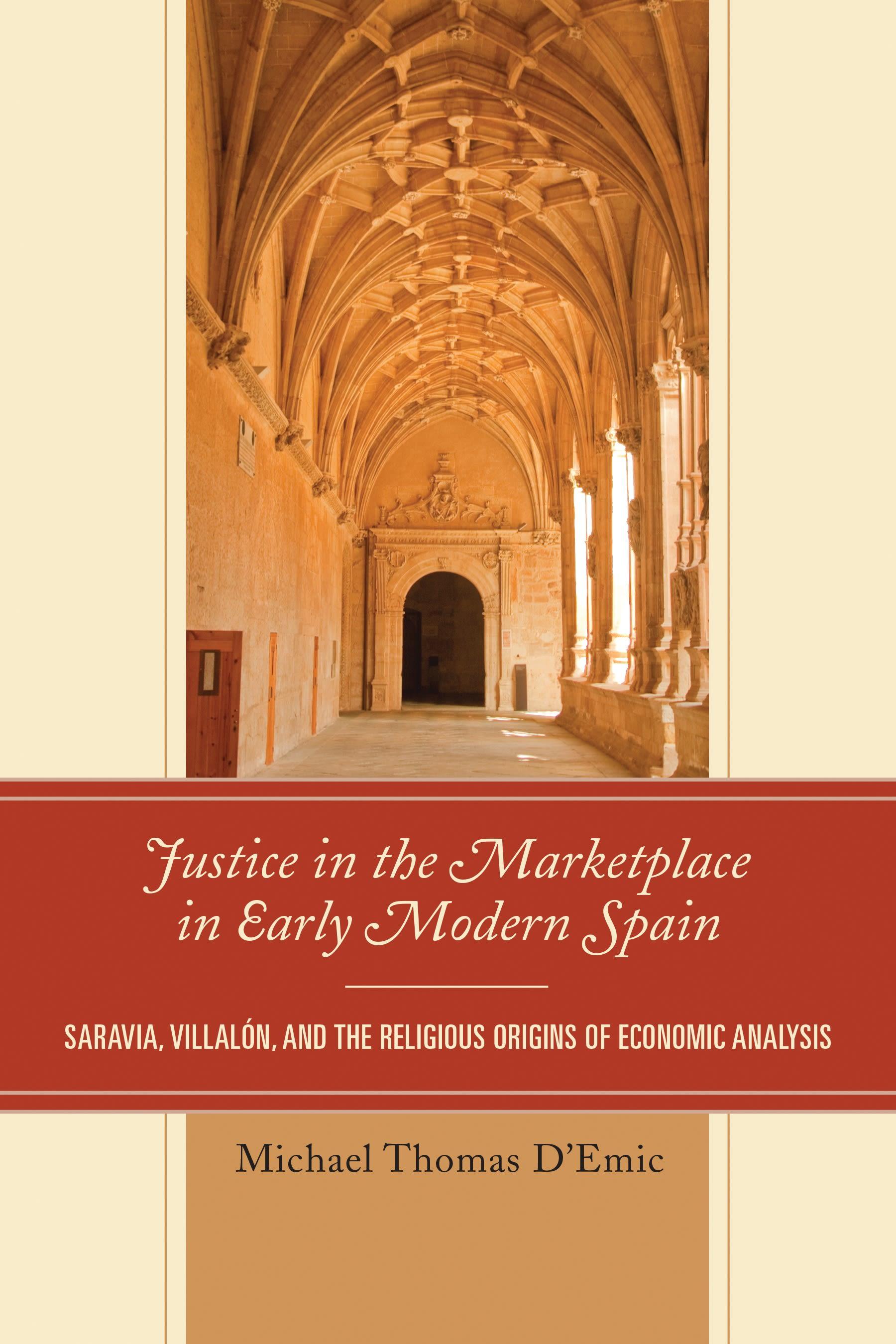
Justice in the Marketplace in Early Modern Spain examines two late scholastic economic treatises, the Provechoso tratado de cambios of Cristóbal de Villalón (1542) and the Instrución de mercaderes of Saravia de la Calle (1544). It does this in the context of the two principal questions that economic historians pose concerning the economic literature of the Spanish late scholastics in general. Is there a clear link between this literature and modern economic science, and does it manifest a free market orientation?
Michael D’Emic draws two conclusions. First, there is a palpable relationship between the work of these two authors and modern economic analysis, particularly that of financial economics. Second, the authors fundamentally disagreed on most questions, mostly concerning the justice of the free market. Villalón condemns the workings of the market and refuses to allow any possibility that the profit motive may be morally neutral. With considerable clarity, he articulates a cost of production theory of value and advocates a system of prices based upon labor and cost and administered by civil authority. Saravia counters with an elegant expression of the utility theory of value and argues with logical force that prices established by the workings of the market are fundamentally just. He allows considerable moral latitude to the pursuit of profit, which he regards as spiritually dangerous but not necessarily evil.
Through the lens of their opposing views on economic value, the market price, and what does or does not constitute the sin of ‘usury,’ the authors, with astonishing technical acumen, observe, analyze, and pass moral judgment on a remarkably wide range of complex transactions, most of which have counterparts in twenty-first century financial markets. In the process, they tackle problems that still bedevil economists and accountants in our own day, such as the difference between a sale and a borrowing, the ‘just’ value of future income flows, and the presence of asymmetrical information in pricing. The result is a vivid record of the color and texture of early modern economic life that reveals a surprising degree of financial sophistication that the present book makes accessible to the modern reader.
Michael D’Emic draws two conclusions. First, there is a palpable relationship between the work of these two authors and modern economic analysis, particularly that of financial economics. Second, the authors fundamentally disagreed on most questions, mostly concerning the justice of the free market. Villalón condemns the workings of the market and refuses to allow any possibility that the profit motive may be morally neutral. With considerable clarity, he articulates a cost of production theory of value and advocates a system of prices based upon labor and cost and administered by civil authority. Saravia counters with an elegant expression of the utility theory of value and argues with logical force that prices established by the workings of the market are fundamentally just. He allows considerable moral latitude to the pursuit of profit, which he regards as spiritually dangerous but not necessarily evil.
Through the lens of their opposing views on economic value, the market price, and what does or does not constitute the sin of ‘usury,’ the authors, with astonishing technical acumen, observe, analyze, and pass moral judgment on a remarkably wide range of complex transactions, most of which have counterparts in twenty-first century financial markets. In the process, they tackle problems that still bedevil economists and accountants in our own day, such as the difference between a sale and a borrowing, the ‘just’ value of future income flows, and the presence of asymmetrical information in pricing. The result is a vivid record of the color and texture of early modern economic life that reveals a surprising degree of financial sophistication that the present book makes accessible to the modern reader.
Payez facilement par carte, Klarna, Apple Pay ou Google Pay. Pas satisfait ? Vous avez toujours une garantie de remboursement de 14 jours. En savoir plus dans nos conditions. Si vous avez des questions, envoyez-nous un e-mail à hello@memmo.org.
Memmo facilite tes études, où que tu sois dans le monde. On rassemble tes manuels de cours et des outils d'étude intelligents au même endroit : résumés, quiz, podcasts et flashcards. Et il y a Ted, ton compagnon d'étude qui répond à toutes tes questions. Plus de 50 000 étudiants étudient déjà ici – conçu pour t'aider à apprendre plus vite et à moins stresser.