
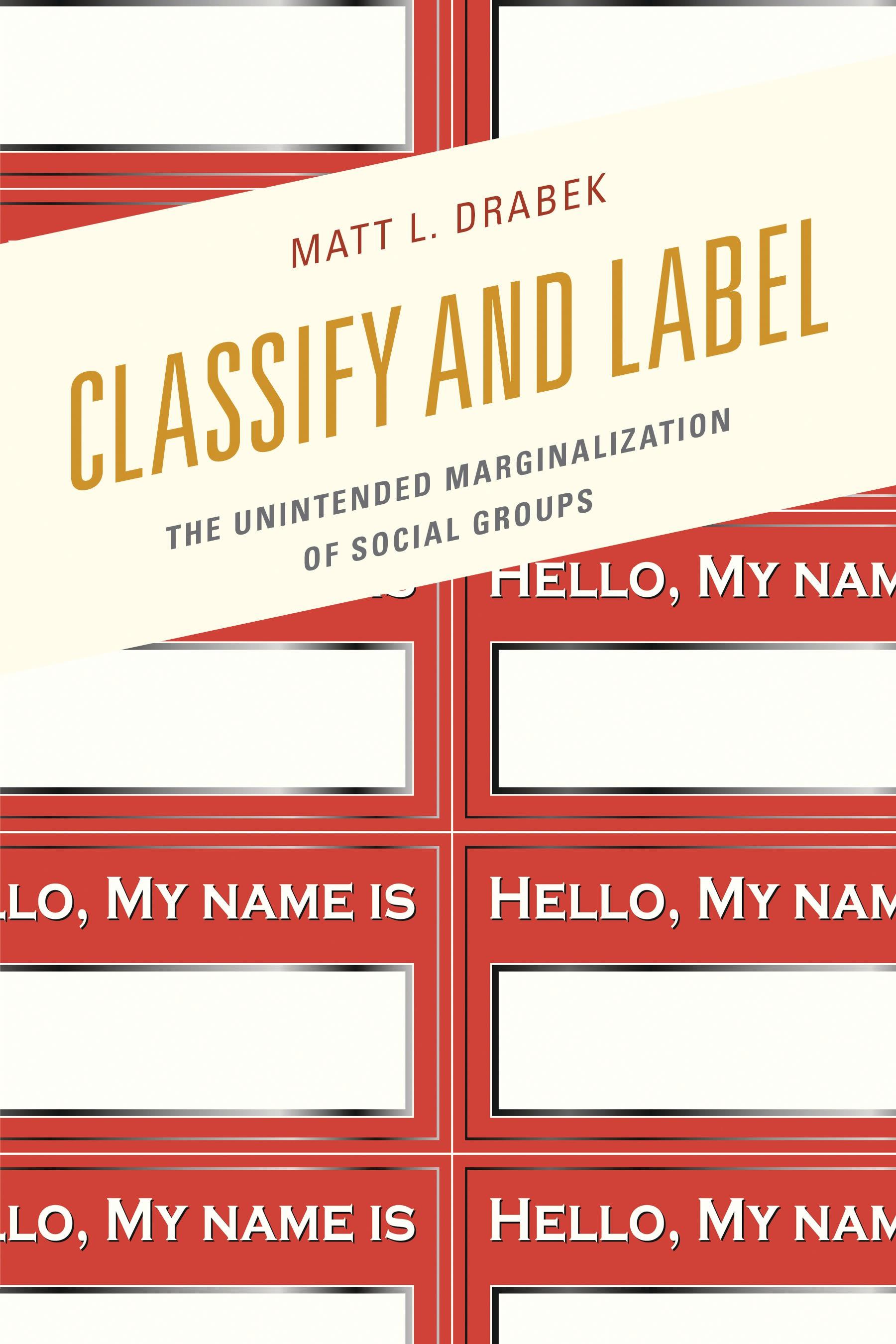
Classify and Label: The Unintended Marginalization of Social Groups is a philosophical treatment of classification in the social sciences and everyday life, focusing on moral, social, and political implications. The use of labels is essential to how people navigate and understand the world. Classifications and labels also have a dark side, as they may unintentionally misrepresent groups and individuals. These misrepresentations disrupt how people think about themselves and how they treat others, sometimes leading to marginalization.
Matt L. Drabek analyzes classification by considering rich case studies across a variety of domains, including the classification of gender and sexual orientation, the psychiatric classification of sadomasochism and gender disorders, and the classification of people in everyday life through the production of pornography and use of gender identities. This broad sample reveals deep connections between the classifications proposed by social scientists and the classifications used by society at large. Drabek explores how classifications evolve from and eventually affect such seemingly disconnected issues as the situation of under-represented groups in academia, new models of parenting and the family, the nature of sexual orientation, and the nature of scientific bias.
Matt L. Drabek analyzes classification by considering rich case studies across a variety of domains, including the classification of gender and sexual orientation, the psychiatric classification of sadomasochism and gender disorders, and the classification of people in everyday life through the production of pornography and use of gender identities. This broad sample reveals deep connections between the classifications proposed by social scientists and the classifications used by society at large. Drabek explores how classifications evolve from and eventually affect such seemingly disconnected issues as the situation of under-represented groups in academia, new models of parenting and the family, the nature of sexual orientation, and the nature of scientific bias.
Payez facilement par carte, Klarna, Apple Pay ou Google Pay. Pas satisfait ? Vous avez toujours une garantie de remboursement de 14 jours. En savoir plus dans nos conditions. Si vous avez des questions, envoyez-nous un e-mail à hello@memmo.org.
Memmo facilite tes études, où que tu sois dans le monde. On rassemble tes manuels de cours et des outils d'étude intelligents au même endroit : résumés, quiz, podcasts et flashcards. Et il y a Ted, ton compagnon d'étude qui répond à toutes tes questions. Plus de 50 000 étudiants étudient déjà ici – conçu pour t'aider à apprendre plus vite et à moins stresser.