
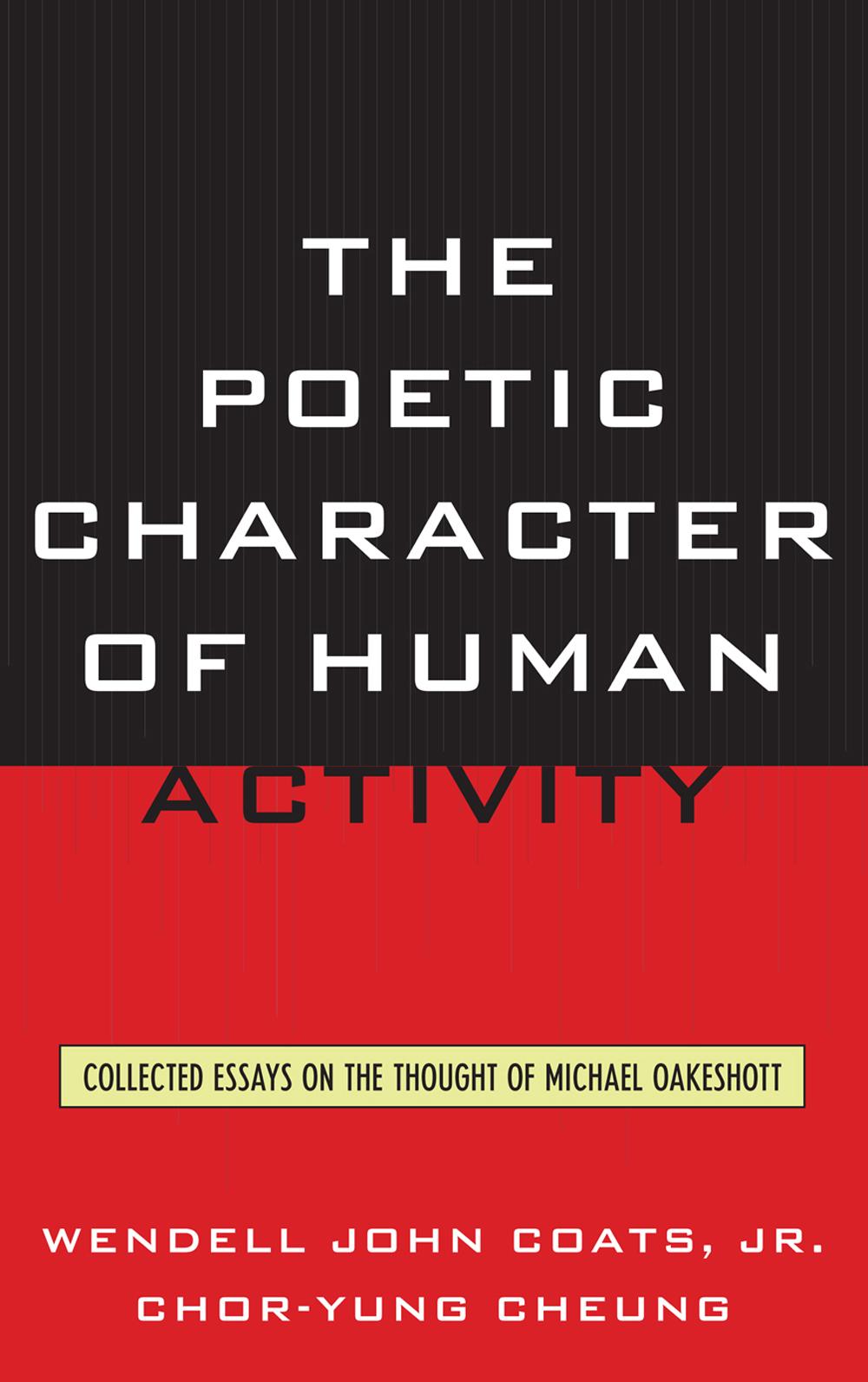
The Poetic Character of Human Activity is a collection of essays by two Oakeshott scholars, most of which explores the meaning of Oakeshott’s pregnant phrase, “the poetic character of human activity” by comparing and contrasting this idea with similar and opposing ones, in particular those of the Taoist thinker, Zhuangzi (Chuang Tzu), and his Western interpreter, A.C. Graham. Oakeshott’s deep appreciation of the poetic and non-instrumental character of human activity led him to develop an interest in the works of Zhuangzi and Confucius. Comparison of shared themes between Oakeshott and these two Chinese thinkers facilitates appreciation of his elegant analytic style and his resort to use of metaphors and story-telling when conveying some of his most profound insights. The collection also contains essays contrasting Oakeshott’s idea of the “creative” in human experience with views of, among others, Plato, Leo Strauss and Eric Voegelin.
Oakeshott used the phrase “the poetic character of human activity” (arguably the animating center of his entire thought), to refer to the “creative” character of human experiential reality, that is, to the fact that the form (the how) and content (the what) of all human experience and activity arise simultaneously and fluidly, and can be separated only at the expense of theoretical coherence and practical skill. The various essays in this collection explore the meaning of this claim, and its ramifications for the proper role of critical intellect in especially philosophy, morality, learning, and governance. There is also some brief contrast of Oakeshott with John Rawls, Alasdair MacIntyre, Charles Taylor, and Quentin Skinner.
Oakeshott used the phrase “the poetic character of human activity” (arguably the animating center of his entire thought), to refer to the “creative” character of human experiential reality, that is, to the fact that the form (the how) and content (the what) of all human experience and activity arise simultaneously and fluidly, and can be separated only at the expense of theoretical coherence and practical skill. The various essays in this collection explore the meaning of this claim, and its ramifications for the proper role of critical intellect in especially philosophy, morality, learning, and governance. There is also some brief contrast of Oakeshott with John Rawls, Alasdair MacIntyre, Charles Taylor, and Quentin Skinner.
Payez facilement par carte, Klarna, Apple Pay ou Google Pay. Pas satisfait ? Vous avez toujours une garantie de remboursement de 14 jours. En savoir plus dans nos conditions. Si vous avez des questions, envoyez-nous un e-mail à hello@memmo.org.
Memmo facilite tes études, où que tu sois dans le monde. On rassemble tes manuels de cours et des outils d'étude intelligents au même endroit : résumés, quiz, podcasts et flashcards. Et il y a Ted, ton compagnon d'étude qui répond à toutes tes questions. Plus de 50 000 étudiants étudient déjà ici – conçu pour t'aider à apprendre plus vite et à moins stresser.