
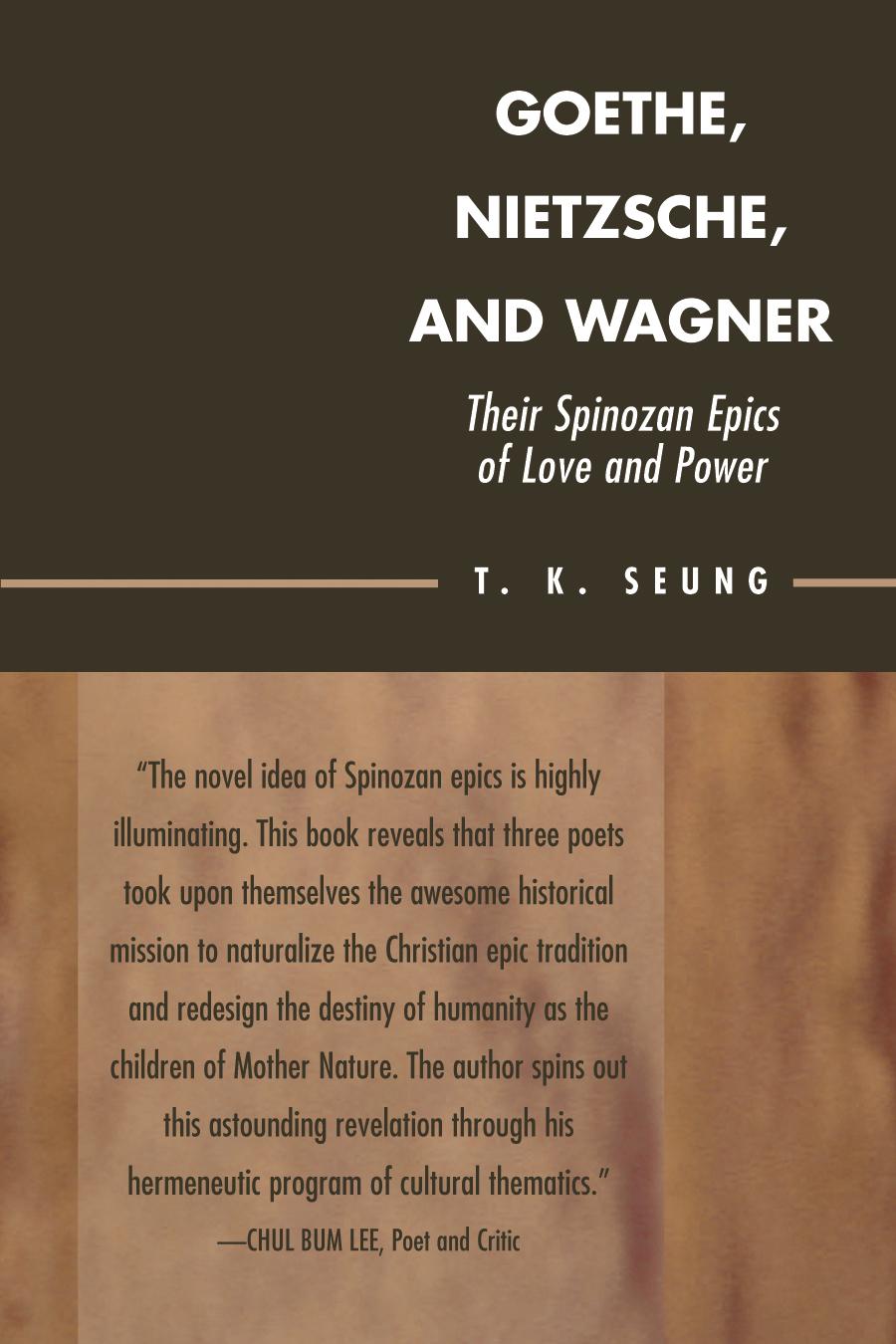
The author reads Goethe's Faust as the first epic written under Spinoza's influence. He shows how its thematic development is governed by Spinoza's pantheistic naturalism. He further contends that Wagner and Nietzsche have tried to surpass their mentor Goethe's work by writing their own Spinozan epics of love and power in The Ring of the Nibelung and Thus Spoke Zarathustra. These Spinozan epics are designed to succeed the Christian epics in the Western literary tradition. Whereas the Christian epics dared to groom human beings for their destiny in the supernatural world, the Spinozan epics try to reinstate humanity as the children of Mother Nature and overcome their alienation from the natural world, which had been dictated by the long reign of Christianity. However, it has been well noted that none of these new epics seems to hang together thematically as a coherent work. By his Spinozan reading, the author not only demonstrates the thematic unity of each of them singly, but further illustrates their thematic relation with each other.
Payez facilement par carte, Klarna, Apple Pay ou Google Pay. Pas satisfait ? Vous avez toujours une garantie de remboursement de 14 jours. En savoir plus dans nos conditions. Si vous avez des questions, envoyez-nous un e-mail à hello@memmo.org.
Memmo facilite tes études, où que tu sois dans le monde. On rassemble tes manuels de cours et des outils d'étude intelligents au même endroit : résumés, quiz, podcasts et flashcards. Et il y a Ted, ton compagnon d'étude qui répond à toutes tes questions. Plus de 50 000 étudiants étudient déjà ici – conçu pour t'aider à apprendre plus vite et à moins stresser.