
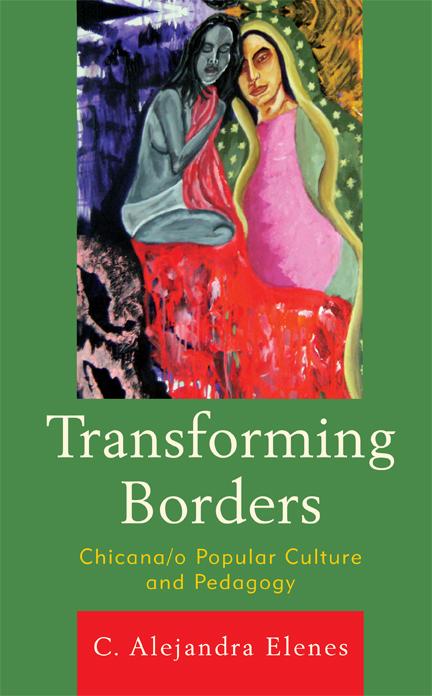
Transforming Borders: Chicana/o Popular Culture and Pedagogy contributes to transformative pedagogies scholarship by adding the voices of Chicana feminist pedagogies, epistemologies, and ontologies. C. Alejandra Elenes develops her conceptualizations of border/transformative pedagogies by linking the relationship between cultural practices, knowledge, and teaching in everyday life. She analyzes Chicana feminist cultural workers/educational actors re-imagining three Mexican figures: La Llorona (the weeping woman), the Virgen of Guadalupe, and Malintzin/Malinche as epistemological and pedagogical meanings. The three figures represent multiple meanings: traditional views on femininity, religion, and nationalist views on women, yet at the same time, feminists have re-imagined these three figures and developed counter-narratives that can offer alternatives to the traditional meanings.
In developing border/transformative pedagogies, Elenes looks at the significance of historical events, such as the creation of the Mexico-U.S. border, to understand the experiences of people of Mexican descent in the United States. She also examines oral histories of the legend of La Llorona in the Southwest, historical documents on the Spanish conquest of Mexico, and Chicana artists such as Ester Hernandez, Yolanda Lopez, Consuelo Jimenez Underwood, and Alma Lopez re-imagining of the Virgen of Guadalupe. The conflicts over the meanings of the three figures can help us understand how Chicanas have used their voices to counter economic and gender inequalities and how pedagogical practices show that cultural productions are sites where forms of domination can be contested and recreated in ways that allow for the creation of alternative identities and subjectivities.
In developing border/transformative pedagogies, Elenes looks at the significance of historical events, such as the creation of the Mexico-U.S. border, to understand the experiences of people of Mexican descent in the United States. She also examines oral histories of the legend of La Llorona in the Southwest, historical documents on the Spanish conquest of Mexico, and Chicana artists such as Ester Hernandez, Yolanda Lopez, Consuelo Jimenez Underwood, and Alma Lopez re-imagining of the Virgen of Guadalupe. The conflicts over the meanings of the three figures can help us understand how Chicanas have used their voices to counter economic and gender inequalities and how pedagogical practices show that cultural productions are sites where forms of domination can be contested and recreated in ways that allow for the creation of alternative identities and subjectivities.
Payez facilement par carte, Klarna, Apple Pay ou Google Pay. Pas satisfait ? Vous avez toujours une garantie de remboursement de 14 jours. En savoir plus dans nos conditions. Si vous avez des questions, envoyez-nous un e-mail à hello@memmo.org.
Memmo facilite tes études, où que tu sois dans le monde. On rassemble tes manuels de cours et des outils d'étude intelligents au même endroit : résumés, quiz, podcasts et flashcards. Et il y a Ted, ton compagnon d'étude qui répond à toutes tes questions. Plus de 50 000 étudiants étudient déjà ici – conçu pour t'aider à apprendre plus vite et à moins stresser.