
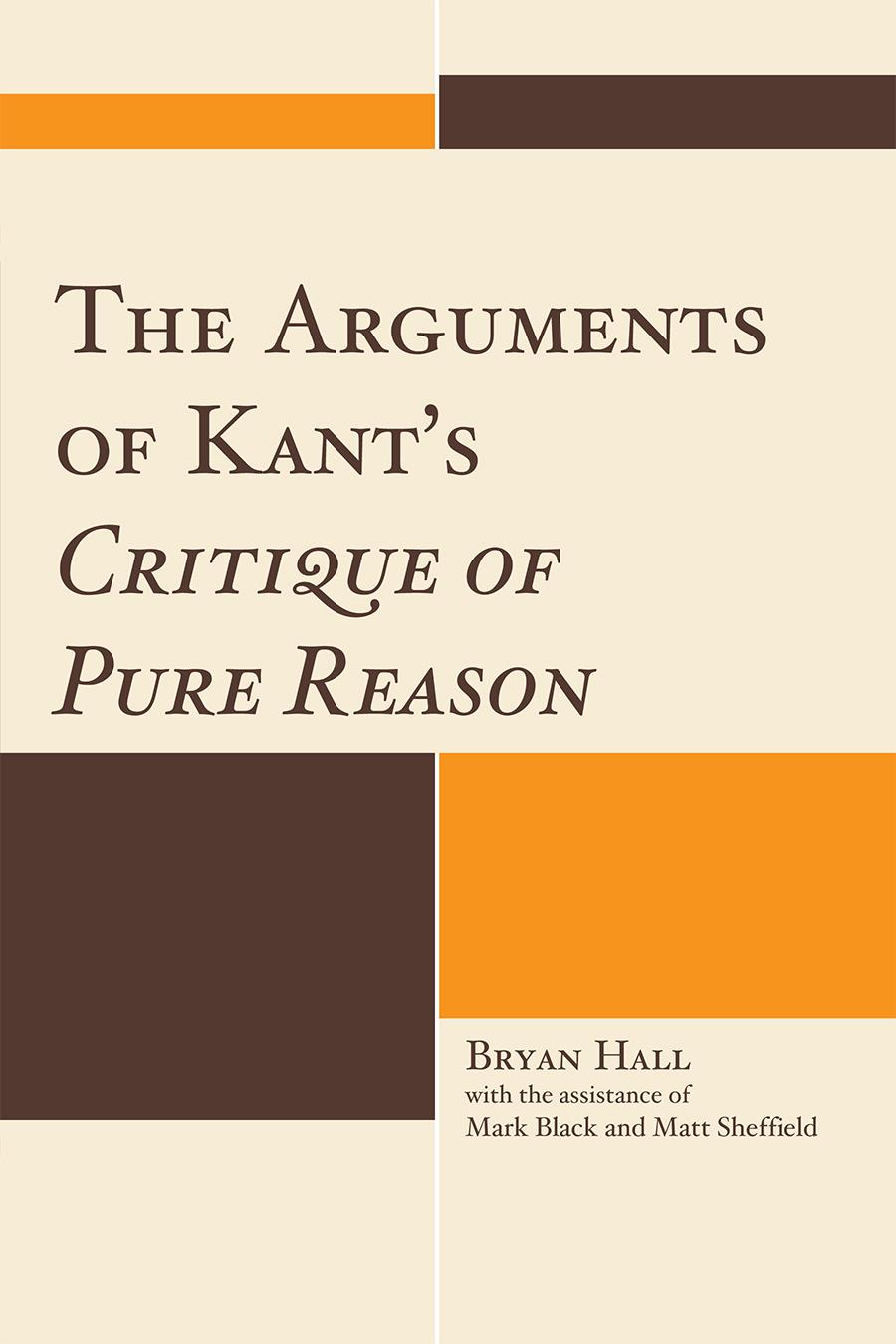
The importance of Immanuel Kant's Critique of Pure Reason in the history of philosophy is matched only by its difficulty. In particular, readers are often frustrated by how difficult it is to extract Kant's arguments from his dense prose. This book reconstructs, using the tools of propositional logic, the central arguments of the Critique. In all, the book reconstructs thirty-six of Kant's arguments spanning the Transcendental Aesthetic, Transcendental Analytic, and Transcendental Dialectic. For each argument, they begin with a quote from Kant's text followed by a synopsis that explains the argument informally. Finally, each synopsis is followed by a formal reconstruction of the argument. The synopses offer examples, metaphors, historical background, and objections/responses to aid the reader in appreciating Kant's arguments. Even though many readers who approach Kant for the first time have a good philosophical vocabulary, few will understand Kant's unique lexicon. In addition to formally reconstructing Kant's arguments, the book also includes a glossary that defines the technical terms that Kant uses in his arguments. Finally, since this book is directed largely at students, Bryan Hall enlisted two of his own students to ensure that the book is maximally student friendly. In contrast to most pedagogical philosophical literature, the content of this book has been tailored by students for students.
Payez facilement par carte, Klarna, Apple Pay ou Google Pay. Pas satisfait ? Vous avez toujours une garantie de remboursement de 14 jours. En savoir plus dans nos conditions. Si vous avez des questions, envoyez-nous un e-mail à hello@memmo.org.
Memmo facilite tes études, où que tu sois dans le monde. On rassemble tes manuels de cours et des outils d'étude intelligents au même endroit : résumés, quiz, podcasts et flashcards. Et il y a Ted, ton compagnon d'étude qui répond à toutes tes questions. Plus de 50 000 étudiants étudient déjà ici – conçu pour t'aider à apprendre plus vite et à moins stresser.