
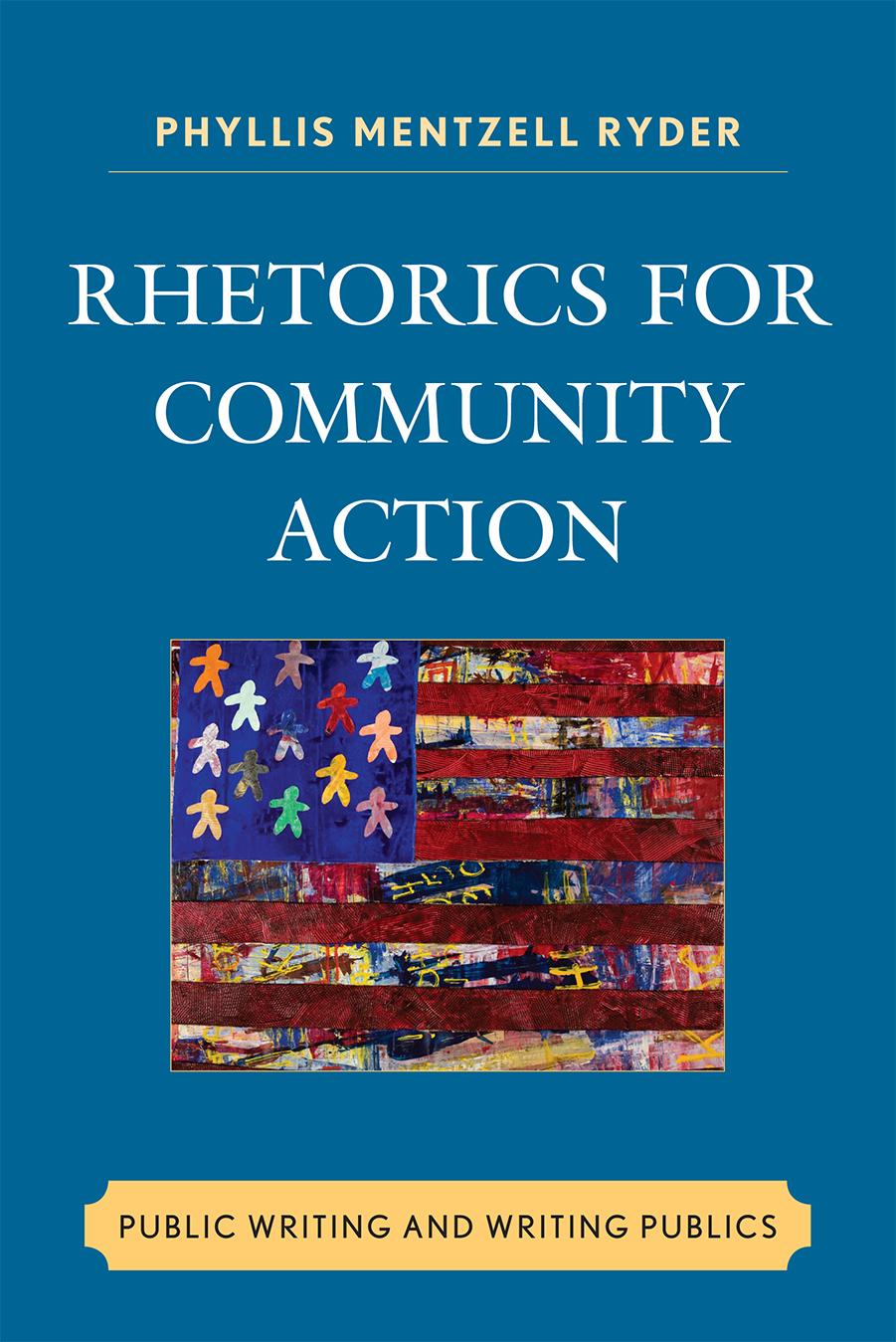
Rhetorics for Community Action: Public Writing and Writing Publics, by Phyllis Mentzell Ryder, offers theory and pedagogy to introduce public writing as a complex political and creative action. To write public texts, we have to invent the public we wish to address. Such invention is a complex task, with many components to consider: exigency that brings people together; a sense of agency and capacity; a sense of how the world is and what it can become. All these components constantly compete against texts that put forward other public ideals-opposing ideas about who really has power and who really can create change. Teachers of public writing must adopt a generous response to those who venture into this arena.
Some scholars believe that to prepare students for public life, university classes should partner with grassroots community organizations, rather than nonprofits that serve food or tutor students. They worry that a service-related focus will create more passive citizens who do not rally and resist or grab the attention of government leaders or corporations. With carefully contextualized study of an after-school arts program, an area soup kitchen, and parks organizations, among others, Ryder shows that many so-called "service" organizations are not passive places at all, and she argues that the main challenge of public work is precisely that it has to take place among all of these compelling definitions of democracy.
Ryder proposes teaching public writing by partnering with multiple community nonprofits. She develops a framework to help students analyze how their community partners inspire people to action, and offers a course design that support them as they convey those public ideals in community texts.
But composing public texts is only part of the challenge. Traditional newspapers and magazines, through their business models and writing styles, reinforce a dominant role for citizens as thinking and reading, but not necessarily acting. This civic role is also professed
Some scholars believe that to prepare students for public life, university classes should partner with grassroots community organizations, rather than nonprofits that serve food or tutor students. They worry that a service-related focus will create more passive citizens who do not rally and resist or grab the attention of government leaders or corporations. With carefully contextualized study of an after-school arts program, an area soup kitchen, and parks organizations, among others, Ryder shows that many so-called "service" organizations are not passive places at all, and she argues that the main challenge of public work is precisely that it has to take place among all of these compelling definitions of democracy.
Ryder proposes teaching public writing by partnering with multiple community nonprofits. She develops a framework to help students analyze how their community partners inspire people to action, and offers a course design that support them as they convey those public ideals in community texts.
But composing public texts is only part of the challenge. Traditional newspapers and magazines, through their business models and writing styles, reinforce a dominant role for citizens as thinking and reading, but not necessarily acting. This civic role is also professed
Payez facilement par carte, Klarna, Apple Pay ou Google Pay. Pas satisfait ? Vous avez toujours une garantie de remboursement de 14 jours. En savoir plus dans nos conditions. Si vous avez des questions, envoyez-nous un e-mail à hello@memmo.org.
Memmo facilite tes études, où que tu sois dans le monde. On rassemble tes manuels de cours et des outils d'étude intelligents au même endroit : résumés, quiz, podcasts et flashcards. Et il y a Ted, ton compagnon d'étude qui répond à toutes tes questions. Plus de 50 000 étudiants étudient déjà ici – conçu pour t'aider à apprendre plus vite et à moins stresser.