
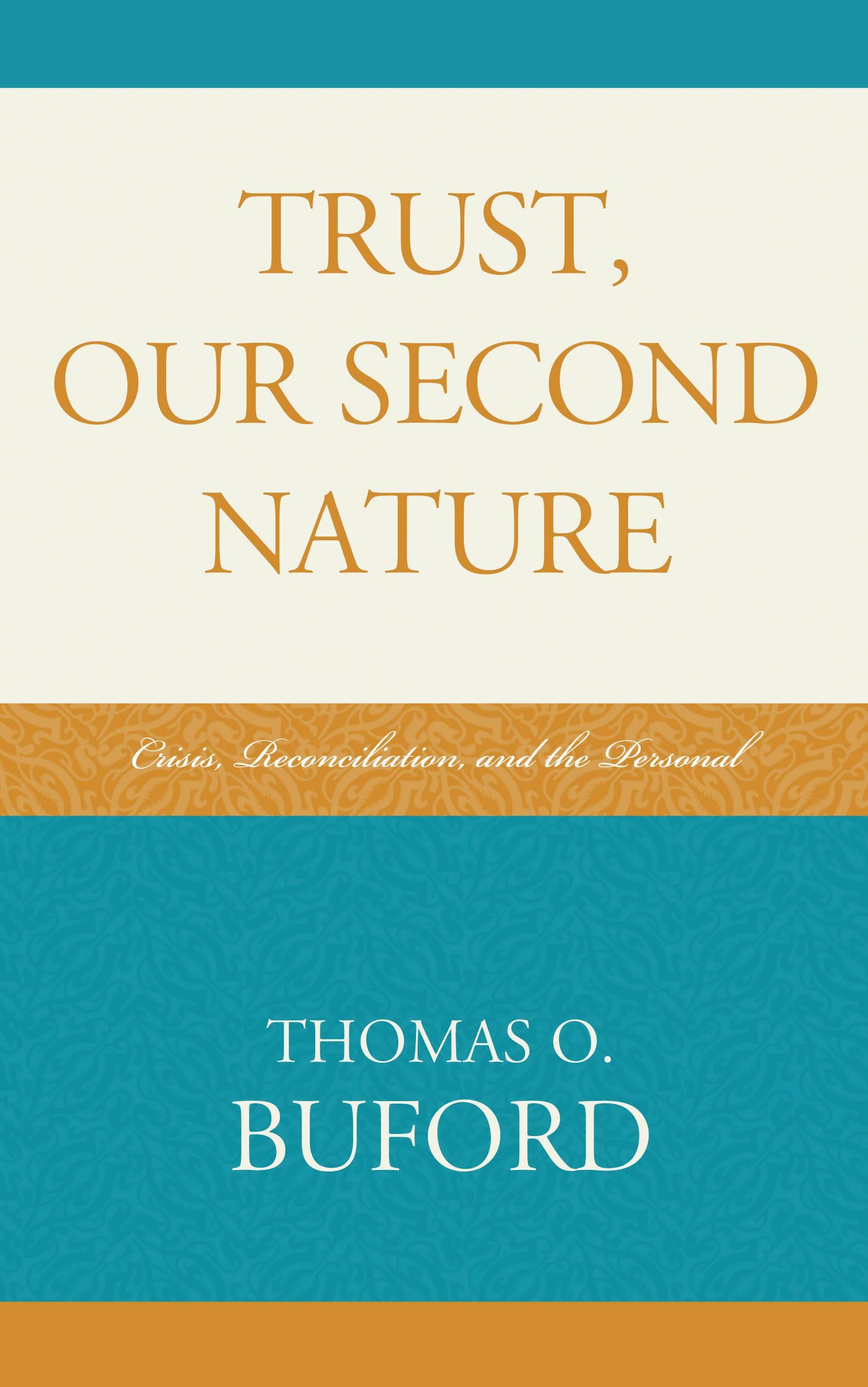
The thesis of this book is that only a social personalism and no form of impersonalism can adequately account for the solidarity and stability of what we individuals share with all other members of our society, our second nature. In the ancient world the discussion of society, at least since Plato and Aristotle, began with the social nature of individuals as found in families and proceeded to topics such as the formation and the well ordering of societies according to eternal principles grasped by reason. Since the beginning of the modern world, at least since Hobbes and Locke, the discussion of society began with the relation of persons and society and then moved on to other topics, usually political and legal ones. The central problem was to find the basis on which individuals formed societies and how they could do so.
Buford's question is with a more basic issue: "What do individuals and society share in common?" or what philosophers since Cicero have called our second nature, and how to best understand its unity and stability. The crisis of our culture in the erosion of both solidarity and stability pointedly manifests itself in our second nature. There the culture in which we live is felt, lived, and shared. Buford asks how we can lay bare our second nature, revealing the extent of the crisis. Our second nature is the form of social actions of persons in triadic relations, and Buford argues that it is there that we find that trust unifies a society and provides the basis for the institutions that stabilize it.
Buford's question is with a more basic issue: "What do individuals and society share in common?" or what philosophers since Cicero have called our second nature, and how to best understand its unity and stability. The crisis of our culture in the erosion of both solidarity and stability pointedly manifests itself in our second nature. There the culture in which we live is felt, lived, and shared. Buford asks how we can lay bare our second nature, revealing the extent of the crisis. Our second nature is the form of social actions of persons in triadic relations, and Buford argues that it is there that we find that trust unifies a society and provides the basis for the institutions that stabilize it.
Payez facilement par carte, Klarna, Apple Pay ou Google Pay. Pas satisfait ? Vous avez toujours une garantie de remboursement de 14 jours. En savoir plus dans nos conditions. Si vous avez des questions, envoyez-nous un e-mail à hello@memmo.org.
Memmo facilite tes études, où que tu sois dans le monde. On rassemble tes manuels de cours et des outils d'étude intelligents au même endroit : résumés, quiz, podcasts et flashcards. Et il y a Ted, ton compagnon d'étude qui répond à toutes tes questions. Plus de 50 000 étudiants étudient déjà ici – conçu pour t'aider à apprendre plus vite et à moins stresser.