
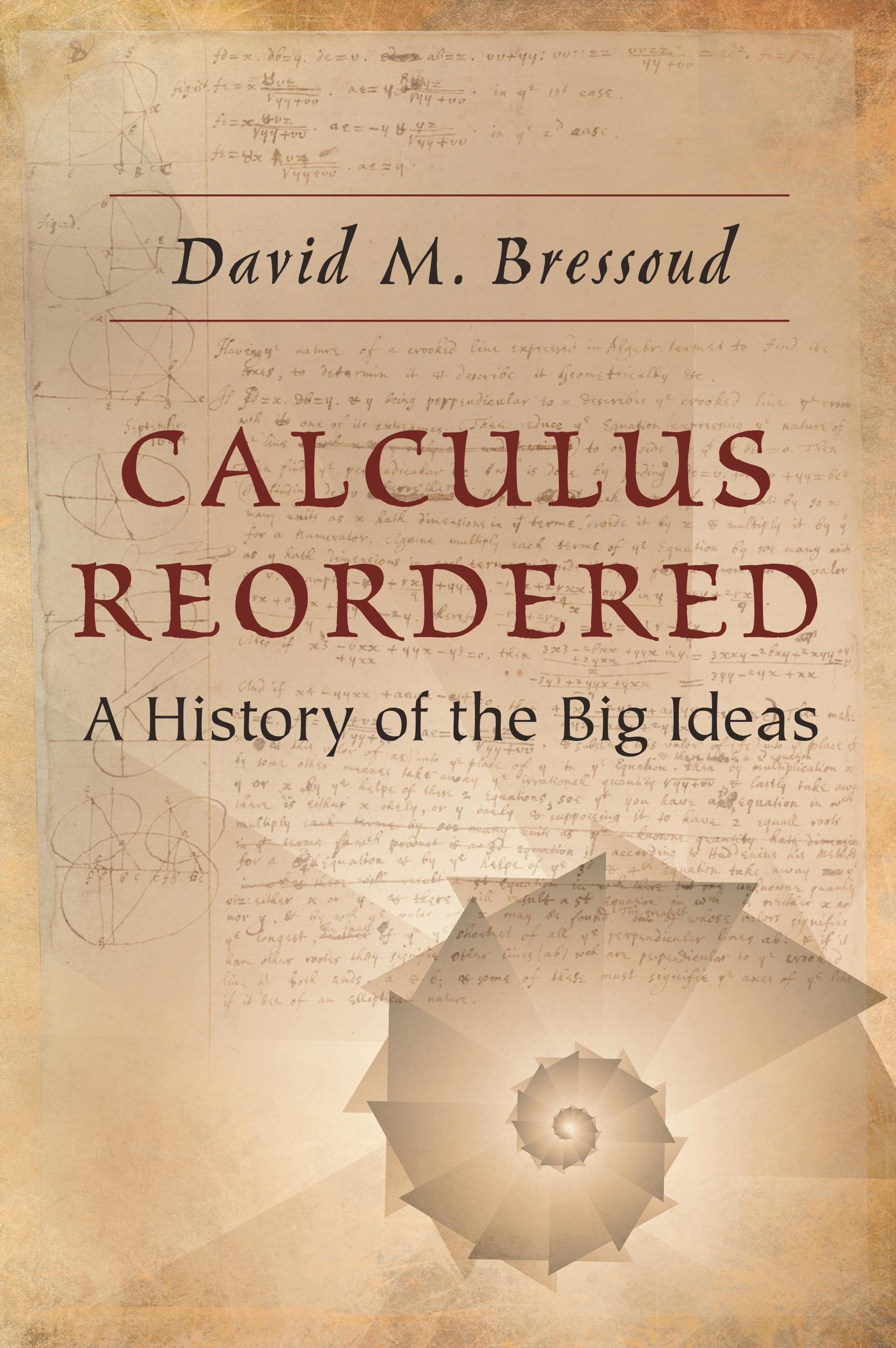
How our understanding of calculus has evolved over more than three centuries, how this has shaped the way it is taught in the classroom, and why calculus pedagogy needs to change
Calculus Reordered takes readers on a remarkable journey through hundreds of years to tell the story of how calculus evolved into the subject we know today. David Bressoud explains why calculus is credited to seventeenth-century figures Isaac Newton and Gottfried Leibniz, and how its current structure is based on developments that arose in the nineteenth century. Bressoud argues that a pedagogy informed by the historical development of calculus represents a sounder way for students to learn this fascinating area of mathematics.
Delving into calculus’s birth in the Hellenistic Eastern Mediterranean—particularly in Syracuse, Sicily and Alexandria, Egypt—as well as India and the Islamic Middle East, Bressoud considers how calculus developed in response to essential questions emerging from engineering and astronomy. He looks at how Newton and Leibniz built their work on a flurry of activity that occurred throughout Europe, and how Italian philosophers such as Galileo Galilei played a particularly important role. In describing calculus’s evolution, Bressoud reveals problems with the standard ordering of its curriculum: limits, differentiation, integration, and series. He contends that the historical order—integration as accumulation, then differentiation as ratios of change, series as sequences of partial sums, and finally limits as they arise from the algebra of inequalities—makes more sense in the classroom environment.
Exploring the motivations behind calculus’s discovery, Calculus Reordered highlights how this essential tool of mathematics came to be.
Payez facilement par carte, Klarna, Apple Pay ou Google Pay. Pas satisfait ? Vous avez toujours une garantie de remboursement de 14 jours. En savoir plus dans nos conditions. Si vous avez des questions, envoyez-nous un e-mail à hello@memmo.org.
Memmo facilite tes études, où que tu sois dans le monde. On rassemble tes manuels de cours et des outils d'étude intelligents au même endroit : résumés, quiz, podcasts et flashcards. Et il y a Ted, ton compagnon d'étude qui répond à toutes tes questions. Plus de 50 000 étudiants étudient déjà ici – conçu pour t'aider à apprendre plus vite et à moins stresser.