
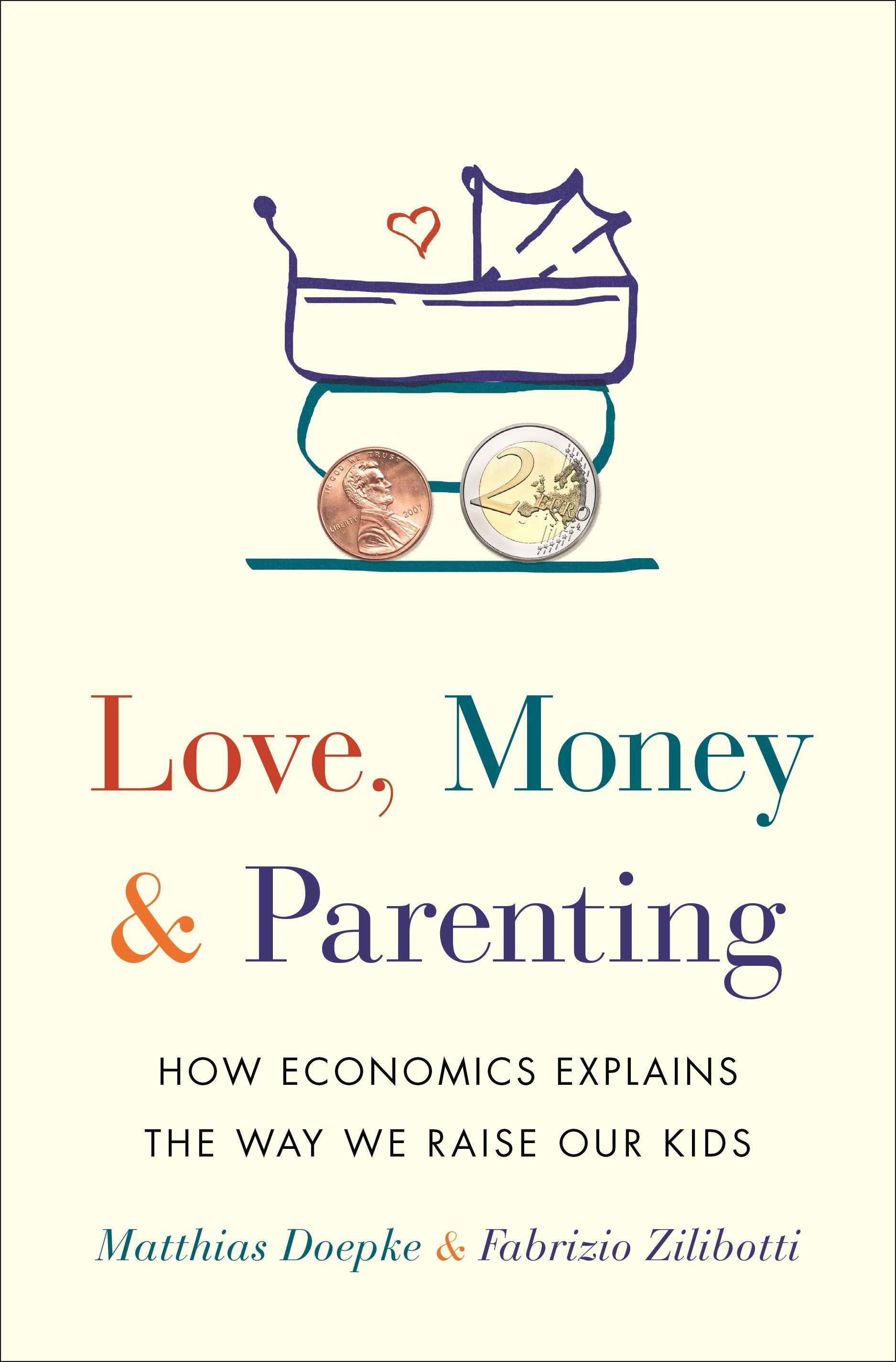
An international and historical look at how parenting choices change in the face of economic inequality
Parents everywhere want their children to be happy and do well. Yet how parents seek to achieve this ambition varies enormously. For instance, American and Chinese parents are increasingly authoritative and authoritarian, whereas Scandinavian parents tend to be more permissive. Why? Love, Money, and Parenting investigates how economic forces and growing inequality shape how parents raise their children. From medieval times to the present, and from the United States, the United Kingdom, Germany, Italy, Spain, and Sweden to China and Japan, Matthias Doepke and Fabrizio Zilibotti look at how economic incentives and constraints—such as money, knowledge, and time—influence parenting practices and what is considered good parenting in different countries.
Through personal anecdotes and original research, Doepke and Zilibotti show that in countries with increasing economic inequality, such as the United States, parents push harder to ensure their children have a path to security and success. Economics has transformed the hands-off parenting of the 1960s and ’70s into a frantic, overscheduled activity. Growing inequality has also resulted in an increasing “parenting gap” between richer and poorer families, raising the disturbing prospect of diminished social mobility and fewer opportunities for children from disadvantaged backgrounds. In nations with less economic inequality, such as Sweden, the stakes are less high, and social mobility is not under threat. Doepke and Zilibotti discuss how investments in early childhood development and the design of education systems factor into the parenting equation, and how economics can help shape policies that will contribute to the ideal of equal opportunity for all.
Love, Money, and Parenting presents an engrossing look at the economics of the family in the modern world.
Payez facilement par carte, Klarna, Apple Pay ou Google Pay. Pas satisfait ? Vous avez toujours une garantie de remboursement de 14 jours. En savoir plus dans nos conditions. Si vous avez des questions, envoyez-nous un e-mail à hello@memmo.org.
Memmo facilite tes études, où que tu sois dans le monde. On rassemble tes manuels de cours et des outils d'étude intelligents au même endroit : résumés, quiz, podcasts et flashcards. Et il y a Ted, ton compagnon d'étude qui répond à toutes tes questions. Plus de 50 000 étudiants étudient déjà ici – conçu pour t'aider à apprendre plus vite et à moins stresser.