
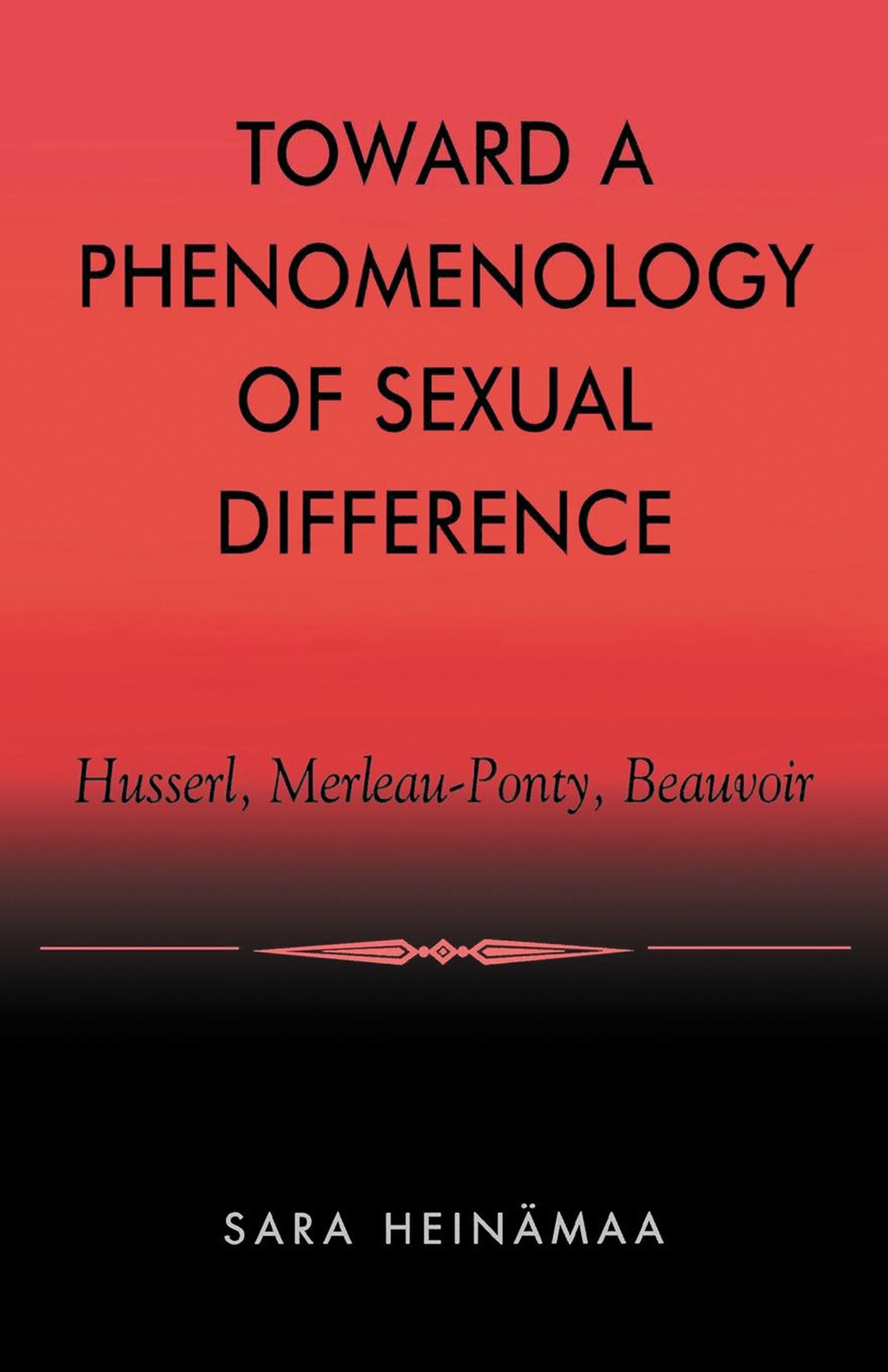
Simone de Beauvoir's Le Deuxi_me Sexe has been studied extensively since its appearance in 1949. Through the years, certain passages have taken on prestige; others are seen as unimportant to understanding Beauvoir's argument. In Toward a Phenomenology of Sexual Difference, Sara HeinSmaa rediscovers those neglected passages in her quest to follow Beauvoir's line of thinking. HeinSmaa, like some other recent philosophers, finds that Le Duexi_me Sexe is a philosophical inquiry, not the empirical study it is commonly thought to be. Others who view Beauvoir's masterpiece as a work of philosophy argue it is a criticism not only of Sartrean phenomenology, but of phenomenology as a whole. HeinSmaa thinks differently. She finds that Beauvoir's starting point is the Husserlian idea of the living body that she found developed in Merleau-Ponty's PhZnomZnologie de la perception. So when Beavoir wrote Le Duexi_me Sexe, she was writing not as Sartre's pupil, but as a scholar in the tradition of Husserl and Merleau-Ponty.
Payez facilement par carte, Klarna, Apple Pay ou Google Pay. Pas satisfait ? Vous avez toujours une garantie de remboursement de 14 jours. En savoir plus dans nos conditions. Si vous avez des questions, envoyez-nous un e-mail à hello@memmo.org.
Memmo facilite tes études, où que tu sois dans le monde. On rassemble tes manuels de cours et des outils d'étude intelligents au même endroit : résumés, quiz, podcasts et flashcards. Et il y a Ted, ton compagnon d'étude qui répond à toutes tes questions. Plus de 50 000 étudiants étudient déjà ici – conçu pour t'aider à apprendre plus vite et à moins stresser.