
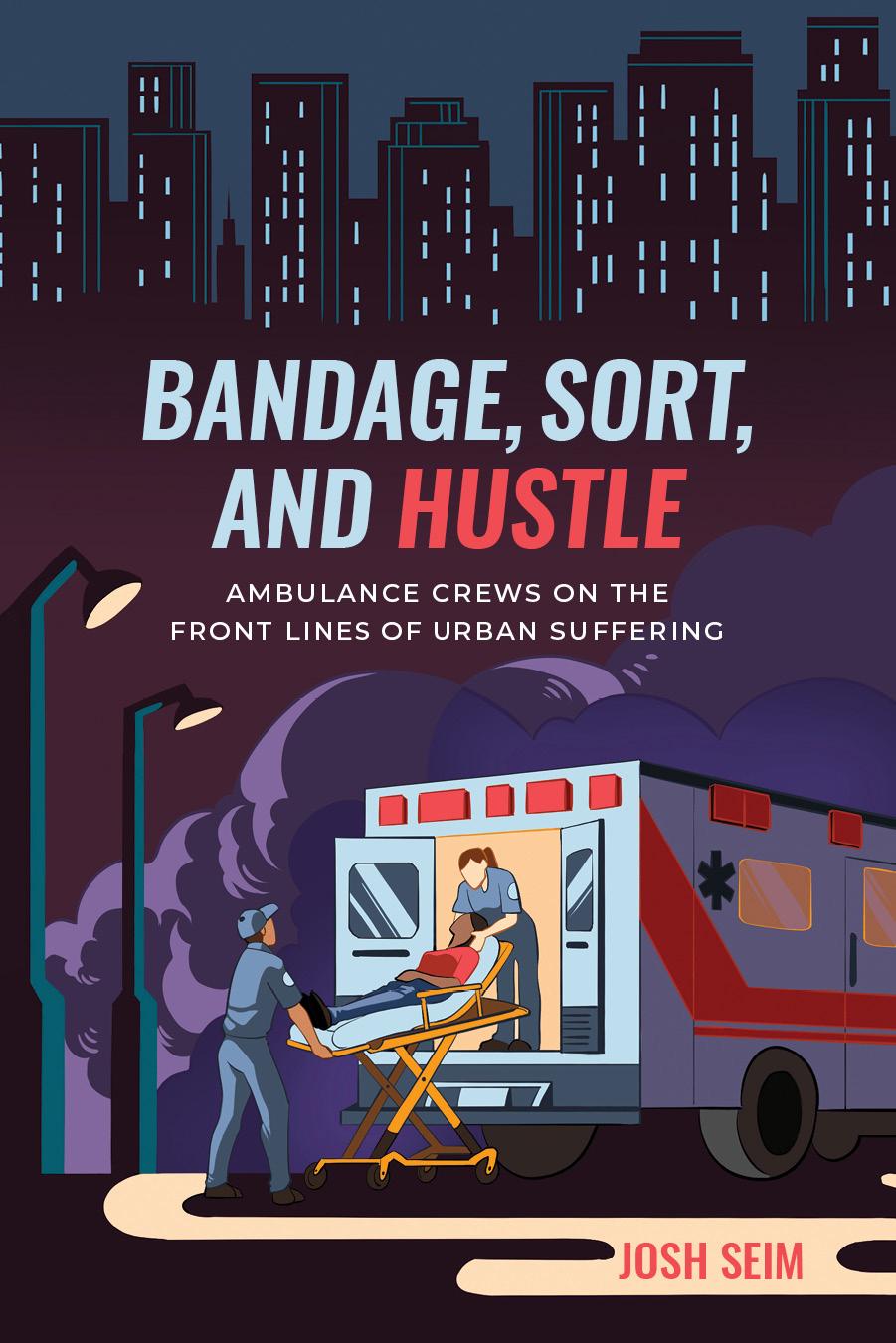
What is the role of the ambulance in the American city? The prevailing narrative provides a rather simple answer: saving and transporting the critically ill and injured. This is not an incorrect description, but it is incomplete.
Drawing on field observations, medical records, and his own experience as a novice emergency medical technician, sociologist Josh Seim reimagines paramedicine as a frontline institution for governing urban suffering. Bandage, Sort, and Hustle argues that the ambulance is part of a fragmented regime that is focused more on neutralizing hardships (which are disproportionately carried by poor people and people of color) than on eradicating the root causes of agony. Whether by compressing lifeless chests on the streets or by transporting the publicly intoxicated into the hospital, ambulance crews tend to handle suffering bodies near the bottom of the polarized metropolis.
Seim illustrates how this work puts crews in recurrent, and sometimes tense, contact with the emergency department nurses and police officers who share their clientele. These street-level relations, however, cannot be understood without considering the bureaucratic and capitalistic forces that control and coordinate ambulance labor from above. Beyond the ambulance, this book motivates a labor-centric model for understanding the frontline governance of down-and-out populations.
Drawing on field observations, medical records, and his own experience as a novice emergency medical technician, sociologist Josh Seim reimagines paramedicine as a frontline institution for governing urban suffering. Bandage, Sort, and Hustle argues that the ambulance is part of a fragmented regime that is focused more on neutralizing hardships (which are disproportionately carried by poor people and people of color) than on eradicating the root causes of agony. Whether by compressing lifeless chests on the streets or by transporting the publicly intoxicated into the hospital, ambulance crews tend to handle suffering bodies near the bottom of the polarized metropolis.
Seim illustrates how this work puts crews in recurrent, and sometimes tense, contact with the emergency department nurses and police officers who share their clientele. These street-level relations, however, cannot be understood without considering the bureaucratic and capitalistic forces that control and coordinate ambulance labor from above. Beyond the ambulance, this book motivates a labor-centric model for understanding the frontline governance of down-and-out populations.
Payez facilement par carte, Klarna, Apple Pay ou Google Pay. Pas satisfait ? Vous avez toujours une garantie de remboursement de 14 jours. En savoir plus dans nos conditions. Si vous avez des questions, envoyez-nous un e-mail à hello@memmo.org.
Memmo facilite tes études, où que tu sois dans le monde. On rassemble tes manuels de cours et des outils d'étude intelligents au même endroit : résumés, quiz, podcasts et flashcards. Et il y a Ted, ton compagnon d'étude qui répond à toutes tes questions. Plus de 50 000 étudiants étudient déjà ici – conçu pour t'aider à apprendre plus vite et à moins stresser.
Tu pourrais aussi aimer
Acheter le livre0