
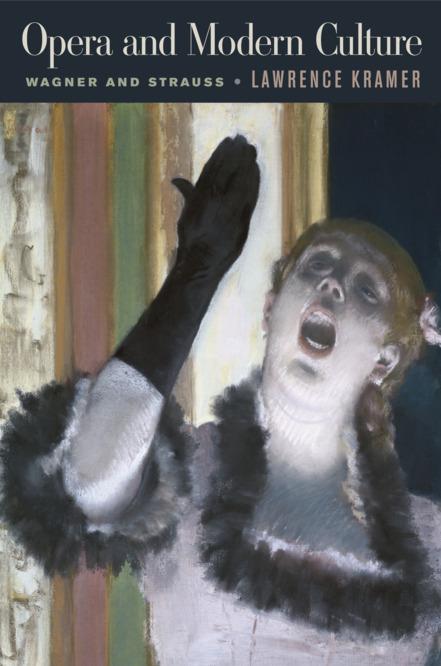
In this enlightening and entertaining book, one of the most original and sophisticated musicologists writing today turns his attention to music's most dramatic genre. Extending his ongoing project of clarifying music's various roles in Western society, Kramer brings to opera his distinctive and pioneering blend of historical concreteness and theoretical awareness.
Opera is legendary for going to extremes, a tendency that has earned it a reputation for unreality. Opera and Modern Culture shows the reverse to be true. Kramer argues that for the past two centuries the preoccupation of a group of famous operas with the limits of supremacy and debasement helped to define a normality that seems the very opposite of the operatic. Exemplified in a series of beloved examples, a certain idea of opera—a fiction of opera—has contributed in key ways to the modern era's characterizations of desire, identity, and social order. Opera and Modern Culture exposes this process at work in operas by Richard Wagner, who put modernity on the agenda in ways no one after him could ignore, and by the young Richard Strauss. The book continues the initiative of much recent writing in treating opera as a multimedia rather than a primarily musical form. From Lohengrin and The Ring of the Niebelung to Salome and Elektra, it traces the rich interplay of operatic visions and voices and their contexts in the birth pangs of modern life.
Opera is legendary for going to extremes, a tendency that has earned it a reputation for unreality. Opera and Modern Culture shows the reverse to be true. Kramer argues that for the past two centuries the preoccupation of a group of famous operas with the limits of supremacy and debasement helped to define a normality that seems the very opposite of the operatic. Exemplified in a series of beloved examples, a certain idea of opera—a fiction of opera—has contributed in key ways to the modern era's characterizations of desire, identity, and social order. Opera and Modern Culture exposes this process at work in operas by Richard Wagner, who put modernity on the agenda in ways no one after him could ignore, and by the young Richard Strauss. The book continues the initiative of much recent writing in treating opera as a multimedia rather than a primarily musical form. From Lohengrin and The Ring of the Niebelung to Salome and Elektra, it traces the rich interplay of operatic visions and voices and their contexts in the birth pangs of modern life.
Payez facilement par carte, Klarna, Apple Pay ou Google Pay. Pas satisfait ? Vous avez toujours une garantie de remboursement de 14 jours. En savoir plus dans nos conditions. Si vous avez des questions, envoyez-nous un e-mail à hello@memmo.org.
Memmo facilite tes études, où que tu sois dans le monde. On rassemble tes manuels de cours et des outils d'étude intelligents au même endroit : résumés, quiz, podcasts et flashcards. Et il y a Ted, ton compagnon d'étude qui répond à toutes tes questions. Plus de 50 000 étudiants étudient déjà ici – conçu pour t'aider à apprendre plus vite et à moins stresser.
Tu pourrais aussi aimer
Acheter le livre0