
''The historian of mathematics will find much to interest him here . . . while the casual reader is likely to be intrigued by the author's superior narrative ability." — Library Journal
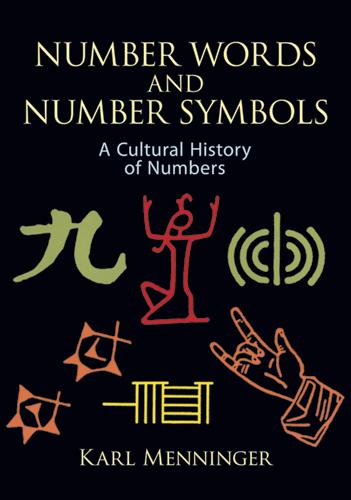
This book is not only a fascinating introduction to the concept of number and to numbers themselves, hut a multifaceted linguistic and historical analysis of how numbers have developed and evolved in many different cultures. Drawing on evidence from history, literature, philosophy and ethnology, noted German scholar Karl Menninger. recounts the development of numbers both as they are spoken (and written as words) and as symbolic abstract numerals that can he readily manipulated and combined.
Despite the immense erudition the author brings to the topic, he maintains a light tone throughout, presenting much of the information in anecdotal form. Moreover, almost 300 illustrations (photographs and drawings) and many comparative language tables serve to enhance the text. The author begins with a lucid treatment of number sequence and number language, including the formation of number words in both Indo-European and non-IndoEuropean languages, hidden number words and the evolution of the number sequence. He then turns to written numerals and computations: finger counting, folk symbols for numbers, alphabetical numerals, the "German" Roman numerals, the abacus and more. The final section concerns the development of our modem decimal system, with its place notation and zero, based on the Indian number system, and its introduction to the West through the work of the Italian mathematician Fibonacci. The author concludes with a review of spoken numbers and number symbols in China and Japan.
"The book is especially good on early counting and calculating devices: primitive tally sticks, the knotted cords of ancient Peru, the elaborate finger symbols once used for numbers, counting boards with movable counters, and of course the abacus." — Martin Gardner, Book World
Payez facilement par carte, Klarna, Apple Pay ou Google Pay. Pas satisfait ? Vous avez toujours une garantie de remboursement de 14 jours. En savoir plus dans nos conditions. Si vous avez des questions, envoyez-nous un e-mail à hello@memmo.org.
Memmo facilite tes études, où que tu sois dans le monde. On rassemble tes manuels de cours et des outils d'étude intelligents au même endroit : résumés, quiz, podcasts et flashcards. Et il y a Ted, ton compagnon d'étude qui répond à toutes tes questions. Plus de 50 000 étudiants étudient déjà ici – conçu pour t'aider à apprendre plus vite et à moins stresser.