
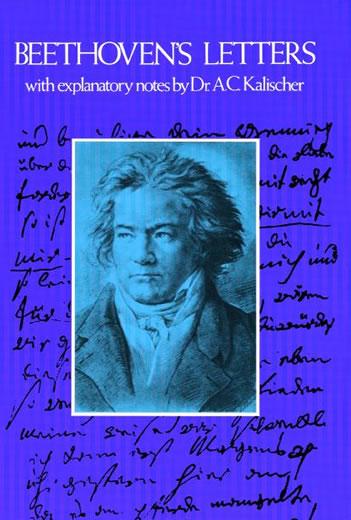
Ludwig van Beethoven (1770–1827), the protagonist of freedom for music, disentangled music from the control of the ruling class. In publishing his music and writing for the rising classes, Beethoven claimed freedom and expressed the emotions of the new rulers, the artists. The Eroica, Fidelio, and the piano works express the emotions of the new rulers — the intense love, the need for companionship of people, the forces that conspired to defeat the artist, and the strength and superiority of the artist in overcoming the weaknesses. The letters of Beethoven are the principal nonmusical expression of his personality in its relationship with the world of his time.
In what he called the "dry letters of the alphabet," Beethoven depicted his fears, his loves, and his friendly relations: his fears of deafness and of corrupted texts by pirating printers; his loves, Bettina Brentano and Giulietta Guicciardi; and his friendly relations with Baron Zmeskall, Frau Nannette Streicher, and the music publishers Steiner and Company. He praises the poetry of Goethe and Schiller but condemns Goethe for his obeisance toward royalty. He solicits help during his perpetual trouble with his health and with his servants. He castigates publishers, sets prices for his works, and calculates letters of dedication. He expresses his love for his nephew, Carl, but documents the trouble that Carl was causing him by taking up his precious time. And although Beethoven liked to decorate the letters with musical openings and closings and an occasional song to the receiver, he increasingly signed his letters, "In haste."
The 457 letters collected here are the most important of the letters of the spirit that was to shape and move a century. Explanatory notes comment upon works, on persons mentioned, and on the puns of which Beethoven was fond. The letters chronicle his business, his needs, his humor and bitterness, and his philosophy. They will give many insights into Beethoven's methods, his influences, his moods, and the conditions under which the master worked.
Payez facilement par carte, Klarna, Apple Pay ou Google Pay. Pas satisfait ? Vous avez toujours une garantie de remboursement de 14 jours. En savoir plus dans nos conditions. Si vous avez des questions, envoyez-nous un e-mail à hello@memmo.org.
Memmo facilite tes études, où que tu sois dans le monde. On rassemble tes manuels de cours et des outils d'étude intelligents au même endroit : résumés, quiz, podcasts et flashcards. Et il y a Ted, ton compagnon d'étude qui répond à toutes tes questions. Plus de 50 000 étudiants étudient déjà ici – conçu pour t'aider à apprendre plus vite et à moins stresser.