
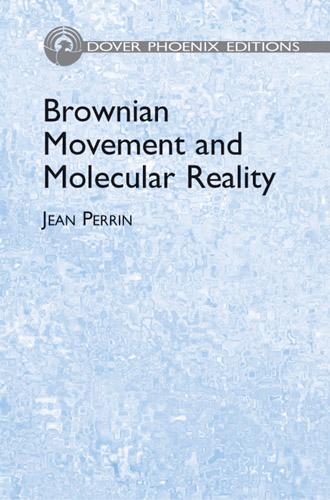
How do we know that molecules really exist? An important clue came from Brownian movement, a concept developed in 1827 by botanist Robert Brown, who noticed that tiny objects like pollen grains shook and moved erratically when viewed under a microscope. Nearly 80 years later, in 1905, Albert Einstein explained this "Brownian motion" as the result of bombardment by molecules. Einstein offered a quantitative explanation by mathematically estimating the average distance covered by the particles over time as a result of molecular bombardment. Four years later, Jean Baptiste Perrin wrote Brownian Movement and Molecular Reality, a work that explains his painstaking measurements of the displacements of particles of a resin suspended in water — experiments that yielded average displacements in excellent accord with Einstein's theoretical prediction.
The studies of Einstein and Perrin provided some of the first concrete evidence for the existence of molecules. Perrin, whose name is familiar to all who employ his methods for calculations in molecular dynamics, received the 1926 Nobel Prize in physics. In this classic paper, he introduced the concept of Avogadro's number, along with other groundbreaking work. Originally published in the French journal Annates de chimie et de physique, it was translated into English by Frederick Soddy to enduring influence and acclaim.
Payez facilement par carte, Klarna, Apple Pay ou Google Pay. Pas satisfait ? Vous avez toujours une garantie de remboursement de 14 jours. En savoir plus dans nos conditions. Si vous avez des questions, envoyez-nous un e-mail à hello@memmo.org.
Memmo facilite tes études, où que tu sois dans le monde. On rassemble tes manuels de cours et des outils d'étude intelligents au même endroit : résumés, quiz, podcasts et flashcards. Et il y a Ted, ton compagnon d'étude qui répond à toutes tes questions. Plus de 50 000 étudiants étudient déjà ici – conçu pour t'aider à apprendre plus vite et à moins stresser.