
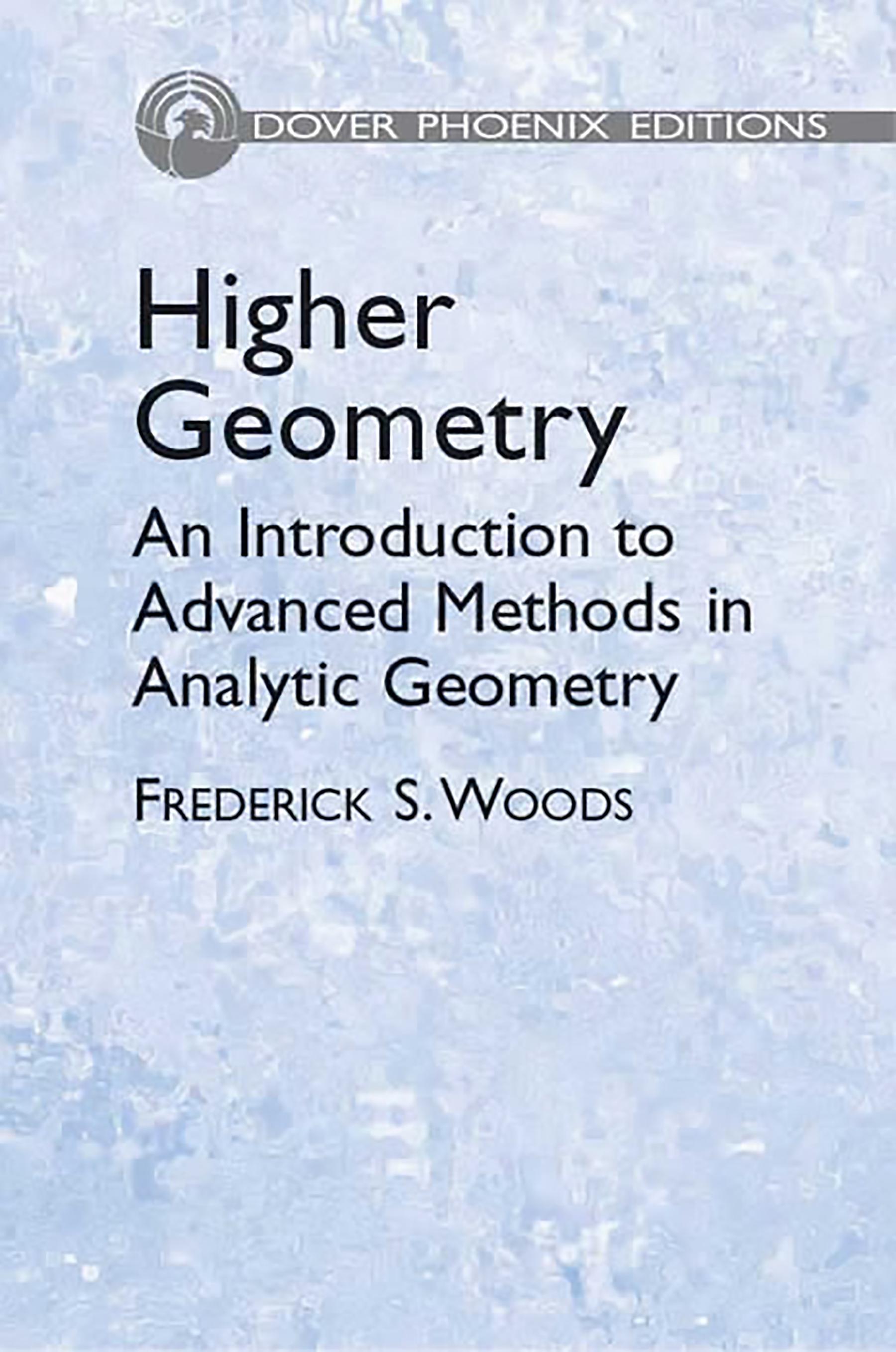
For students of mathematics with a sound background in analytic geometry and some knowledge of determinants, this volume has long been among the best available expositions of advanced work on projective and algebraic geometry. Developed from Professor Woods' lectures at the Massachusetts Institute of Technology, it bridges the gap between intermediate studies in the field and highly specialized works.
With exceptional thoroughness, it presents the most important general concepts and methods of advanced algebraic geometry (as distinguished from differential geometry). It offers a thorough study of one-, two-, three-, and four-dimensional coordinated systems, the concepts they entail, and their associated geometrical elements. This study culminates with a discussion of n-dimensional geometry in an abstract sense, of which the earlier subjects form concrete illustrations.
As each system of coordinates is introduced, the meaning of the linear and quadratic equations is studied, with principal emphasis on the interpretation of equations as well as on a knowledge of useful geometrical facts. The principle of duality is kept at the forefront, and the nature of imaginary elements and the conventional character of the locus of infinity, dependent upon the type of coordinates used, are carefully explained.
With exceptional thoroughness, it presents the most important general concepts and methods of advanced algebraic geometry (as distinguished from differential geometry). It offers a thorough study of one-, two-, three-, and four-dimensional coordinated systems, the concepts they entail, and their associated geometrical elements. This study culminates with a discussion of n-dimensional geometry in an abstract sense, of which the earlier subjects form concrete illustrations.
As each system of coordinates is introduced, the meaning of the linear and quadratic equations is studied, with principal emphasis on the interpretation of equations as well as on a knowledge of useful geometrical facts. The principle of duality is kept at the forefront, and the nature of imaginary elements and the conventional character of the locus of infinity, dependent upon the type of coordinates used, are carefully explained.
Payez facilement par carte, Klarna, Apple Pay ou Google Pay. Pas satisfait ? Vous avez toujours une garantie de remboursement de 14 jours. En savoir plus dans nos conditions. Si vous avez des questions, envoyez-nous un e-mail à hello@memmo.org.
Memmo facilite tes études, où que tu sois dans le monde. On rassemble tes manuels de cours et des outils d'étude intelligents au même endroit : résumés, quiz, podcasts et flashcards. Et il y a Ted, ton compagnon d'étude qui répond à toutes tes questions. Plus de 50 000 étudiants étudient déjà ici – conçu pour t'aider à apprendre plus vite et à moins stresser.
Tu pourrais aussi aimer
Acheter le livre0