
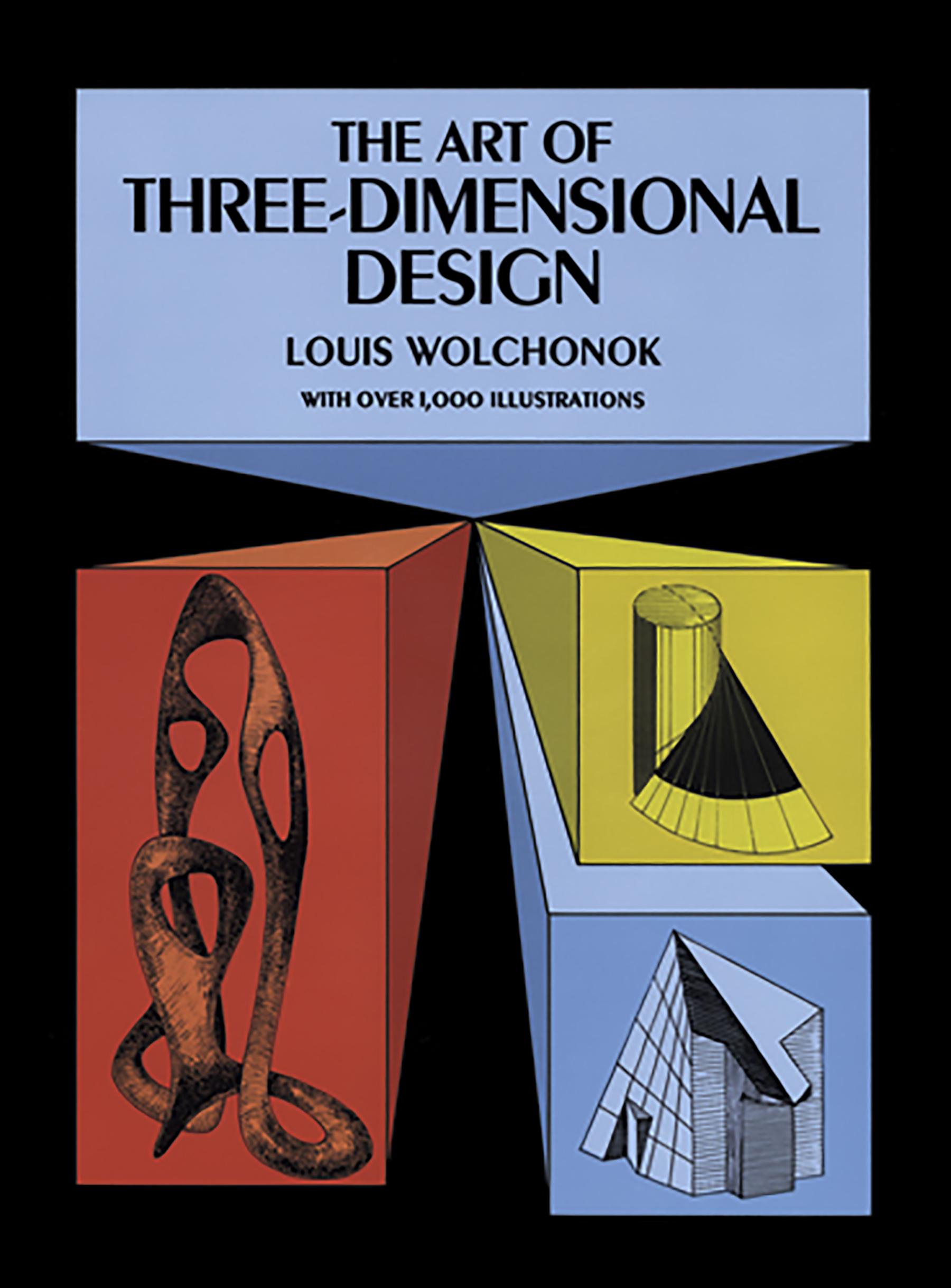
Prepared by a nationally known teacher of art and design, this guide to the creation of space figures in design points out the countless possibilities inherent in the basic geometric surfaces and solids. It demonstrates how they can be transformed into three-dimensional design motifs, and it encourages the reader's imagination to envision in the round the space figures he draws and sketches as rough notations. It also shows how to reduce natural and man-made forms to their geometric equivalents and, by new combinations, create original three-dimensional products.
Mr. Wolchonok approaches his subject through an investigation of the properties of the various geometric surfaces — plane, prismatic, cylindric, pyramidal, conical, spherical, ribbon and sheet surfaces and surfaces of revolution — and demonstrates ably how each of these can be modified, adapted, and transformed into many new forms. He shows how designs can be constructed from combinations of surfaces — for example, how intersections between cylinders, prisms and pyramids can be used in designing such objects as candelabras, receptacles, or table legs. He discusses repetition of motif and the rhythmic flow of surfaces; he describes and illustrates more than two hundred variations of human and animal forms that can be constructed in stone, clay, silver, brass, copper, or wood with combinations of three-dimensional geometric forms.
This book will be a source of constant reference for interior designers, sculptors, ceramists, silversmiths, product designers, architects, display craftsmen, furniture designers, and all those whose hobbies or professions make use of three-dimensional design.
Mr. Wolchonok approaches his subject through an investigation of the properties of the various geometric surfaces — plane, prismatic, cylindric, pyramidal, conical, spherical, ribbon and sheet surfaces and surfaces of revolution — and demonstrates ably how each of these can be modified, adapted, and transformed into many new forms. He shows how designs can be constructed from combinations of surfaces — for example, how intersections between cylinders, prisms and pyramids can be used in designing such objects as candelabras, receptacles, or table legs. He discusses repetition of motif and the rhythmic flow of surfaces; he describes and illustrates more than two hundred variations of human and animal forms that can be constructed in stone, clay, silver, brass, copper, or wood with combinations of three-dimensional geometric forms.
This book will be a source of constant reference for interior designers, sculptors, ceramists, silversmiths, product designers, architects, display craftsmen, furniture designers, and all those whose hobbies or professions make use of three-dimensional design.
Pages: 169
Catégorie: Konst, Design & Fotografi
e-ISBN: 9780486157214
Poids d'expédition: 1.2 kg
Expédié sous: 1-2 jours
Payez facilement par carte, Klarna, Apple Pay ou Google Pay. Pas satisfait ? Vous avez toujours une garantie de remboursement de 14 jours. En savoir plus dans nos conditions. Si vous avez des questions, envoyez-nous un e-mail à hello@memmo.org.
Memmo facilite tes études, où que tu sois dans le monde. On rassemble tes manuels de cours et des outils d'étude intelligents au même endroit : résumés, quiz, podcasts et flashcards. Et il y a Ted, ton compagnon d'étude qui répond à toutes tes questions. Plus de 50 000 étudiants étudient déjà ici – conçu pour t'aider à apprendre plus vite et à moins stresser.
Tu pourrais aussi aimer
Acheter le livre0