
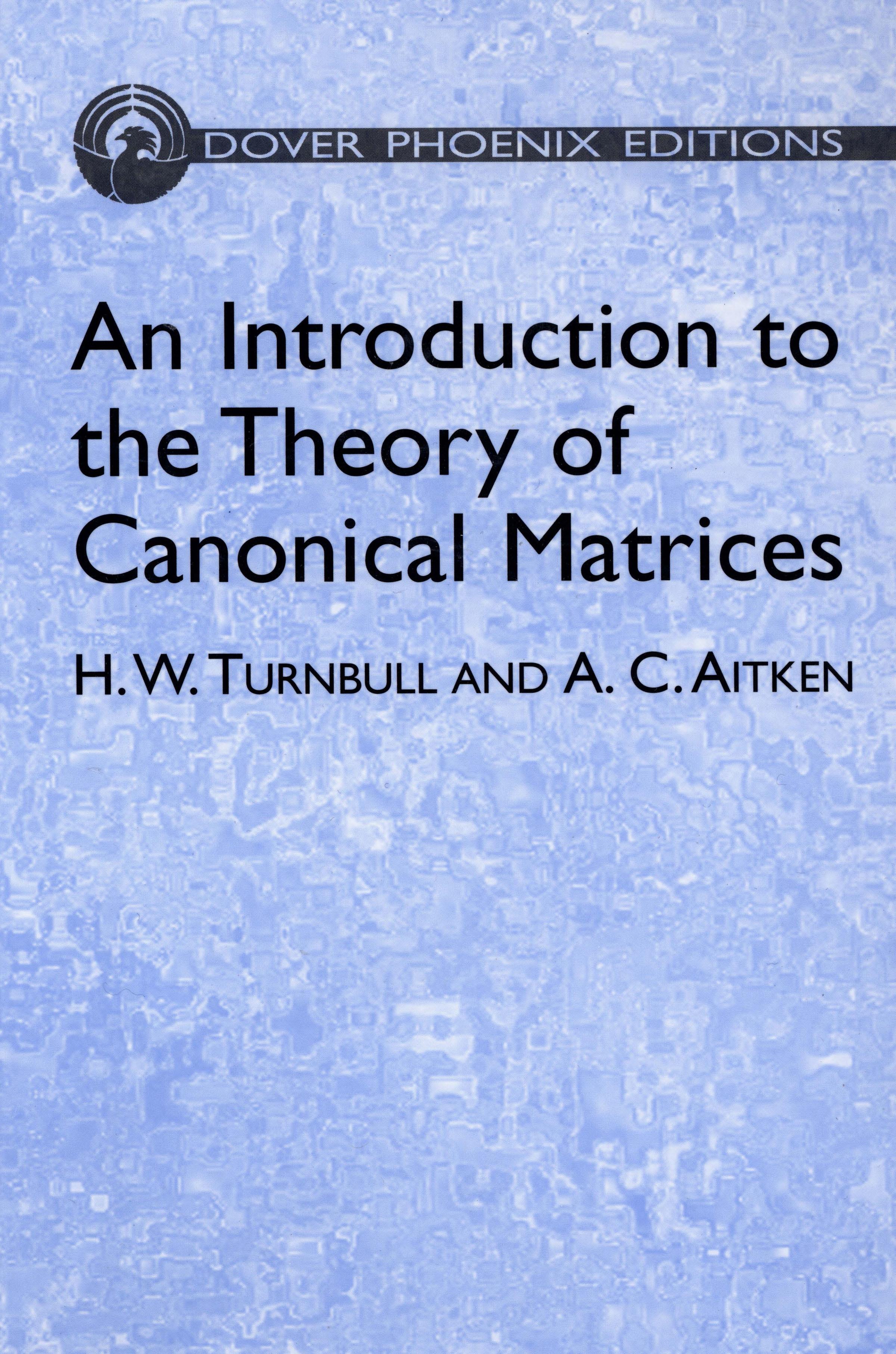
Thorough and self-contained, this penetrating study of the theory of canonical matrices presents a detailed consideration of all the theory’s principal features — from definitions and fundamental properties of matrices to the practical applications of their reduction to canonical forms.
Beginning with matrix multiplication, reciprocals, and partitioned matrices, the text proceeds to elementary transformations and bilinear and quadratic forms. A discussion of the canonical reduction of equivalent matrices follows, including treatments of general linear transformations, equivalent matrices in a field, the H. C. F. process for polynomials, and Smith’s canonical form for equivalent matrices. Subsequent chapters treat subgroups of the group of equivalent transformations and collineatory groups, discussing both rational and classical canonical forms for the latter.
Examinations of the quadratic and Hermitian forms of congruent and conjunctive transformative serve as preparation for the methods of canonical reduction explored in the final chapters. These methods include canonical reduction by unitary and orthogonal transformation, canonical reduction of pencils of matrices using invariant factors, the theory of commutants, and the application of canonical forms to the solution of linear matrix equations. The final chapter demonstrates the application of canonical reductions to the determination of the maxima and minima of a real function, solving the equations of the vibrations of a dynamical system, and evaluating integrals occurring in statistics.
Beginning with matrix multiplication, reciprocals, and partitioned matrices, the text proceeds to elementary transformations and bilinear and quadratic forms. A discussion of the canonical reduction of equivalent matrices follows, including treatments of general linear transformations, equivalent matrices in a field, the H. C. F. process for polynomials, and Smith’s canonical form for equivalent matrices. Subsequent chapters treat subgroups of the group of equivalent transformations and collineatory groups, discussing both rational and classical canonical forms for the latter.
Examinations of the quadratic and Hermitian forms of congruent and conjunctive transformative serve as preparation for the methods of canonical reduction explored in the final chapters. These methods include canonical reduction by unitary and orthogonal transformation, canonical reduction of pencils of matrices using invariant factors, the theory of commutants, and the application of canonical forms to the solution of linear matrix equations. The final chapter demonstrates the application of canonical reductions to the determination of the maxima and minima of a real function, solving the equations of the vibrations of a dynamical system, and evaluating integrals occurring in statistics.
Payez facilement par carte, Klarna, Apple Pay ou Google Pay. Pas satisfait ? Vous avez toujours une garantie de remboursement de 14 jours. En savoir plus dans nos conditions. Si vous avez des questions, envoyez-nous un e-mail à hello@memmo.org.
Memmo facilite tes études, où que tu sois dans le monde. On rassemble tes manuels de cours et des outils d'étude intelligents au même endroit : résumés, quiz, podcasts et flashcards. Et il y a Ted, ton compagnon d'étude qui répond à toutes tes questions. Plus de 50 000 étudiants étudient déjà ici – conçu pour t'aider à apprendre plus vite et à moins stresser.
Tu pourrais aussi aimer
Acheter le livre0