
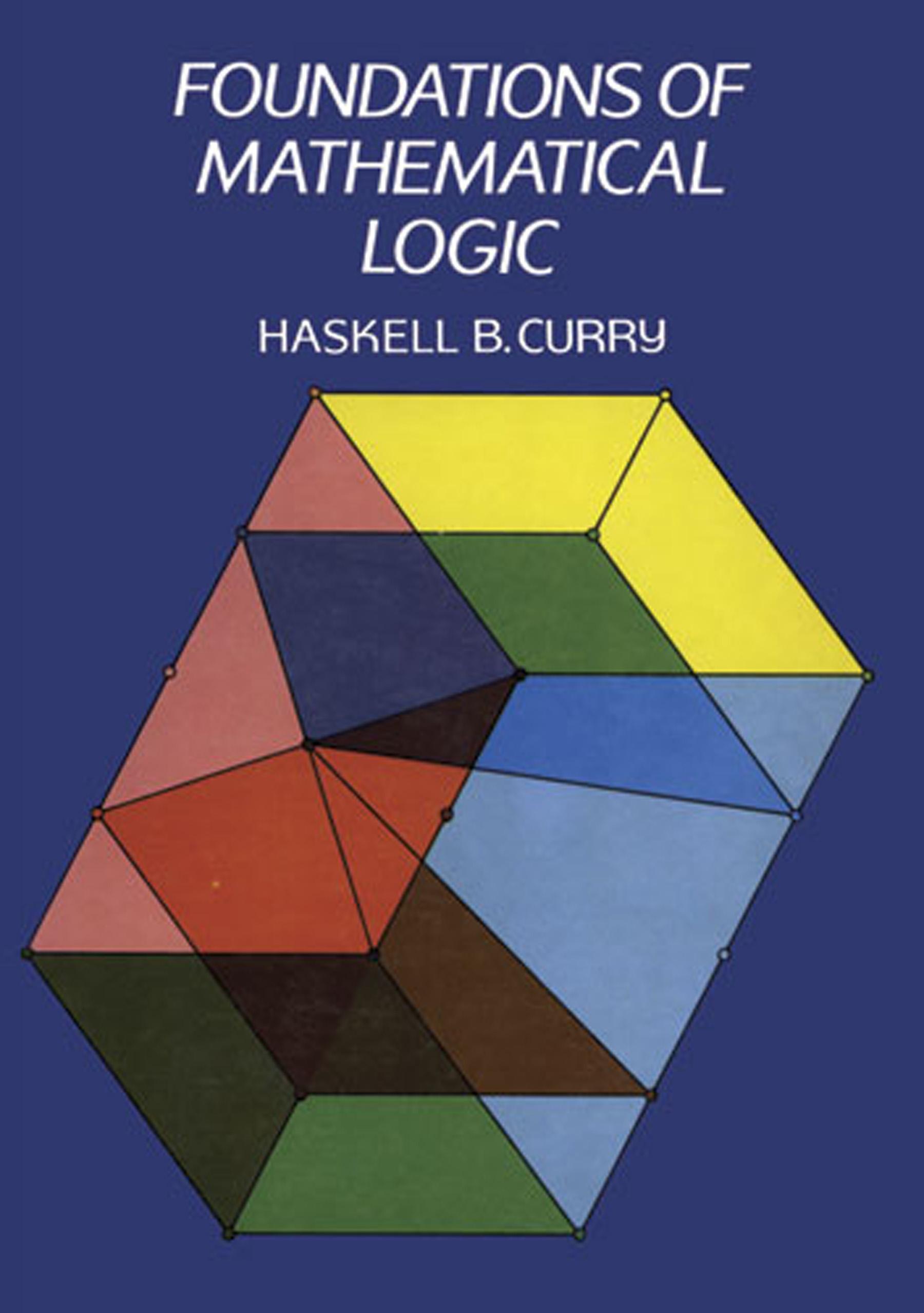
This book is a thoroughly documented and comprehensive account of the constructive theory of the first-order predicate calculus. This is a calculus that is central to modern mathematical logic and important for mathematicians, philosophers, and scientists whose work impinges upon logic.
Professor Curry begins by asking a simple question: What is mathematical logic? If we can define logic as "the analysis and criticism of thought" (W. E. Johnson), then mathematical logic is, according to Curry, "a branch of mathematics which has much the same relation to the analysis and criticism of thought as geometry does to the science of space."
The first half of the book gives the basic principles and outlines of the field. After a general introduction to the subject, the author discusses formal methods including algorithms and epitheory. A brief treatment of the Markov treatment of algorithms is included here. The elementary facts about lattices and similar algebraic systems are then covered. In the second half of the book Curry investigates the possibility for a formulation that expresses the meaning to be attached to the logical connectives and to develop the properties that follow from the assumptions so motivated. The author covers positive connectives: implication, conjunction, and alternation. He then goes on to negation and quantification, and concludes with modal operations. Extensive use is made in these latter chapters of the work of Gentzen. Lists of exercises are included.
Haskell B. Curry, Evan Pugh Research Professor, Emeritus, at Pennsylvania State University, was a member of the Institute for Advanced Study, Princeton; a former Director of the Institute for Foundational Research, the University of Amsterdam; and President of the Association for Symbolic Logic. His book avoids a doctrinaire stance, presenting various interpretations of logical systems, and offers philosophical and reflective as well as mathematical perspectives.
Professor Curry begins by asking a simple question: What is mathematical logic? If we can define logic as "the analysis and criticism of thought" (W. E. Johnson), then mathematical logic is, according to Curry, "a branch of mathematics which has much the same relation to the analysis and criticism of thought as geometry does to the science of space."
The first half of the book gives the basic principles and outlines of the field. After a general introduction to the subject, the author discusses formal methods including algorithms and epitheory. A brief treatment of the Markov treatment of algorithms is included here. The elementary facts about lattices and similar algebraic systems are then covered. In the second half of the book Curry investigates the possibility for a formulation that expresses the meaning to be attached to the logical connectives and to develop the properties that follow from the assumptions so motivated. The author covers positive connectives: implication, conjunction, and alternation. He then goes on to negation and quantification, and concludes with modal operations. Extensive use is made in these latter chapters of the work of Gentzen. Lists of exercises are included.
Haskell B. Curry, Evan Pugh Research Professor, Emeritus, at Pennsylvania State University, was a member of the Institute for Advanced Study, Princeton; a former Director of the Institute for Foundational Research, the University of Amsterdam; and President of the Association for Symbolic Logic. His book avoids a doctrinaire stance, presenting various interpretations of logical systems, and offers philosophical and reflective as well as mathematical perspectives.
Payez facilement par carte, Klarna, Apple Pay ou Google Pay. Pas satisfait ? Vous avez toujours une garantie de remboursement de 14 jours. En savoir plus dans nos conditions. Si vous avez des questions, envoyez-nous un e-mail à hello@memmo.org.
Memmo facilite tes études, où que tu sois dans le monde. On rassemble tes manuels de cours et des outils d'étude intelligents au même endroit : résumés, quiz, podcasts et flashcards. Et il y a Ted, ton compagnon d'étude qui répond à toutes tes questions. Plus de 50 000 étudiants étudient déjà ici – conçu pour t'aider à apprendre plus vite et à moins stresser.
Tu pourrais aussi aimer
Acheter le livre0