
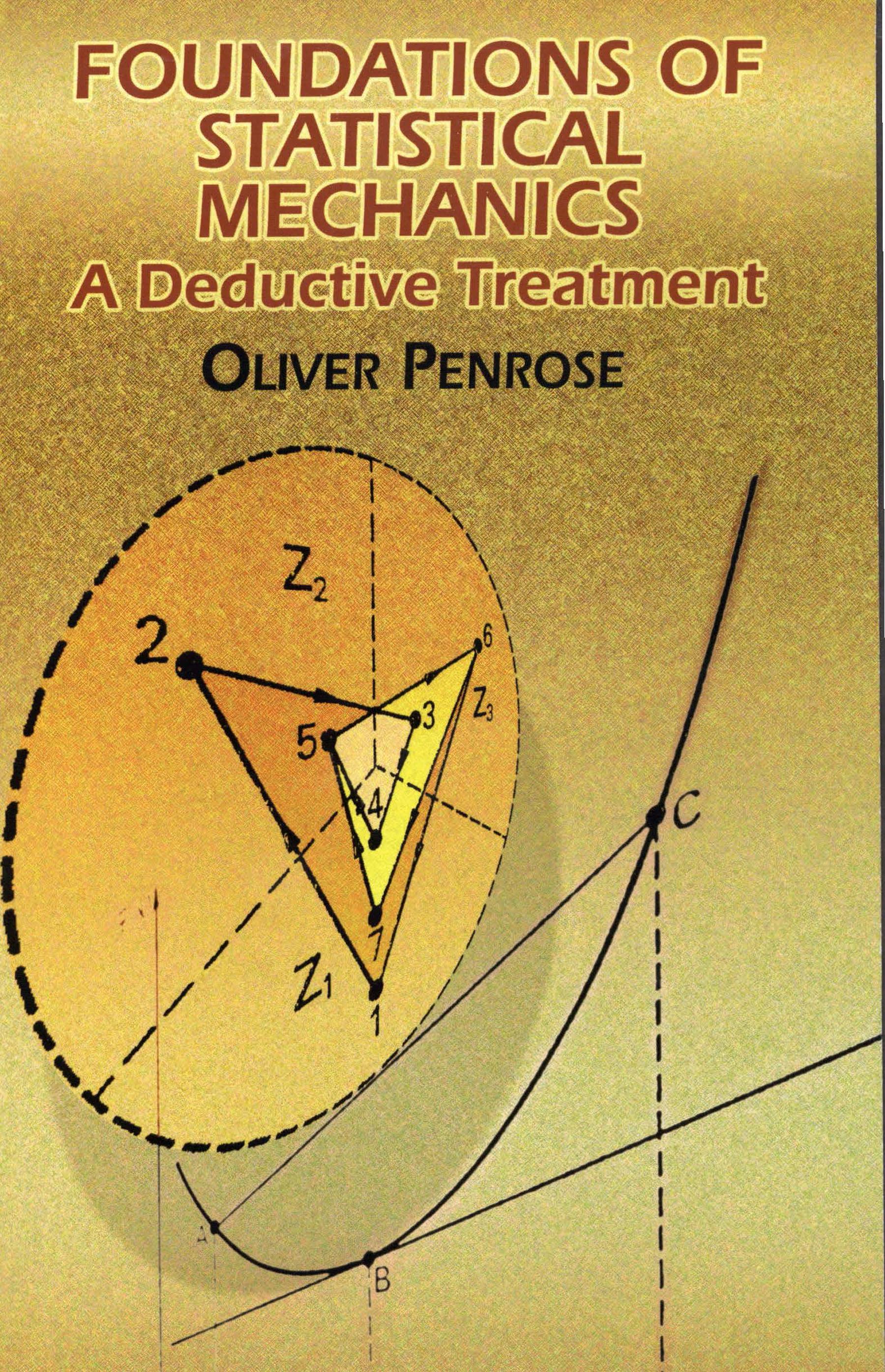
This volume demonstrates the manner in which statistical mechanics can be built up deductively from a small number of well-defined physical assumptions. A solid basis for the deductive structure is provided by embodying these assumptions in a system of five postulates that describe an idealized model of real physical systems. These postulates play a theoretical role similar to that of the first and second laws in thermodynamics.
The first chapter concerns the primary physical assumptions and their idealization in the form of postulates. The following three chapters examine the consequences of these postulates, culminating in the derivation of the fundamental formulas for calculating probabilities in terms of dynamical quantities. Two concluding chapters are devoted to an analysis of the notion of entropy, illustrating its links between statistical mechanics and thermodynamics and between statistical mechanics and communication theory. Because this book deals mostly with general principles, its only detailed considerations of physical applications are in terms of the system with the simplest possible dynamics: the ideal classical gas, which is discussed both in its equilibrium and its nonequilibrium aspects.
Intended for readers with a knowledge of physics at the advanced undergraduate and graduate levels, this volume considers topics of interest not only to physicists, but also to statisticians, communication theorists, chemists, and mathematicians.
The first chapter concerns the primary physical assumptions and their idealization in the form of postulates. The following three chapters examine the consequences of these postulates, culminating in the derivation of the fundamental formulas for calculating probabilities in terms of dynamical quantities. Two concluding chapters are devoted to an analysis of the notion of entropy, illustrating its links between statistical mechanics and thermodynamics and between statistical mechanics and communication theory. Because this book deals mostly with general principles, its only detailed considerations of physical applications are in terms of the system with the simplest possible dynamics: the ideal classical gas, which is discussed both in its equilibrium and its nonequilibrium aspects.
Intended for readers with a knowledge of physics at the advanced undergraduate and graduate levels, this volume considers topics of interest not only to physicists, but also to statisticians, communication theorists, chemists, and mathematicians.
Payez facilement par carte, Klarna, Apple Pay ou Google Pay. Pas satisfait ? Vous avez toujours une garantie de remboursement de 14 jours. En savoir plus dans nos conditions. Si vous avez des questions, envoyez-nous un e-mail à hello@memmo.org.
Memmo facilite tes études, où que tu sois dans le monde. On rassemble tes manuels de cours et des outils d'étude intelligents au même endroit : résumés, quiz, podcasts et flashcards. Et il y a Ted, ton compagnon d'étude qui répond à toutes tes questions. Plus de 50 000 étudiants étudient déjà ici – conçu pour t'aider à apprendre plus vite et à moins stresser.
Tu pourrais aussi aimer
Acheter le livre0