
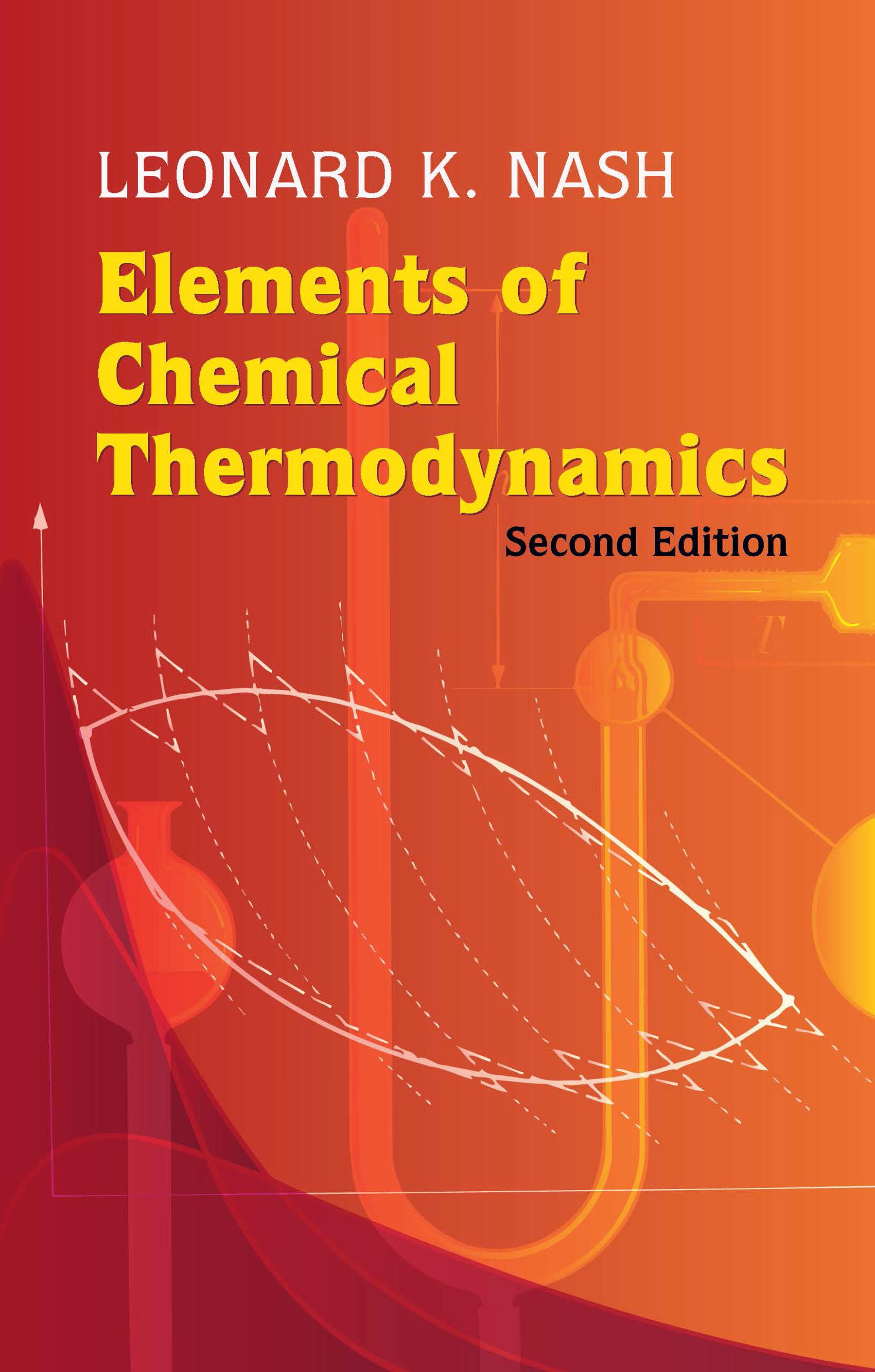
This text addresses the use of purely thermal data in calculating the position of equilibrium in a chemical reaction. Its argument highlights the physical content of thermodynamics, as distinct from purely mathematical aspects. Methods are limited to a very few of the most elementary operations of the calculus, all of which are explained in an appendix. Readers need no more than a sound background in high school mathematics and physics, as well as some familiarity with the leading quantitative concepts of an introductory college chemistry course.
An introduction establishes the fundamentals of temperature, heat and work, reversibility, and pressure-volume work. The first principle of thermodynamics is explored in terms of energy, enthalpy, thermochemistry and Hess's Law, heat capacity, Kirchhoff's equations, and adiabatic processes. Considerations of the second principle of thermodynamics encompass the Carnot cycle, the concept of entropy, and evaluation of entropy changes. The consequences of thermodynamic principles are examined in chapters on the free energies, the Clapeyron equation, ideal solutions and colligative properties, and the equilibrium state and equilibrium constant. Numerous problems appear throughout the text, in addition to 30 fully worked illustrative examples.
An introduction establishes the fundamentals of temperature, heat and work, reversibility, and pressure-volume work. The first principle of thermodynamics is explored in terms of energy, enthalpy, thermochemistry and Hess's Law, heat capacity, Kirchhoff's equations, and adiabatic processes. Considerations of the second principle of thermodynamics encompass the Carnot cycle, the concept of entropy, and evaluation of entropy changes. The consequences of thermodynamic principles are examined in chapters on the free energies, the Clapeyron equation, ideal solutions and colligative properties, and the equilibrium state and equilibrium constant. Numerous problems appear throughout the text, in addition to 30 fully worked illustrative examples.
Payez facilement par carte, Klarna, Apple Pay ou Google Pay. Pas satisfait ? Vous avez toujours une garantie de remboursement de 14 jours. En savoir plus dans nos conditions. Si vous avez des questions, envoyez-nous un e-mail à hello@memmo.org.
Memmo facilite tes études, où que tu sois dans le monde. On rassemble tes manuels de cours et des outils d'étude intelligents au même endroit : résumés, quiz, podcasts et flashcards. Et il y a Ted, ton compagnon d'étude qui répond à toutes tes questions. Plus de 50 000 étudiants étudient déjà ici – conçu pour t'aider à apprendre plus vite et à moins stresser.
Tu pourrais aussi aimer
Acheter le livre0