
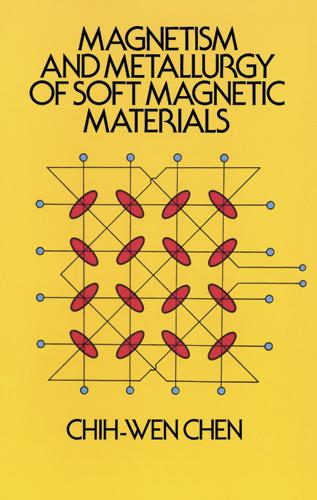
Soft magnetic materials are economically and technologically the most important of all magnetic materials. In particular, the development of new materials and novel applications for the computer and telecommunications industries during the past few decades has immensely broadened the scope and altered the nature of soft magnetic materials. In addition to metallic substances, nonmetallic compounds and amorphous thin films are coming increasingly important. This thorough, well-organized volume — on of the most comprehensive treatments available — offers a coherent, logical presentation of the physical principles underlying both the intrinsic and applied properties of soft magnetism. Two basic components are stressed: (1) traditional magnetism, which imparts magnetization and spin-dependent properties, and (2) metallurgy, which governs the preparation of the products and the attainment of their structure-sensitive properties. The book comprises seven major chapters: Introduction; Ferromagnetism and Ferrimagnetism; Magnetization and Domain Structure; Magnetic Properties; Metallurgy of Soft Magnetic Materials; Applications of Soft Magnetic Materials; and Special Topics (radiation effects and magnetic bubbles and devices).
In addition to an extensive introduction to the basic principles of magnetism relevant to all magnetic materials (Chapters I-IV), Professor Chen (Lawrence Livermore National Laboratory) devotes the core of the book to a rigorous, detailed discussion of the effects of metallurgical factors such as purity, alloying, grain structure, defects, and atomic order on the properties and performance of magnetic metals, alloys, and compounds. An extensive and important chapter on the special topics of magnetic bubbles and radiation effects rounds out this timely and wide-ranging survey of a crucial topic in solid state physics.
Written for materials scientists, experimental physicists, and metallurgists, the book also lends itself to use as a textbook for graduate courses in magnetic materials.
In addition to an extensive introduction to the basic principles of magnetism relevant to all magnetic materials (Chapters I-IV), Professor Chen (Lawrence Livermore National Laboratory) devotes the core of the book to a rigorous, detailed discussion of the effects of metallurgical factors such as purity, alloying, grain structure, defects, and atomic order on the properties and performance of magnetic metals, alloys, and compounds. An extensive and important chapter on the special topics of magnetic bubbles and radiation effects rounds out this timely and wide-ranging survey of a crucial topic in solid state physics.
Written for materials scientists, experimental physicists, and metallurgists, the book also lends itself to use as a textbook for graduate courses in magnetic materials.
Payez facilement par carte, Klarna, Apple Pay ou Google Pay. Pas satisfait ? Vous avez toujours une garantie de remboursement de 14 jours. En savoir plus dans nos conditions. Si vous avez des questions, envoyez-nous un e-mail à hello@memmo.org.
Memmo facilite tes études, où que tu sois dans le monde. On rassemble tes manuels de cours et des outils d'étude intelligents au même endroit : résumés, quiz, podcasts et flashcards. Et il y a Ted, ton compagnon d'étude qui répond à toutes tes questions. Plus de 50 000 étudiants étudient déjà ici – conçu pour t'aider à apprendre plus vite et à moins stresser.
Tu pourrais aussi aimer
Acheter le livre0