
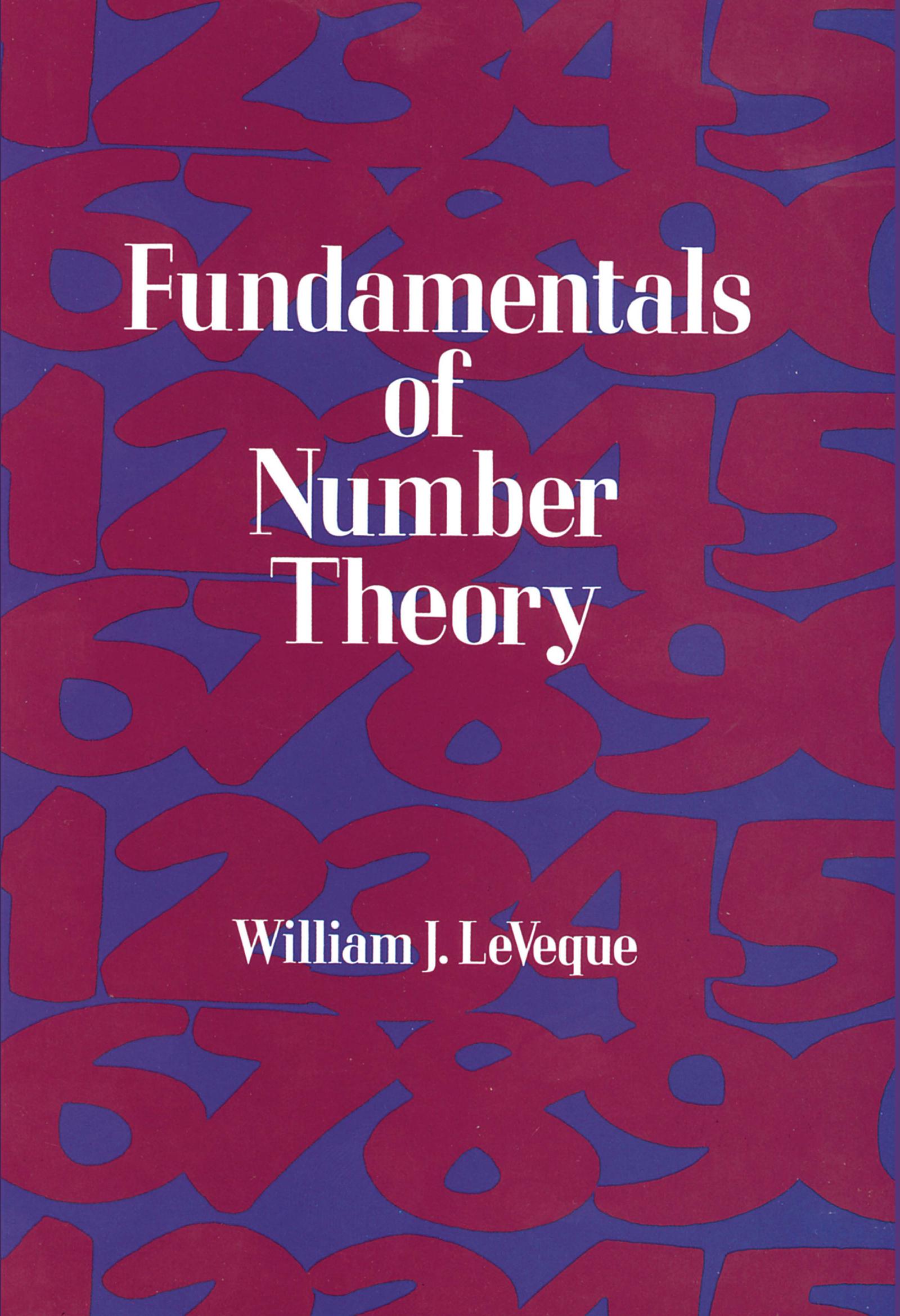
This excellent textbook introduces the basics of number theory, incorporating the language of abstract algebra. A knowledge of such algebraic concepts as group, ring, field, and domain is not assumed, however; all terms are defined and examples are given — making the book self-contained in this respect.
The author begins with an introductory chapter on number theory and its early history. Subsequent chapters deal with unique factorization and the GCD, quadratic residues, number-theoretic functions and the distribution of primes, sums of squares, quadratic equations and quadratic fields, diophantine approximation, and more. Included are discussions of topics not always found in introductory texts: factorization and primality of large integers, p-adic numbers, algebraic number fields, Brun's theorem on twin primes, and the transcendence of e, to mention a few.
Readers will find a substantial number of well-chosen problems, along with many notes and bibliographical references selected for readability and relevance. Five helpful appendixes — containing such study aids as a factor table, computer-plotted graphs, a table of indices, the Greek alphabet, and a list of symbols — and a bibliography round out this well-written text, which is directed toward undergraduate majors and beginning graduate students in mathematics. No post-calculus prerequisite is assumed. 1977 edition.
Payez facilement par carte, Klarna, Apple Pay ou Google Pay. Pas satisfait ? Vous avez toujours une garantie de remboursement de 14 jours. En savoir plus dans nos conditions. Si vous avez des questions, envoyez-nous un e-mail à hello@memmo.org.
Memmo facilite tes études, où que tu sois dans le monde. On rassemble tes manuels de cours et des outils d'étude intelligents au même endroit : résumés, quiz, podcasts et flashcards. Et il y a Ted, ton compagnon d'étude qui répond à toutes tes questions. Plus de 50 000 étudiants étudient déjà ici – conçu pour t'aider à apprendre plus vite et à moins stresser.