
"Vignola codified the rules of classical architecture for the Italian Renaissance . . . Ware codified Vignola for the American Renaissance." — John Barrington Bayley, from the Introductory Notes to The American Vignola
From 1890 to 1940, Americans designed and built classical architecture on an extraordinary scale. During this American Renaissance were built countless libraries, museums, universities, courthouses, capitol buildings and other structures, both public and private, rich with domes, pediments, colonnades, and other classical features. "We built with unparalleled grandeur," architect and scholar John Barrington Bayley observes, "and our architecture led the world."
More than any other document of the period, The American Vignola laid the groundwork for this grand resurgence in American architecture. Its author, William R. Ware, founded America's first school of architecture at M.I.T. in 1865, and sixteen years later, the School of Architecture at Columbia University. He became America's leading teacher of the art of designing classical architecture. The American Vignola is his textbook on that art.
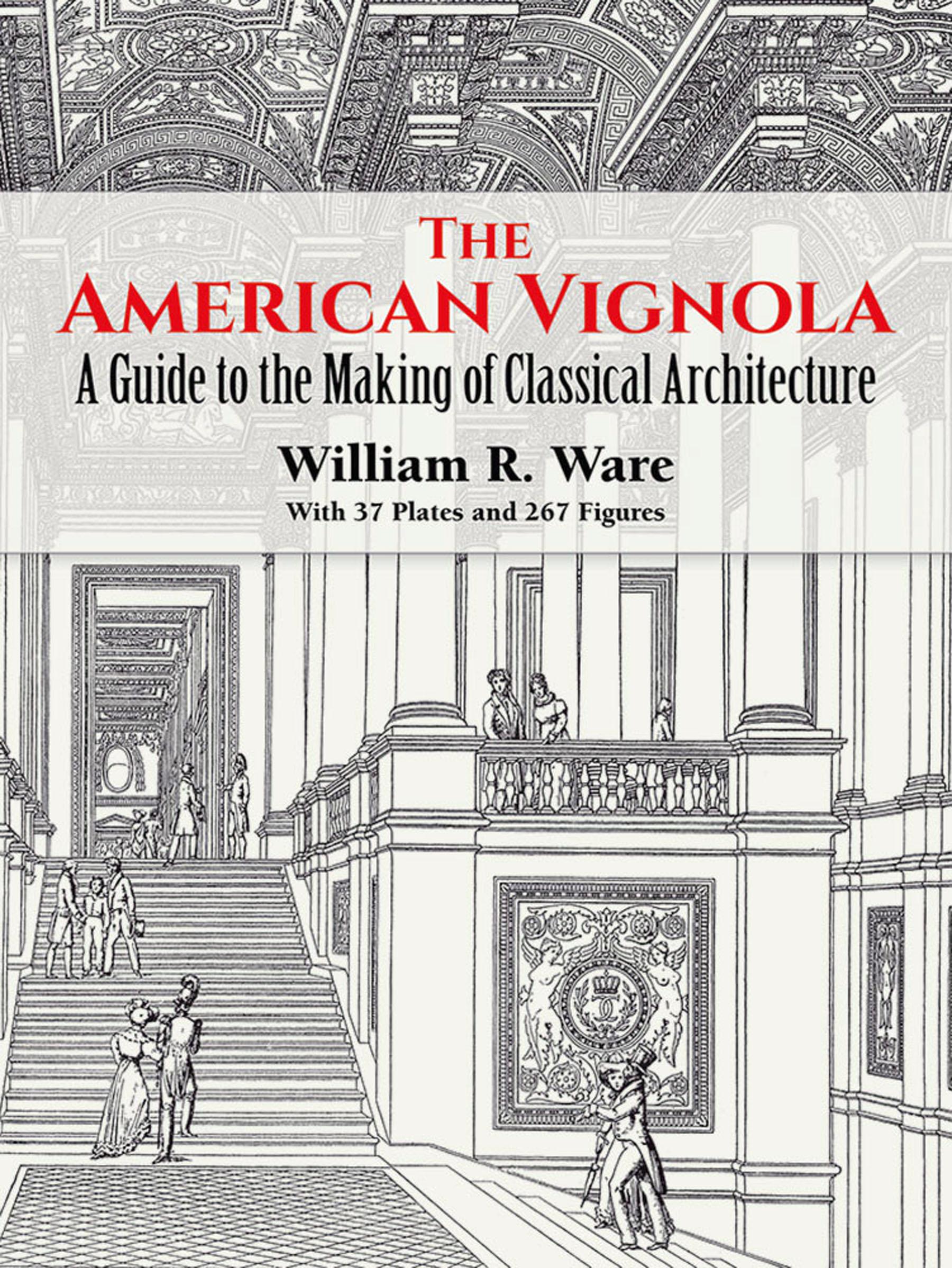
As the Renaissance architect Giacomo Barozzi da Vignola helped to recover the lost laws of classical architecture that made possible the architectural wonders of the Italian Renaissance, Ware helped lay the groundwork for the wonders of the American Renaissance. The American Vignola contains tables of the Tuscan, Ionic, Doric, Corinthian, and Composite Orders; measured drawings of the great monuments of the ancient, Renaissance, and baroque periods; and guides for drawing and establishing geometrical relations. Especially important are its detailed practical instructions for designing classical arches and vaults, roofs and domes, doors and windows, walls and ceilings, steps and staircases, and more. Over 300 illustrations illuminate the text, including 37 full-page plates and 267 smaller figures. Introductory notes by Mr. Bayley and architectural expert Henry Hope Reed set Mr. Ware's great achievement in perspective.
From 1890 to 1940, Americans designed and built classical architecture on an extraordinary scale. During this American Renaissance were built countless libraries, museums, universities, courthouses, capitol buildings and other structures, both public and private, rich with domes, pediments, colonnades, and other classical features. "We built with unparalleled grandeur," architect and scholar John Barrington Bayley observes, "and our architecture led the world."
More than any other document of the period, The American Vignola laid the groundwork for this grand resurgence in American architecture. Its author, William R. Ware, founded America's first school of architecture at M.I.T. in 1865, and sixteen years later, the School of Architecture at Columbia University. He became America's leading teacher of the art of designing classical architecture. The American Vignola is his textbook on that art.
As the Renaissance architect Giacomo Barozzi da Vignola helped to recover the lost laws of classical architecture that made possible the architectural wonders of the Italian Renaissance, Ware helped lay the groundwork for the wonders of the American Renaissance. The American Vignola contains tables of the Tuscan, Ionic, Doric, Corinthian, and Composite Orders; measured drawings of the great monuments of the ancient, Renaissance, and baroque periods; and guides for drawing and establishing geometrical relations. Especially important are its detailed practical instructions for designing classical arches and vaults, roofs and domes, doors and windows, walls and ceilings, steps and staircases, and more. Over 300 illustrations illuminate the text, including 37 full-page plates and 267 smaller figures. Introductory notes by Mr. Bayley and architectural expert Henry Hope Reed set Mr. Ware's great achievement in perspective.
Payez facilement par carte, Klarna, Apple Pay ou Google Pay. Pas satisfait ? Vous avez toujours une garantie de remboursement de 14 jours. En savoir plus dans nos conditions. Si vous avez des questions, envoyez-nous un e-mail à hello@memmo.org.
Memmo facilite tes études, où que tu sois dans le monde. On rassemble tes manuels de cours et des outils d'étude intelligents au même endroit : résumés, quiz, podcasts et flashcards. Et il y a Ted, ton compagnon d'étude qui répond à toutes tes questions. Plus de 50 000 étudiants étudient déjà ici – conçu pour t'aider à apprendre plus vite et à moins stresser.
Tu pourrais aussi aimer
Acheter le livre0