
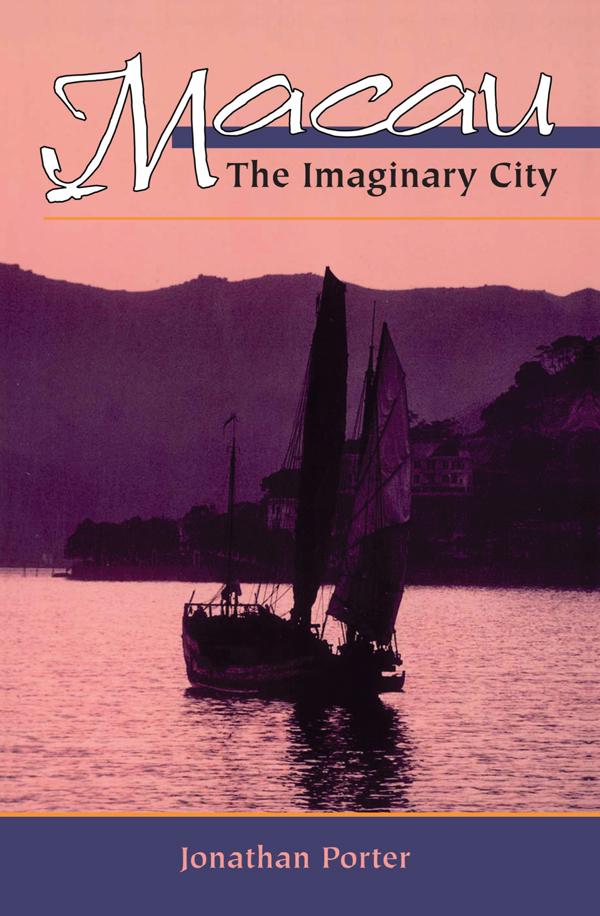
"For many people who have encountered it, Macau makes a deep impression on the imagination, as if the city were not entirely real or, rather, not of the real world. Macau often seems dreamlike, as though it were sustained by the effort of some powerful imagination." In this evocative essay on the cultural and social history of a unique and fragile city, Jonathan Porter examines Macau as an enduring but ever-changing threshold between East and West. Founded by the Portuguese in 1557, Macau emerged as a vibrant commercial and cultural hub in the early seventeenth century. The city then gradually evolved, flourishing first as a Eurasian community in the eighteenth century and then as an increasingly Chinese city in the nineteenth century. Macau became a modern manufacturing center in the late twentieth century and is now destined for reversion to the People’s Republic of China in 1999. The city was the meeting ground for many cultures, but central to this fascinating story is the encounter between an expansive, seaborne Portuguese empire and the introspective, closed world of imperial China. Unlike the other great colonial port cities of Asia, Macau did not provide natural access to the hinterland, and this geographical and historical isolation has fostered a unique balance of cultural influences that survives to this day. Poised on the periphery of two worlds, an isolated but global crossroads, Macau is a unique cultural and social melange that illuminates crucial issues of cross-cultural exchange in world history. Establishing Portugal and China as distinct cultural archetypes, Porter then examines the subsequent encounters of East and West in Macau from the sixteenth to the twentieth century. Avoiding the traditional linear chronological approach, Porter instead looks at a series of images from the city’s history and culture, including its place in the geographical context of the South China coast; the architecture of Macau, which reflects the memories of its historical passages; the variety of people who crossed the threshold of Macau; the material culture of everyday life; and the spiritual topography resulting from the encounters of popular religious movements in Macau. Jonathan Porter concludes his literary journey by reflecting on the character and meaning of the many cultural and social influences that have met and mingled in Macau. His words and photographs eloquently capture the essence of a place that seems too ephemeral to be real, too captivating to be anything but an imaginary city.
Payez facilement par carte, Klarna, Apple Pay ou Google Pay. Pas satisfait ? Vous avez toujours une garantie de remboursement de 14 jours. En savoir plus dans nos conditions. Si vous avez des questions, envoyez-nous un e-mail à hello@memmo.org.
Memmo facilite tes études, où que tu sois dans le monde. On rassemble tes manuels de cours et des outils d'étude intelligents au même endroit : résumés, quiz, podcasts et flashcards. Et il y a Ted, ton compagnon d'étude qui répond à toutes tes questions. Plus de 50 000 étudiants étudient déjà ici – conçu pour t'aider à apprendre plus vite et à moins stresser.
Tu pourrais aussi aimer
Acheter le livre0