
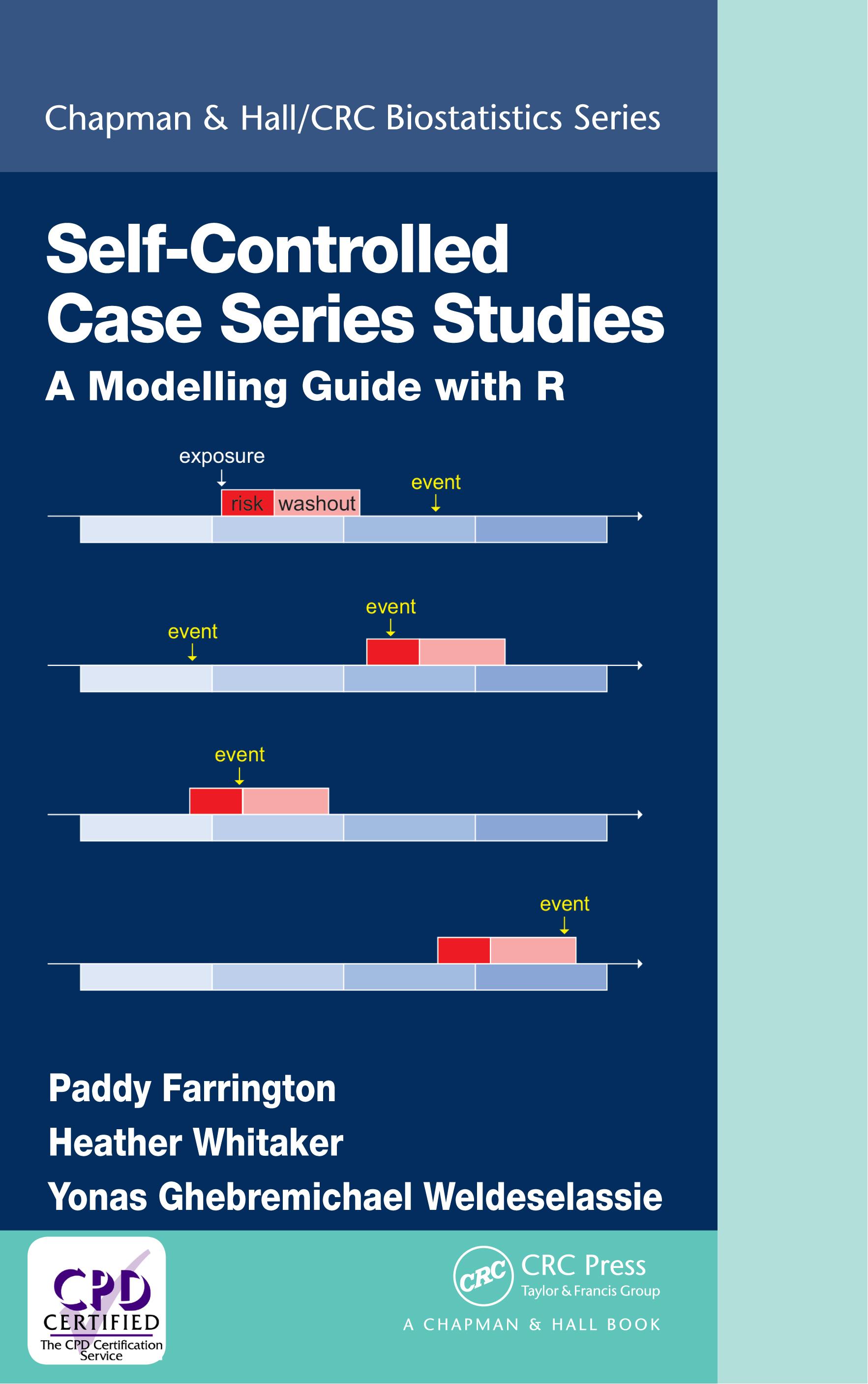
Self-Controlled Case Series Studies: A Modelling Guide with R provides the first comprehensive account of the self-controlled case series (SCCS) method, a statistical technique for investigating associations between outcome events and time-varying exposures. The method only requires information from individuals who have experienced the event of interest, and automatically controls for multiplicative time-invariant confounders, even when these are unmeasured or unknown. It is increasingly being used in epidemiology, most frequently to study the safety of vaccines and pharmaceutical drugs.
Key features of the book include:
- A thorough yet accessible description of the SCCS method, with mathematical details provided in separate starred sections.
- Comprehensive discussion of assumptions and how they may be verified.
- A detailed account of different SCCS models, extensions of the SCCS method, and the design of SCCS studies.
- Extensive practical illustrations and worked examples from epidemiology.
- Full computer code from the associated R package SCCS, which includes all the data sets used in the book.
The book is aimed at a broad range of readers, including epidemiologists and medical statisticians who wish to use the SCCS method, and also researchers with an interest in statistical methodology. The three authors have been closely involved with the inception, development, popularisation and programming of the SCCS method.
Payez facilement par carte, Klarna, Apple Pay ou Google Pay. Pas satisfait ? Vous avez toujours une garantie de remboursement de 14 jours. En savoir plus dans nos conditions. Si vous avez des questions, envoyez-nous un e-mail à hello@memmo.org.
Memmo facilite tes études, où que tu sois dans le monde. On rassemble tes manuels de cours et des outils d'étude intelligents au même endroit : résumés, quiz, podcasts et flashcards. Et il y a Ted, ton compagnon d'étude qui répond à toutes tes questions. Plus de 50 000 étudiants étudient déjà ici – conçu pour t'aider à apprendre plus vite et à moins stresser.