
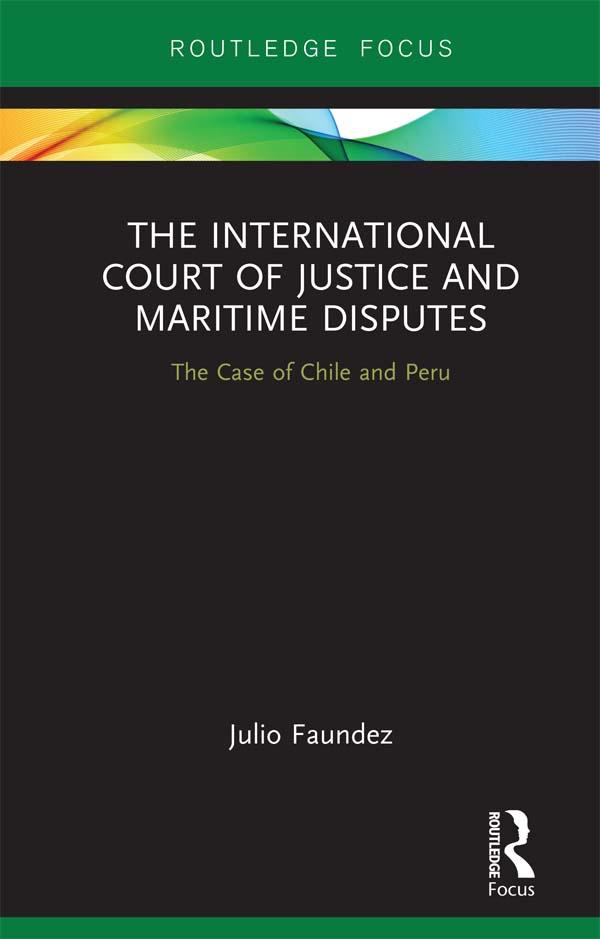
The origins of the maritime dispute between Chile and Peru go back to 1952, when these countries, along with Ecuador, asserted sovereignty over 200 nautical miles from their coasts. This maritime claim is widely regarded as one of the most important contributions by a group of developing countries to the law of the sea. Peru then asked the Court of International Justice to delimit its lateral boundary with Chile in accordance with principles of international law. Chile asked the Court to dismiss the request. The question before the ICJ Justice was whether the treaty concluded by the parties when they made their claim had also delimited their lateral boundary.
This book provides a critical analysis of the approach to treaty interpretation by the International Court of Justice in Maritime Disputes. Focusing on the case of Chile and Peru, the book explores two main issues: the interpretation of the Santiago Declaration and its connected treaties; and the tacit agreement that established a lateral maritime boundary with a seaward extension of 80 nautical miles. Part I argues that the Court’s finding that the Santiago Declaration did not delimit the lateral boundary is mistaken because it ignores its context, as well as its object and purpose. Part II argues that the finding that the parties had entered into a tacit agreement is an unjustified legal inference derived from a hasty interpretation of the Special Agreement of 1954. It questions that the reliability of the evidence used to determine the seaward extent of the lateral boundary and argues that the Court failed to demonstrate the bearing of contemporaneous developments in the law of the sea on the content of the tacit agreement.
Payez facilement par carte, Klarna, Apple Pay ou Google Pay. Pas satisfait ? Vous avez toujours une garantie de remboursement de 14 jours. En savoir plus dans nos conditions. Si vous avez des questions, envoyez-nous un e-mail à hello@memmo.org.
Memmo facilite tes études, où que tu sois dans le monde. On rassemble tes manuels de cours et des outils d'étude intelligents au même endroit : résumés, quiz, podcasts et flashcards. Et il y a Ted, ton compagnon d'étude qui répond à toutes tes questions. Plus de 50 000 étudiants étudient déjà ici – conçu pour t'aider à apprendre plus vite et à moins stresser.