
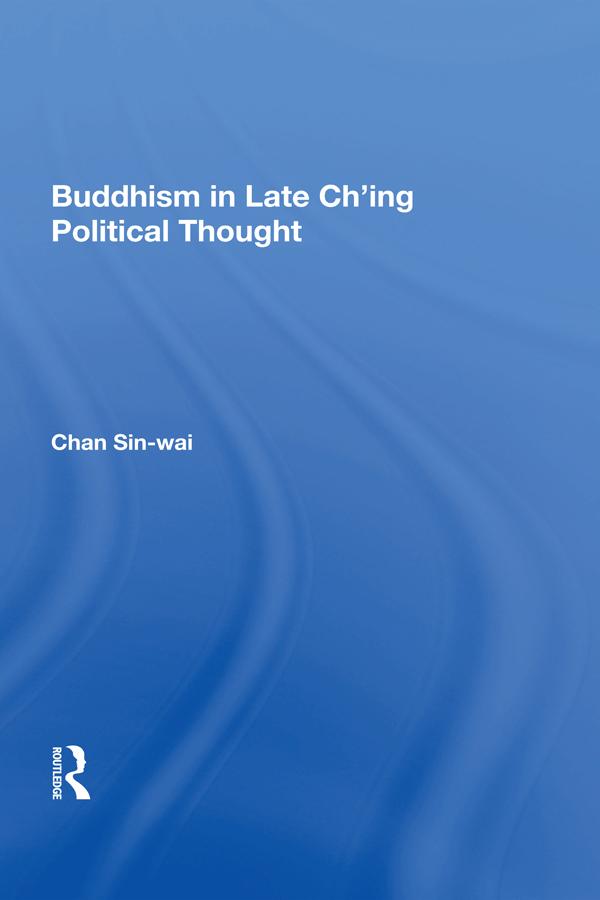
This book is a revised version of the doctoral thesis I presented to the School of Oriental and African Studies, University of London, in 1977. It is basically an attempt to study the religious, cultural and political significance of Buddhism in late Ch'ing intellectual thought through an examination of the writings of a few influential figures like liang Ch'i-ch'ao, K'ang Yu-wei, Chang Ping-lin, and particularly T'an Ssu-t'ung. My findings reveal that Buddhism came to play a part in these reformers' thought as a result of several factors: the rekindled interest in Buddhism brought about through the efforts of laymen such as Yang Wen-hui, the need to find a counter-balance to Christianity, the search for a new unifying ideology for China as Confucianism crumbled before the challenge from the West, and the immense potentiality of Buddhism to cater for the intellectuals' diverse cultural and political purposes. The masterpiece of T'an Ssu-t'ung, entitled An Exposition of Benevolence (Jen-hsiieh), is chosen here to exemplify the use of Buddhism in late Ch'ing political thought. Buddhism not only served as the all-embracing school of his eclectic synthesis, it also formed the foundation of the major concepts in the treatise, and was closely related to his radical thinking.
Payez facilement par carte, Klarna, Apple Pay ou Google Pay. Pas satisfait ? Vous avez toujours une garantie de remboursement de 14 jours. En savoir plus dans nos conditions. Si vous avez des questions, envoyez-nous un e-mail à hello@memmo.org.
Memmo facilite tes études, où que tu sois dans le monde. On rassemble tes manuels de cours et des outils d'étude intelligents au même endroit : résumés, quiz, podcasts et flashcards. Et il y a Ted, ton compagnon d'étude qui répond à toutes tes questions. Plus de 50 000 étudiants étudient déjà ici – conçu pour t'aider à apprendre plus vite et à moins stresser.
Tu pourrais aussi aimer
Acheter le livre0