
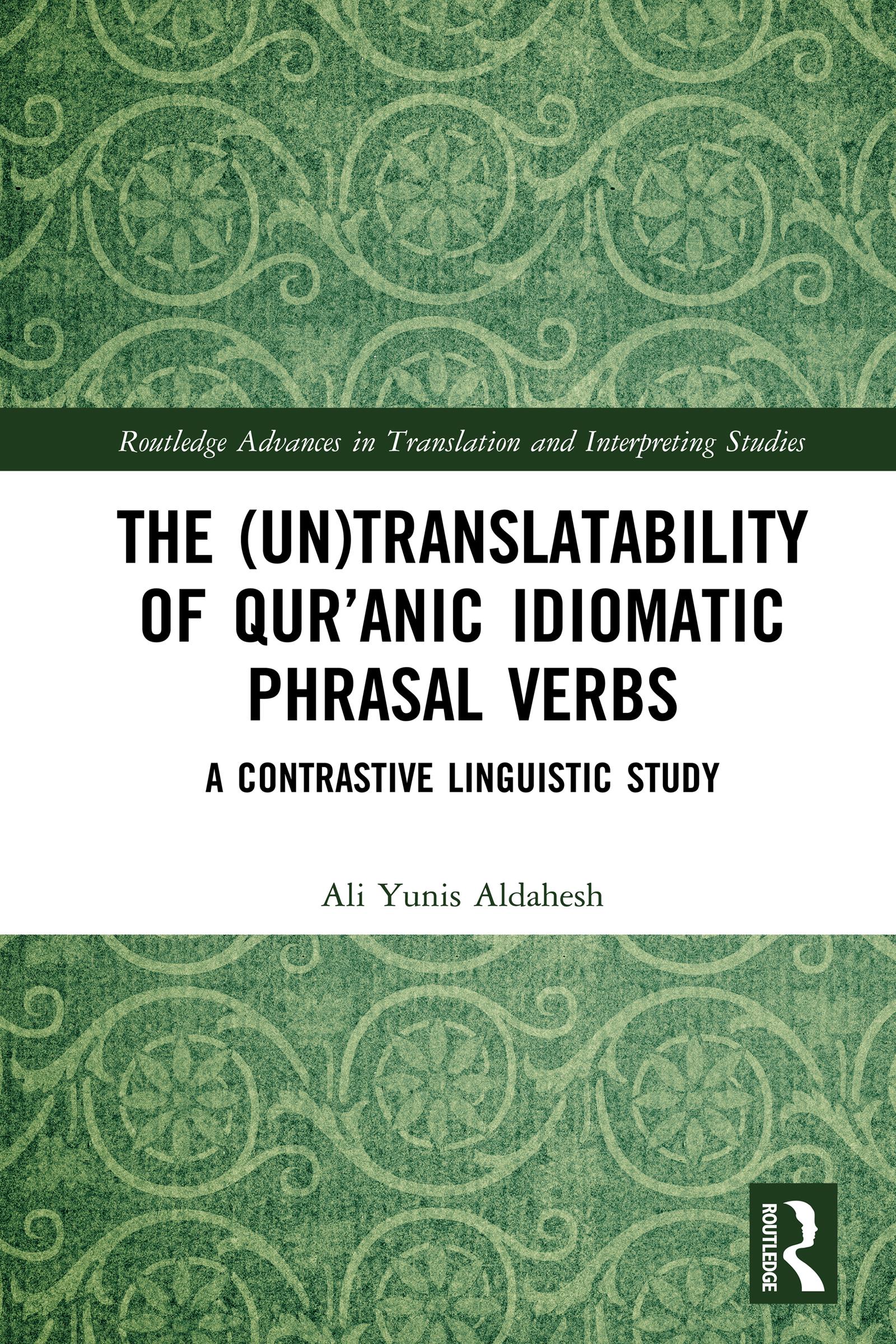
Qur’anic idiomaticity, in its all aspects, poses a great deal of challenge to Qur’an readers, learners, commentators, and translators. One of the most challenging aspects of Qur’anic idiomaticity is Qur’anic idiomatic phrasal verbs, where significances of proper Arabic verbs are entirely fused with significances of prepositions following them to produce new significances that have nothing to do with the basic significances of those verbs and prepositions.
By examining a corpus of ten of the most influential English translations of the Qur’an, this study scrutinizes how some translators of the Qur’an have dealt with the phenomenon of Qur’anic idiomatic phrasal verbs, the difficulties that they have encountered when translating them into English, and the strategies that they have employed in their attempts to overcome the inherent ambiguity of such expressions and provide their functional-pragmatic equivalents for English readership.
The study proposes a working model for analysing and assessing the translation of the Qur’anic idiomatic phrasal verbs and provides a number of theory-based recommendations for translators in general and Qur’an translators in particular.
Payez facilement par carte, Klarna, Apple Pay ou Google Pay. Pas satisfait ? Vous avez toujours une garantie de remboursement de 14 jours. En savoir plus dans nos conditions. Si vous avez des questions, envoyez-nous un e-mail à hello@memmo.org.
Memmo facilite tes études, où que tu sois dans le monde. On rassemble tes manuels de cours et des outils d'étude intelligents au même endroit : résumés, quiz, podcasts et flashcards. Et il y a Ted, ton compagnon d'étude qui répond à toutes tes questions. Plus de 50 000 étudiants étudient déjà ici – conçu pour t'aider à apprendre plus vite et à moins stresser.