
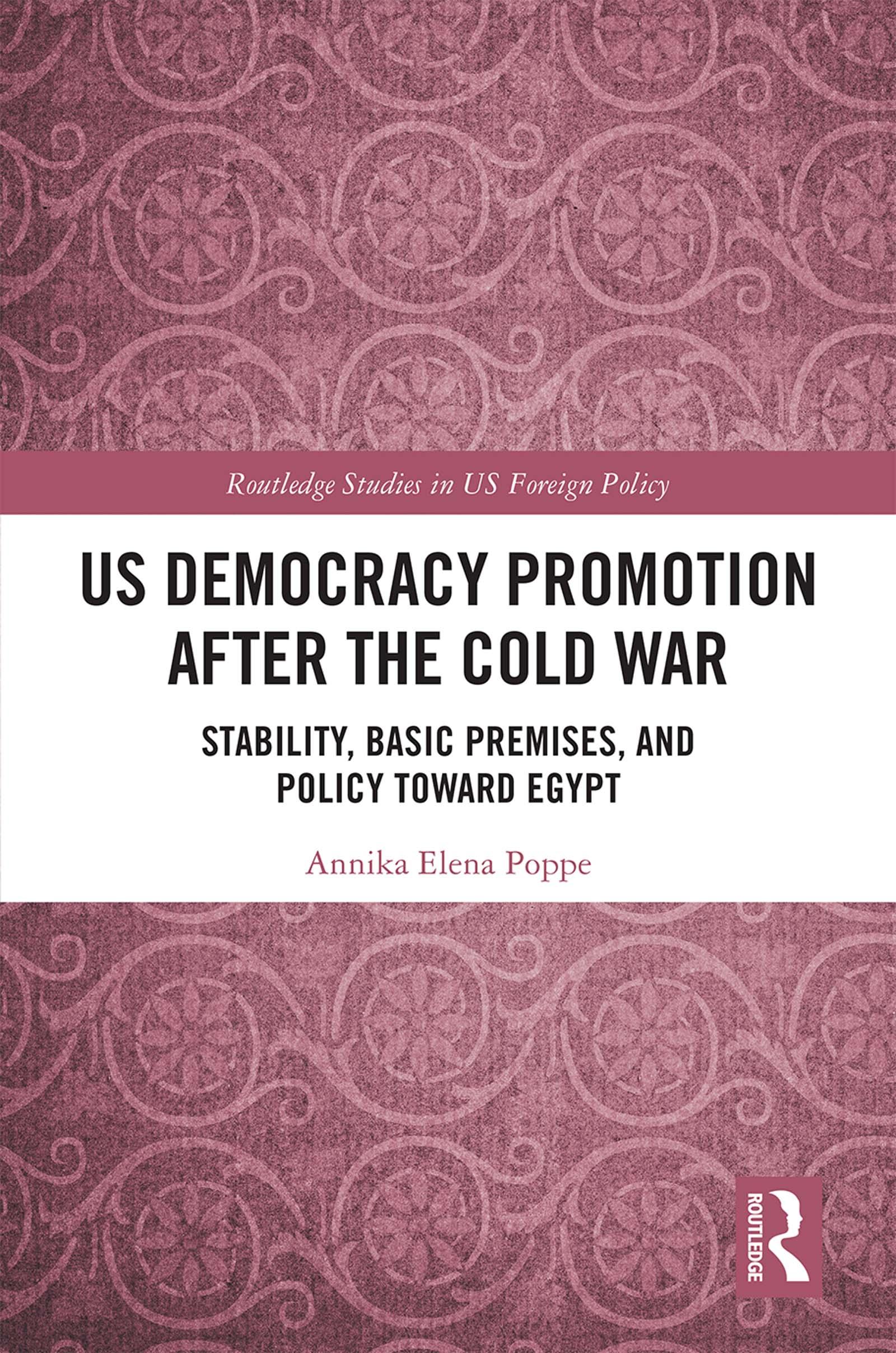
This book explores the often assumed but so far not examined proposition that a particular U.S. culture influences U.S. foreign policy behavior or, more concretely, that widely shared basic assumptions embraced by members of the U.S. administration have a notable impact on foreign policy-making.
Publicly professed beliefs regarding America’s role in the world and about democracy’s universal appeal – despite much contestation – go to the heart of U.S. national identity. Employing extensive foreign policy text analysis as well as using the case study of U.S.-Egyptian bilateral relations during the Clinton, Bush junior, and Obama administrations, it shows that basic assumptions matter in U.S. democracy promotion in general, and the book operationalizes them in detail as well as employs qualitative content analysis to assess their validity and variation.
The research presented lies at the intersection of International Relations, U.S. foreign policy, regional studies, and democracy promotion. The specific focus on the domestic ‘cultural’ angle for the study of foreign policy and this dimension’s operationalization makes it a creative crossover study and a unique contribution to these overlapping fields.
Payez facilement par carte, Klarna, Apple Pay ou Google Pay. Pas satisfait ? Vous avez toujours une garantie de remboursement de 14 jours. En savoir plus dans nos conditions. Si vous avez des questions, envoyez-nous un e-mail à hello@memmo.org.
Memmo facilite tes études, où que tu sois dans le monde. On rassemble tes manuels de cours et des outils d'étude intelligents au même endroit : résumés, quiz, podcasts et flashcards. Et il y a Ted, ton compagnon d'étude qui répond à toutes tes questions. Plus de 50 000 étudiants étudient déjà ici – conçu pour t'aider à apprendre plus vite et à moins stresser.