
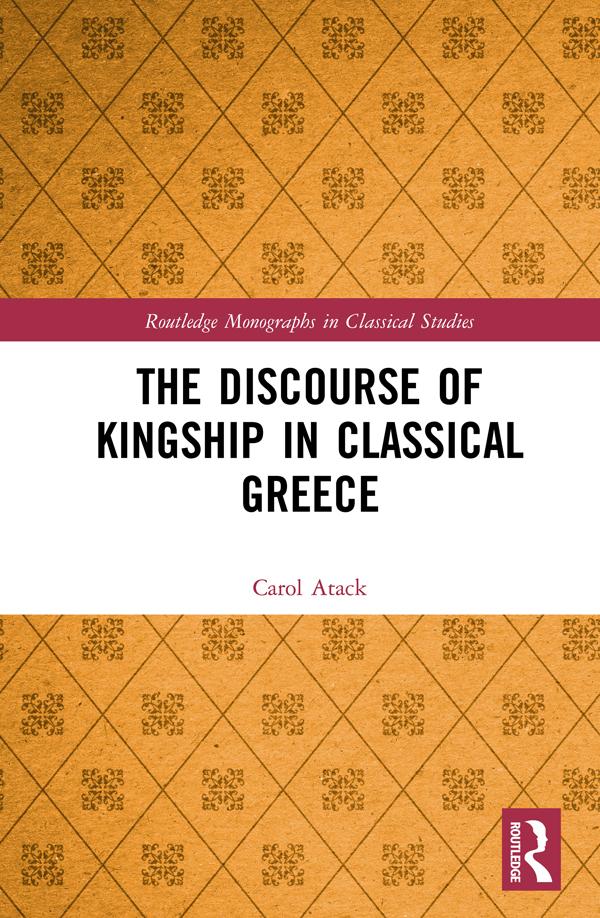
This book examines how ancient authors explored ideas of kingship as a political role fundamental to the construction of civic unity, the use of kingship stories to explain the past and present unity of the polis and the distinctive function or status attributed to kings in such accounts.
It explores the notion of kingship offered by historians such as Herodotus, as well as dramatists writing for the Athenian stage, paying particular attention to dramatic depictions of the unique capabilities of Theseus in uniting the city in the figure of the ‘democratic king’. It also discusses kingship in Greek philosophy: the Socratics’ identification of an ‘art of kingship’, and Xenophon and Isocrates’ model of ‘virtue monarchy’. In turn, these allow a rereading of explorations of kingship and excellence in Plato’s later political thought, seen as a critique of these models, and also in Aristotle’s account of total kingship or pambasileia, treated here as a counterfactual device developed to explore the epistemic benefits of democracy.
This book offers a fascinating insight into the institution of monarchy in classical Greek thought and society, both for those working on Greek philosophy and politics, and also for students of the history of political thought.
Payez facilement par carte, Klarna, Apple Pay ou Google Pay. Pas satisfait ? Vous avez toujours une garantie de remboursement de 14 jours. En savoir plus dans nos conditions. Si vous avez des questions, envoyez-nous un e-mail à hello@memmo.org.
Memmo facilite tes études, où que tu sois dans le monde. On rassemble tes manuels de cours et des outils d'étude intelligents au même endroit : résumés, quiz, podcasts et flashcards. Et il y a Ted, ton compagnon d'étude qui répond à toutes tes questions. Plus de 50 000 étudiants étudient déjà ici – conçu pour t'aider à apprendre plus vite et à moins stresser.