
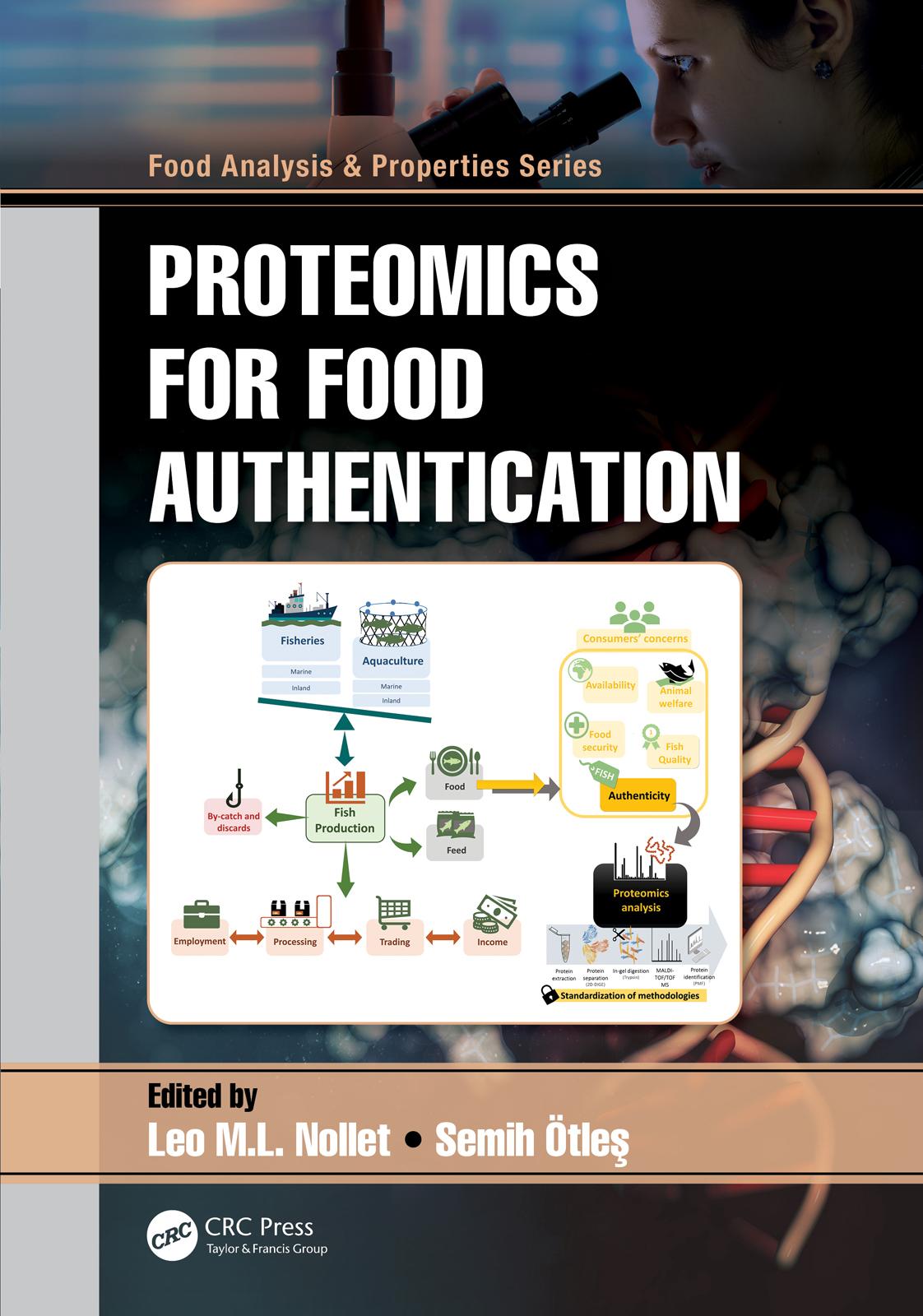
Consumers have the right to know what is in the food they are eating, and accordingly, a number of global food regulations require that the provenance of the food can be guaranteed from farm to fork. Many different instrumental techniques have been proposed for food authentication. Although traditional methods are still being used, new approaches such as genomics, proteomics, and metabolomics are helping to complement existing methodologies for verifying the claims made about certain food products.
During the last decade, proteomics (the largescale analysis of proteins in a particular biological system at a particular time) has been applied to different research areas within food technology. Since proteins can be used as markers for many properties of a food, even indicating processes to which the food has been subjected, they can provide further evidence of the foods labeling claim. Proteomics for Food Authentication, a volume in the Food Analysis and Properties Series, is a comprehensive and updated overview of the applications, drawbacks, advantages, and challenges of proteomics for food authentication.
Features:
- Provides a comprehensive and critical overview of the application of proteomics in food
- Helps food scientists determine the authenticity of several food products
- Provides applied techniques for both laboratory and industrial environments
- Describes workflows, technologies, and tools that are being assessed in proteomics-related studies
Workflows, technologies, and tools that are being assessed in proteomics-related studies are described, followed by a review of the specific applications regarding food authenticity and, now and then, food quality.
The book will provide a comprehensive and critical overview of the application of proteomics approaches to determine the authenticity of several food products updating the performances and current limitations of the applied techniques in both laboratory and industrial environments. As such it is well suited to food scientist, chemical engineers, food engineers, research labs, universities, governments, related food industries.
Also available in the Food Analysis and Properties Series:
Food Aroma Evolution: During Food Processing, Cooking, and Aging, edited by
Matteo Bordiga and Leo M.L. Nollet (ISBN: 9781138338241)
Ambient Mass Spectroscopy Techniques in Food and the Environment, edited by Leo M.L. Nollet and Basil K. Munjanja (ISBN: 9781138505568)
Hyperspectral Imaging Analysis and Applications for Food Quality, edited by N.C. Basantia, Leo M.L. Nollet, and Mohammed Kamruzzaman (ISBN: 9781138630796)
For a complete list of books in this series, please visit our website at:
www.crcpress.com/Food-Analysis--Properties/book-series/CRCFOODANPRO
Payez facilement par carte, Klarna, Apple Pay ou Google Pay. Pas satisfait ? Vous avez toujours une garantie de remboursement de 14 jours. En savoir plus dans nos conditions. Si vous avez des questions, envoyez-nous un e-mail à hello@memmo.org.
Memmo facilite tes études, où que tu sois dans le monde. On rassemble tes manuels de cours et des outils d'étude intelligents au même endroit : résumés, quiz, podcasts et flashcards. Et il y a Ted, ton compagnon d'étude qui répond à toutes tes questions. Plus de 50 000 étudiants étudient déjà ici – conçu pour t'aider à apprendre plus vite et à moins stresser.