
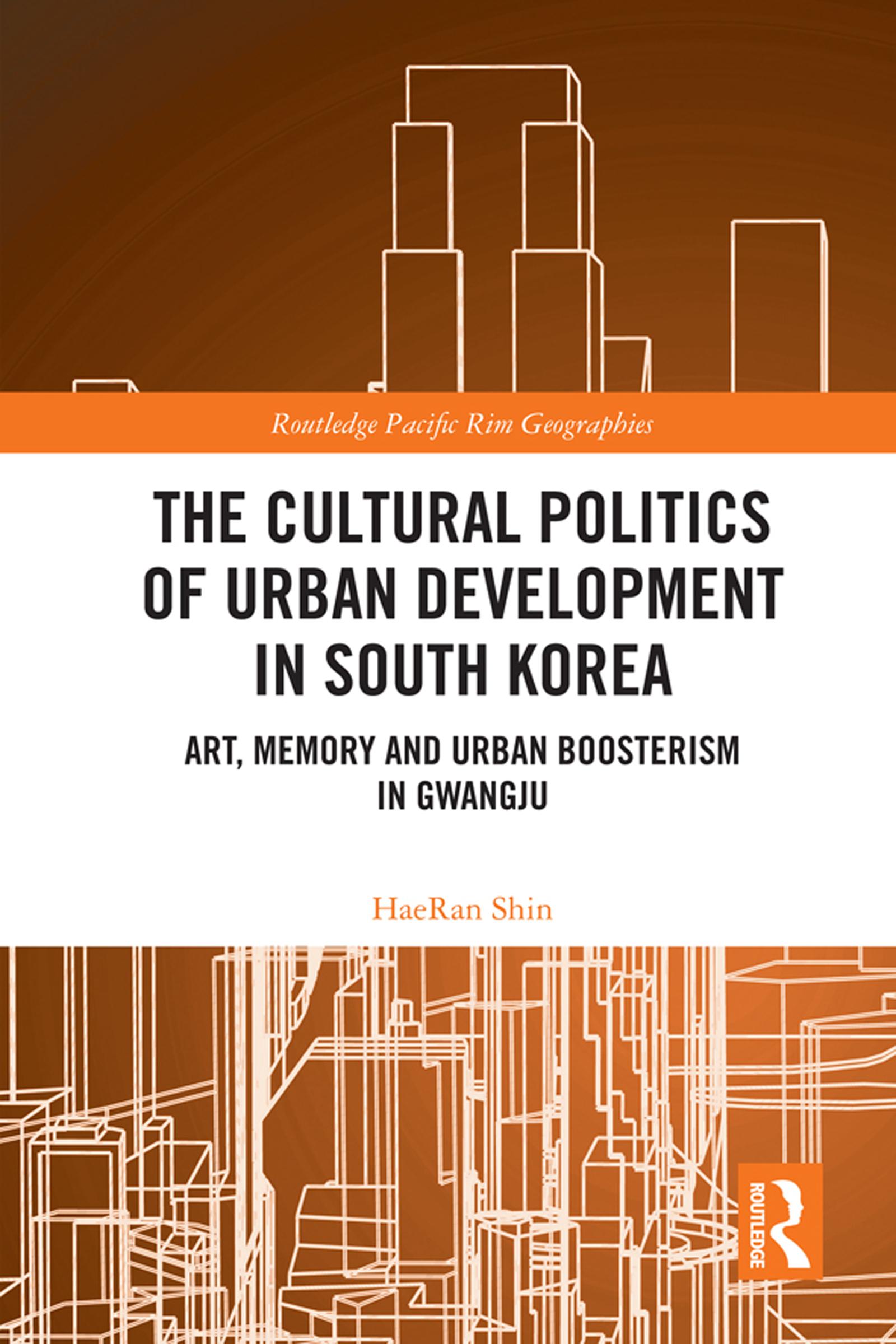
This book analyses the cultural politics of urban development in Gwangju, South Korea, and illustrates the implementation of state-led arts-based urban boosterism efforts in the context of political trauma and the desire for economic growth.
The book explores urban development that is complicated by the recent history of democratic uprising in Gwangju, and it examines the dichotomy between cities as growth machines and progressive metropolises. Actor-oriented qualitative research methods are used to show how culture and economies can evolve from territorial conflicts. The author argues that the quest for both growth and social justice can coexist in intertwined ways and create urban development. Moreover, recent events in Gwangju, such as the May 18 Democratic Uprising and massacre, are shown to act as a backdrop for state-led urban boosterism and desire for economic growth at the same time as depicting a resistance to state-corporate marketing plans, which culminates in the eventual emergence of relatively coherent places-of-memory. These convergences and divergences are comparable to the urban boosterism characteristic of Western cities.
The book contributes to the dialogue surrounding geography, urban studies, and postcolonial urban development, and will be of interest to academics working in these fields as well as human geography, planning, urban politics and East Asian studies.
Payez facilement par carte, Klarna, Apple Pay ou Google Pay. Pas satisfait ? Vous avez toujours une garantie de remboursement de 14 jours. En savoir plus dans nos conditions. Si vous avez des questions, envoyez-nous un e-mail à hello@memmo.org.
Memmo facilite tes études, où que tu sois dans le monde. On rassemble tes manuels de cours et des outils d'étude intelligents au même endroit : résumés, quiz, podcasts et flashcards. Et il y a Ted, ton compagnon d'étude qui répond à toutes tes questions. Plus de 50 000 étudiants étudient déjà ici – conçu pour t'aider à apprendre plus vite et à moins stresser.