
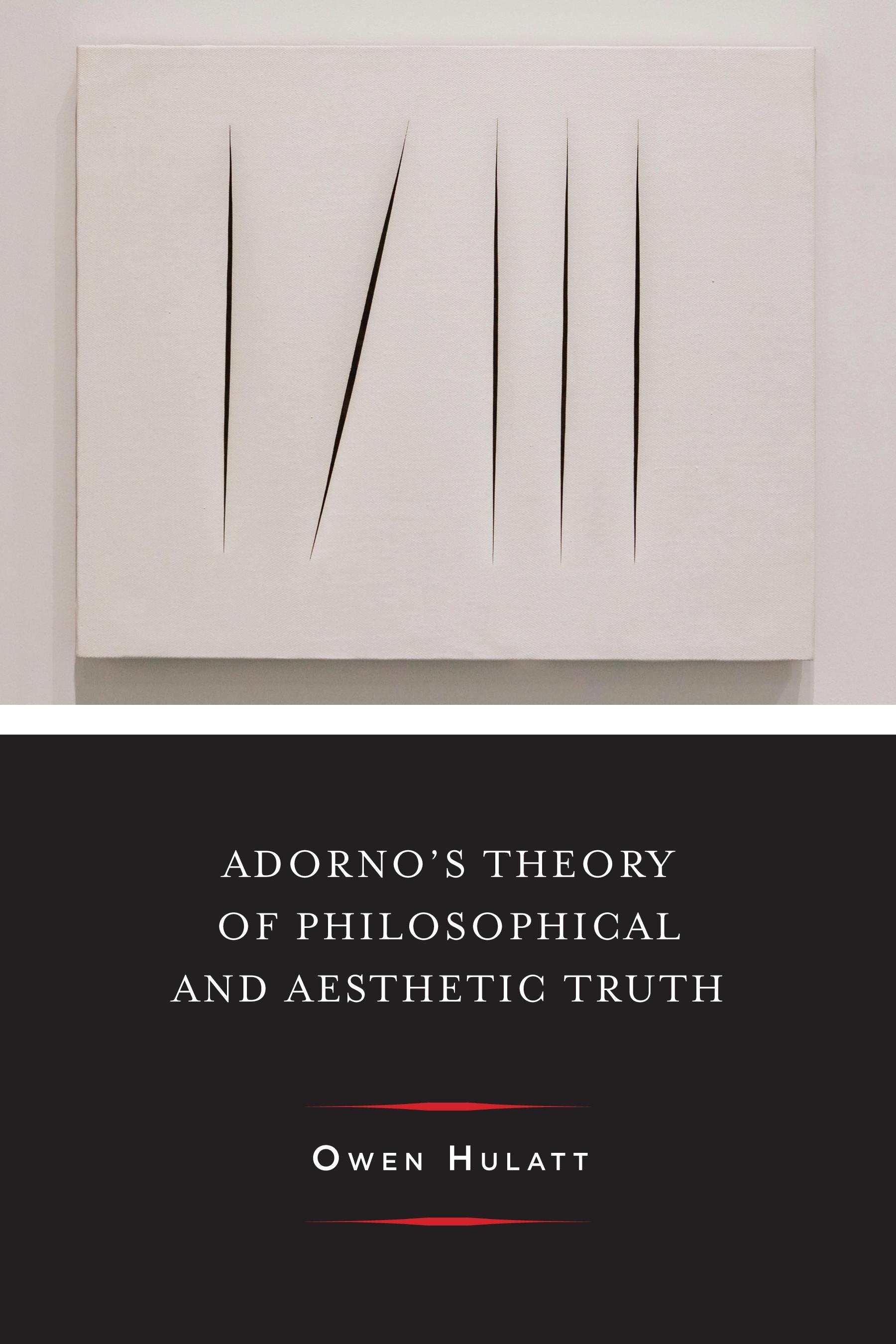
In Adorno's Theory of Philosophical and Aesthetic Truth, Owen Hulatt undertakes an original reading of Theodor W. Adorno's epistemology and its material underpinnings, deepening our understanding of his theories of truth, art, and the nonidentical. Hulatt's novel interpretation casts Adorno's theory of philosophical and aesthetic truth as substantially unified, supporting the thinker's claim that both philosophy and art are capable of being true.
For Adorno, truth is produced when rhetorical "texture" combines with cognitive "performance," leading to the breakdown of concepts that mediate the experience of the consciousness. Both philosophy and art manifest these features, although philosophy enacts these conceptual issues directly, while art does so obliquely. Hulatt builds a robust argument for Adorno's claim that concepts ineluctably misconstrue their objects. He also puts the still influential thinker into conversation with Hegel, Husserl, Frazer, Sohn-Rethel, Benjamin, Strawson, Dahlhaus, Habermas, and Caillois, among many others.
Payez facilement par carte, Klarna, Apple Pay ou Google Pay. Pas satisfait ? Vous avez toujours une garantie de remboursement de 14 jours. En savoir plus dans nos conditions. Si vous avez des questions, envoyez-nous un e-mail à hello@memmo.org.
Memmo facilite tes études, où que tu sois dans le monde. On rassemble tes manuels de cours et des outils d'étude intelligents au même endroit : résumés, quiz, podcasts et flashcards. Et il y a Ted, ton compagnon d'étude qui répond à toutes tes questions. Plus de 50 000 étudiants étudient déjà ici – conçu pour t'aider à apprendre plus vite et à moins stresser.