
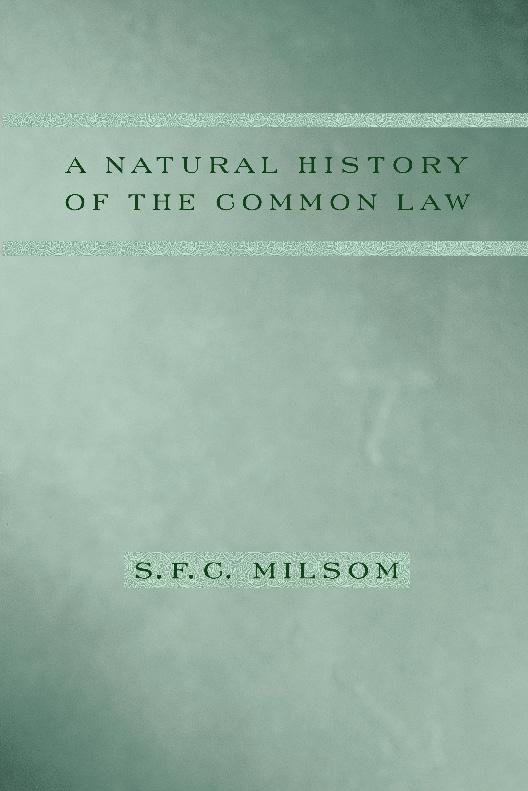
How does law come to be stated as substantive rules, and then how does it change? In this collection of discussions from the James S. Carpentier Lectures in legal history and criticism, one of Britain's most acclaimed legal historians S. F. C. Milsom focuses on the development of English common law—the intellectually coherent system of substantive rules that courts bring to bear on the particular facts of individual cases—from which American law was to grow. Milsom discusses the differences between the development of land law and that of other kinds of law and, in the latter case, how procedural changes allowed substantive rules first to be stated and then to be circumvented. He examines the invisibility of early legal change and how adjustment to conditions was hidden behind such things as the changing meaning of words.
Milsom points out that legal history may be more prone than other kinds of history to serious anachronism. Nobody ever states his assumptions, and a legal writer, addressing his contemporaries, never provided a glossary to warn future historians against attributing their own meanings to his words and therefore their own assumptions to his world. Formal continuity has enabled nineteenth-century assumptions to be carried back, in some respects as far back as the twelfth century. This book brings together Milsom's efforts to understand the uncomfortable changes that lie beneath that comforting formal surface. Those changes were too large to have been intended by anyone at the time and too slow to be perceived by historians working within the short periods now imposed by historical convention. The law was made not by great men making great decisions but by man-sized men unconcerned with the future and thinking only about their own immediate everyday difficulties. King Henry II, for example, did not intend the changes attributed to him in either land law or criminal law; the draftsman of De Donis did not mean to create the entail; nobody ever dreamed up a fiction with intent to change the law.
Payez facilement par carte, Klarna, Apple Pay ou Google Pay. Pas satisfait ? Vous avez toujours une garantie de remboursement de 14 jours. En savoir plus dans nos conditions. Si vous avez des questions, envoyez-nous un e-mail à hello@memmo.org.
Memmo facilite tes études, où que tu sois dans le monde. On rassemble tes manuels de cours et des outils d'étude intelligents au même endroit : résumés, quiz, podcasts et flashcards. Et il y a Ted, ton compagnon d'étude qui répond à toutes tes questions. Plus de 50 000 étudiants étudient déjà ici – conçu pour t'aider à apprendre plus vite et à moins stresser.