
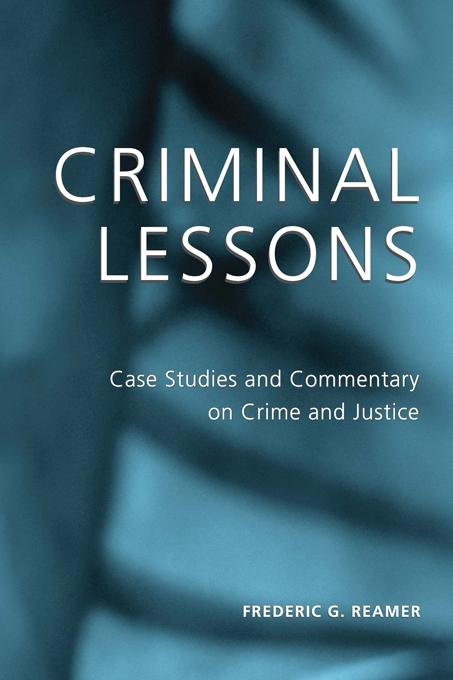
Why do people commit crimes? How can crime be prevented? And what can society and criminal justice professionals do to implement constructive responses to criminal behavior? Summarizing what he has learned about crime and criminals during his long career, one of social work's most distinguished theoreticians speculates about the factors that lead to crime and considers what we can do to prevent and respond to it meaningfully. Criminal Lessons is based on more than thirteen thousand cases in which Frederic G. Reamer has been involved as a parole board member, a role that was supplemented by his earlier experiences working in a federal correctional facility, a state penitentiary, and a forensic unit in a state psychiatric hospital.
Reamer presents an original and compelling typology of crime that classifies offenders on the basis of the circumstances that led to their offenses. He isolates seven categories, tracing crime to desperation, greed, rage, revenge, frolic, addiction, or mental illness. Using actual case studies to illustrate these patterns of 'criminal circumstances,' Reamer presents a model for the prevention of, and response to, crime and throughout the book offers recommendations related to social services, criminal justice, and public policy.
Payez facilement par carte, Klarna, Apple Pay ou Google Pay. Pas satisfait ? Vous avez toujours une garantie de remboursement de 14 jours. En savoir plus dans nos conditions. Si vous avez des questions, envoyez-nous un e-mail à hello@memmo.org.
Memmo facilite tes études, où que tu sois dans le monde. On rassemble tes manuels de cours et des outils d'étude intelligents au même endroit : résumés, quiz, podcasts et flashcards. Et il y a Ted, ton compagnon d'étude qui répond à toutes tes questions. Plus de 50 000 étudiants étudient déjà ici – conçu pour t'aider à apprendre plus vite et à moins stresser.