
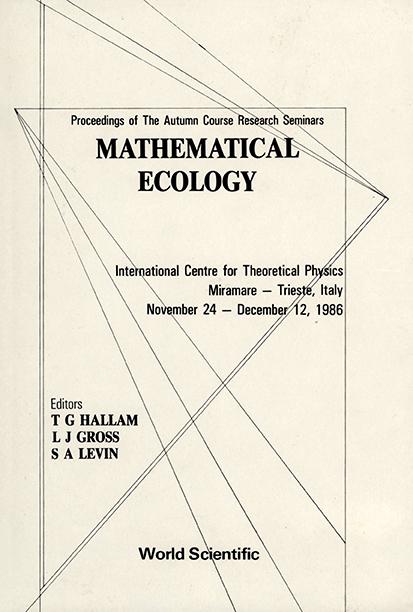
Contents:
Readership: Mathematical ecologists & Theoretical biologists.
- Physiological and Evolutionary Approaches:
- The Von Bertalanffy Growth Rate as a Function of Physiological Paramters (S A L M Kooijman)
- Limits of Hyperbolic Growth and Selection in Molecular and Biological Populations (E Szatkmary, M Kotsis & I Soheuring)
- ESS in Habitat Selection in Structured Populations and in Ecological Communities (I) (D Cohen)
- Avoidable Mortality in Life-History Theory (J A Leon)
- Plant and Plant-Insect Systems:
- Models for Aggregating Populations (P Turchin)
- Plant-Herbivore Systems (L Edelstein-Keshet)
- Extraordinary Latitudinal Gradients in Species-Richness - One Explanation (P Kindlmann)
- Incomplete Data in Ecological Studies: the Problem of Truncation with Mixing (A P Gore & S A Paranjpe)
- An Objective Method for the Determination of an Effective and Efficient Plot Size in Vegatational Sampling (S S Shaukat)
- Aquatic Systems:
- Nutrient Recycling and System Resilience in a Model of an Experimental Aquatic System (D L DeAngelis)
- Modeling and Management for Seawater Fishponds (S Ellner, M D Krom & F Brauer)
- Transient Spatial Patterns in Plankton Communities: Blooms and Travelling Waves of Phytoplankton in Estuaries (T M Powell, S Wilmott, J D Murray & V S Manoranjan)
- Biological Vortex Rings: Fertilization and Dispersal of Fish Eggs (A Okubo)
- Mathematical Modeling in a Sewage Outfall Design (H L Koh)
- Epidemiology:
- Cross-Immunity in the Dynamics of Homogeneous and Heterogeneous
- Populations (C Castillo-Chavez, H W Hethoote, V Andreas en, S A Levin & W-m Liu)
- Global Stability Results for a Multigroup SIR Epidemic Model (E Beretta & V Capasso)
- Dynamics of Parasitic Infections and of Sexually Transmitted Diseases (K P Hadeler)
- Resource Management and Other Applications:
- Specialists and Generalists in the Fishery: Implications of an Ecological-
- Economic Analogy (R MoKelvey)
- Models for Cooperation and Conspiracy in Fisheries: Fishing Mortality Patterns (G N white III)
- The Conservation and Maintenance of Valuable Resources: Optimal Expenditure Strategies (R H Lamberson)
- Discrete Nonlinear Harvesting Models and their Application to Forest Stand Management (W M Getz & R G Haight)
- Population Dynamics in Harshly Varying Environments: Evolutionary, Ecological and Medical Aspects (Z Agur)
- Mixture Approach to Clustering (S Ganesalingam)
- Analysis of Population Models:
- The Allee Effect in Age-Structured Population Dynamics (J M Cashing)
- Some More Results in Young Predation (M Saleem & R K Pandey)
- Modeling and Estimation in Size Structured Population Models (H T Banks, L W Botsford, F Kappel & C Wang)
- On Ergodic Non-Homogeneous Finite First-Order Markov Chains and Their Demographic Applications (F K Atsem)
- Density-Dependent Markov Branching Processes (P R Parthasarathy)
- Numerical Solution of a Population Model with Harvesting in a Random Environment (G W Harrison)
- Analysis of Community Models:
- Models of Community Assembly and the Structure of Ecological Landscapes (J A Drake)
- Coexistence and Survival of Invading Species (F Brauer)
- Boundedness in Persistently Disturbed Systems via the "Second Method" of Liapunov (A B Xaba)
- Saturated Equilibria, Permanence, and Stability for Ecological Systems (J Hofbauer)
- Permanence of Some Four-Species Prey-Predator Systems with Lotka-Volterra Dynamics (G Kirlinger)
- Communities with Interference Competition: Direct and Indirect Effects of Predation on their Structures (N Shigesada* K Kawasaki & E Teramotov)
- A Connection Matrix Approach Illustrated by Means of a Predator-Prey Model Involving Group Defense (K Misohaikow & G S K Wolkowioz)
- Oscillations in Segregation of Competing Populations (M Mimura, Y Kan-on & Y Nishiura)
- The Time Optimal Control Theory of Functional Differential Equations Applicable to Mathematical Ecology (E N Chukwu)
- Relative Persistence for Stochastic Population Models: Finite Sample Boundedness (T C Gard)
Readership: Mathematical ecologists & Theoretical biologists.
Maksa helposti kortilla, Klarnalla, Apple Paylla tai Google Paylla. Etkö ole tyytyväinen? Sinulla on aina 14 päivän palautusoikeus. Lue lisää ehdoistamme. Jos sinulla on kysyttävää, lähetä meille sähköpostia osoitteeseen hello@memmo.org.
Memmo tekee opiskelusta helpompaa – missä päin maailmaa ikinä oletkin. Meillä yhdistät kurssikirjat ja fiksut opiskelutyökalut yhteen paikkaan: tiivistelmät, visat, podcastit ja muistikortit. Ja sitten Ted, opiskelukaverisi, joka vastaa kaikkeen, mitä ikinä mietitkin. Yli 50 000 opiskelijaa opiskelee jo täällä – rakennettu auttamaan sinua oppimaan nopeammin ja stressaamaan vähemmän.
Saatat pitää myös näistä
Osta kirja0