
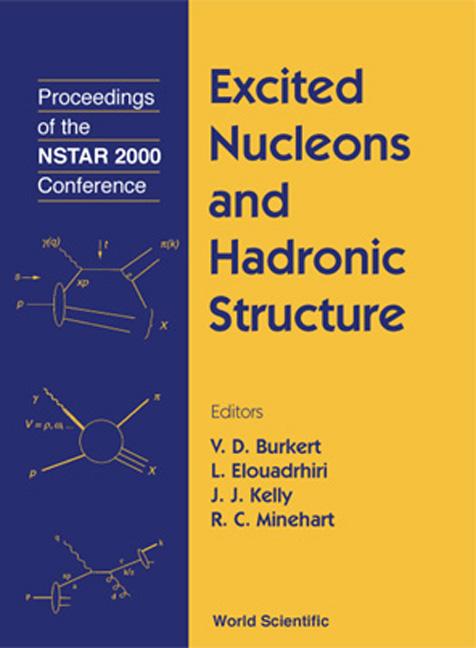
The conference NSTAR 2000 was part of a series of conferences and workshops that began in New York in 1988. Since then, the field of excited nucleons and hadron structure has developed enormously, and the scope has broadened. Most significantly, new experimental facilities have come into operation, allowing precise measurements of resonance couplings and transition form factors. The search for “missing” quark model states and gluonic excitations in complex hadronic channels is now possible.On the theory side, new and promising developments have emerged: quark models with meson degrees of freedom, hybrid baryon models, and studies of baryons in the limit of many colors. For the first time, lattice QCD has been employed to calculate masses of excited nucleons. Nucleon resonances are now recognized as providing significant contributions to the nucleon spin sum rules, as well as the Gerasimov-Drell-Hearn and Bjorken integrals, at finite momentum transfer.
Maksa helposti kortilla, Klarnalla, Apple Paylla tai Google Paylla. Etkö ole tyytyväinen? Sinulla on aina 14 päivän palautusoikeus. Lue lisää ehdoistamme. Jos sinulla on kysyttävää, lähetä meille sähköpostia osoitteeseen hello@memmo.org.
Memmo tekee opiskelusta helpompaa – missä päin maailmaa ikinä oletkin. Meillä yhdistät kurssikirjat ja fiksut opiskelutyökalut yhteen paikkaan: tiivistelmät, visat, podcastit ja muistikortit. Ja sitten Ted, opiskelukaverisi, joka vastaa kaikkeen, mitä ikinä mietitkin. Yli 50 000 opiskelijaa opiskelee jo täällä – rakennettu auttamaan sinua oppimaan nopeammin ja stressaamaan vähemmän.
Saatat pitää myös näistä
Osta kirja0