
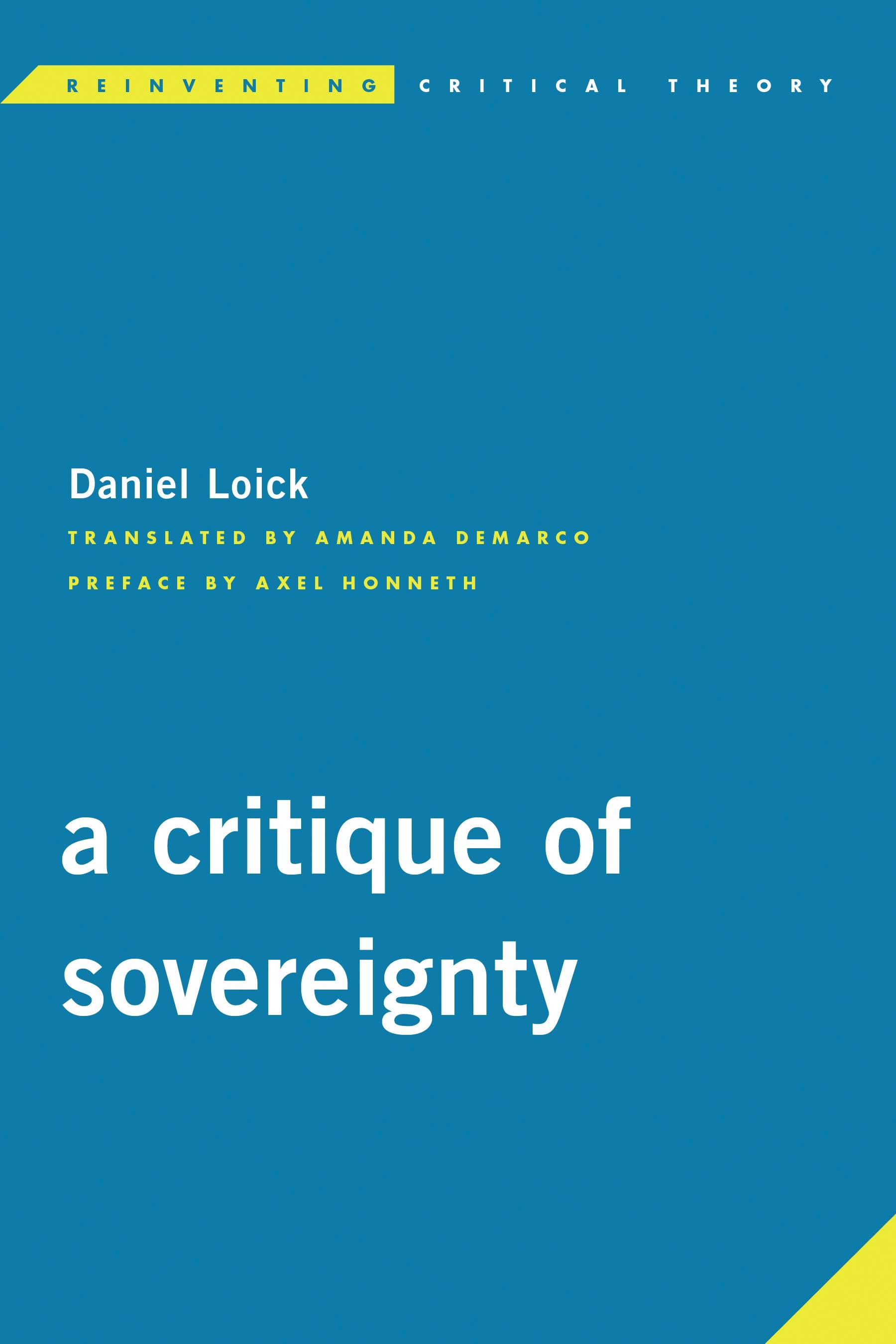
In this important new book, Daniel Loick argues that in order to become sensible to the violence imbedded in our political routines, philosophy must question the current forms of political community – the ways in which it organizes and executes its decisions, in which it creates and interprets its laws – much more radically than before. It must become a critical theory of sovereignty and in doing so eliminate coercion from the law.
The book opens with a historical reconstruction of the concept of sovereignty in Bodin, Hobbes, Rousseau, and Kant. Loick applies Adorno and Horkheimer’s notion of a ‘dialectic of Enlightenment’ to the political sphere, demonstrating that whenever humanity deemed itself progressing from chaos and despotism, it at the same time prolonged exactly the violent forms of interaction it wanted to rid itself from. He goes on to assemble critical theories of sovereignty, using Walter Benjamin’s distinction between ‘law-positing’ and ‘law-preserving’ violence as a terminological source, engaging with Marx, Arendt, Foucault, Agamben and Derrida, and adding several other dimensions of violence in order to draw a more complete picture. Finally, Loick proposes the idea of non-coercive law as a consequence of a critical theory of sovereignty.
The translation of this work was funded by Geisteswissenschaften International – Translation Funding for Humanities and Social Sciences from Germany, a joint initiative of the Fritz Thyssen Foundation, the German Federal Foreign Office, the collecting society VG WORT and the Börsenverein des Deutschen Buchhandels (German Publisher & Booksellers Association)
The book opens with a historical reconstruction of the concept of sovereignty in Bodin, Hobbes, Rousseau, and Kant. Loick applies Adorno and Horkheimer’s notion of a ‘dialectic of Enlightenment’ to the political sphere, demonstrating that whenever humanity deemed itself progressing from chaos and despotism, it at the same time prolonged exactly the violent forms of interaction it wanted to rid itself from. He goes on to assemble critical theories of sovereignty, using Walter Benjamin’s distinction between ‘law-positing’ and ‘law-preserving’ violence as a terminological source, engaging with Marx, Arendt, Foucault, Agamben and Derrida, and adding several other dimensions of violence in order to draw a more complete picture. Finally, Loick proposes the idea of non-coercive law as a consequence of a critical theory of sovereignty.
The translation of this work was funded by Geisteswissenschaften International – Translation Funding for Humanities and Social Sciences from Germany, a joint initiative of the Fritz Thyssen Foundation, the German Federal Foreign Office, the collecting society VG WORT and the Börsenverein des Deutschen Buchhandels (German Publisher & Booksellers Association)
Maksa helposti kortilla, Klarnalla, Apple Paylla tai Google Paylla. Etkö ole tyytyväinen? Sinulla on aina 14 päivän palautusoikeus. Lue lisää ehdoistamme. Jos sinulla on kysyttävää, lähetä meille sähköpostia osoitteeseen hello@memmo.org.
Memmo tekee opiskelusta helpompaa – missä päin maailmaa ikinä oletkin. Meillä yhdistät kurssikirjat ja fiksut opiskelutyökalut yhteen paikkaan: tiivistelmät, visat, podcastit ja muistikortit. Ja sitten Ted, opiskelukaverisi, joka vastaa kaikkeen, mitä ikinä mietitkin. Yli 50 000 opiskelijaa opiskelee jo täällä – rakennettu auttamaan sinua oppimaan nopeammin ja stressaamaan vähemmän.