
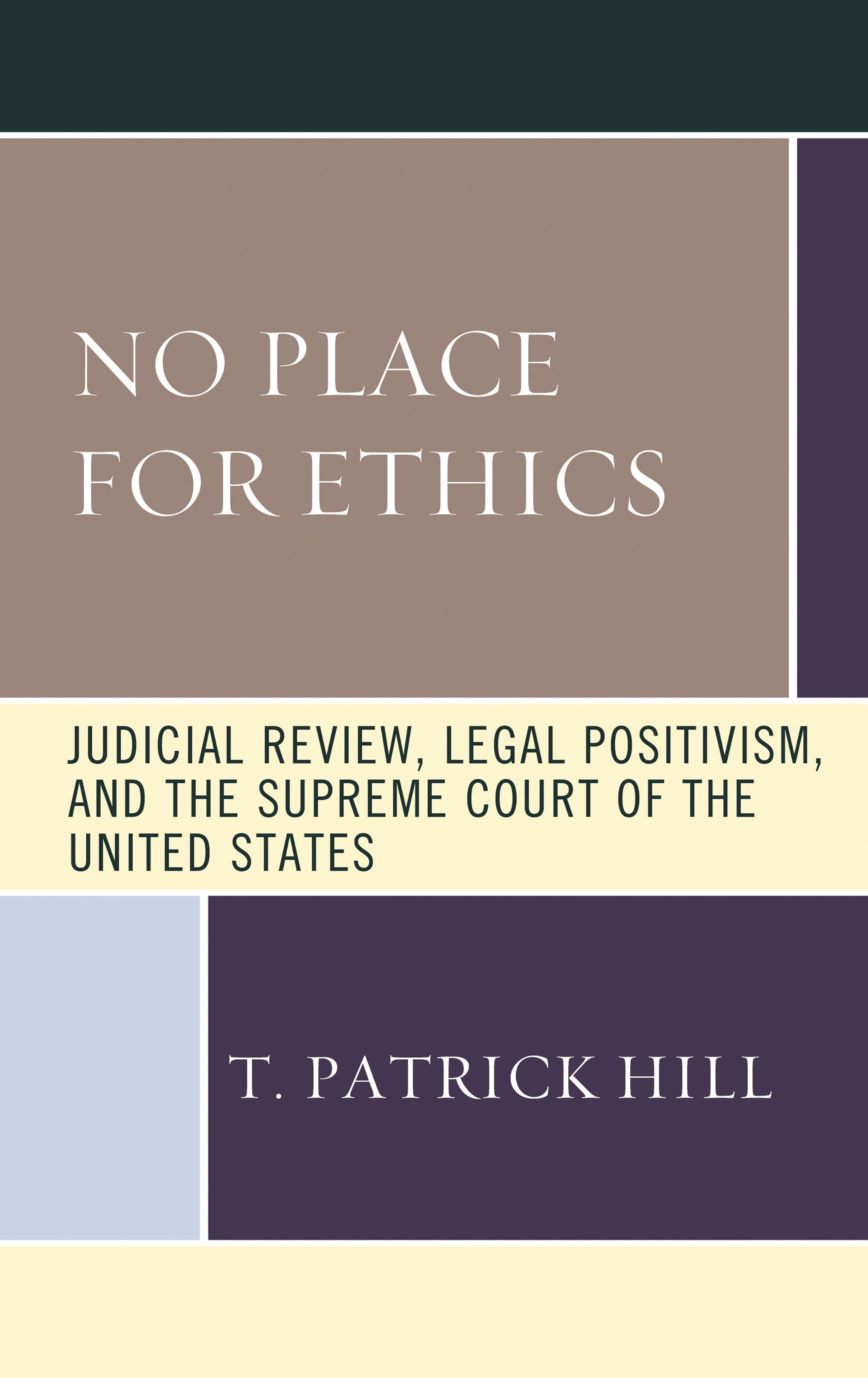
In No Place for Ethics, Hill argues that contemporary judicial review by the U.S. Supreme Court rests on its mistaken positivist understanding of law—law simply because so ordered—as something separate from ethics. Further, to assert any relation between the two is to contaminate both, either by turning law into an arm of ethics, or by making ethics an expression of law. This legal positivism was on full display recently when the Supreme Court declared that the CDC was acting unlawfully by extending the eviction moratorium to contain the spread of the Covid-19 Delta variant, something that, the Court admitted, was of indisputable benefit to the public. How mistaken however to think that acting for the good of the public is to act unlawfully when actually it is to act ethically and must therefore be lawful.
To address this mistake, Hill contends that an understanding of natural law theory provides the basis for a constitutive relation between ethics and law without confusing their distinct role in answering the basic question, how should I behave in society?
To secure that relation, the Court has an overriding responsibility when carrying out its review to do so with reference to normative ethics from which the U.S. Constitution is derived and to which it is accountable. While the Constitution confirms, for example, the liberty interests of individuals, it does not originate those interests which have their origin in human rights that long preceded it.
Essential to this argument is an appreciation of ethics as objective and based on principles, like those of justice, truth, and reason that ought to inform human behavior at its very springs. Applied in an analysis of five major Supreme Court cases, this appreciation of ethics reveals how wrongly decided these cases are.
To address this mistake, Hill contends that an understanding of natural law theory provides the basis for a constitutive relation between ethics and law without confusing their distinct role in answering the basic question, how should I behave in society?
To secure that relation, the Court has an overriding responsibility when carrying out its review to do so with reference to normative ethics from which the U.S. Constitution is derived and to which it is accountable. While the Constitution confirms, for example, the liberty interests of individuals, it does not originate those interests which have their origin in human rights that long preceded it.
Essential to this argument is an appreciation of ethics as objective and based on principles, like those of justice, truth, and reason that ought to inform human behavior at its very springs. Applied in an analysis of five major Supreme Court cases, this appreciation of ethics reveals how wrongly decided these cases are.
Maksa helposti kortilla, Klarnalla, Apple Paylla tai Google Paylla. Etkö ole tyytyväinen? Sinulla on aina 14 päivän palautusoikeus. Lue lisää ehdoistamme. Jos sinulla on kysyttävää, lähetä meille sähköpostia osoitteeseen hello@memmo.org.
Memmo tekee opiskelusta helpompaa – missä päin maailmaa ikinä oletkin. Meillä yhdistät kurssikirjat ja fiksut opiskelutyökalut yhteen paikkaan: tiivistelmät, visat, podcastit ja muistikortit. Ja sitten Ted, opiskelukaverisi, joka vastaa kaikkeen, mitä ikinä mietitkin. Yli 50 000 opiskelijaa opiskelee jo täällä – rakennettu auttamaan sinua oppimaan nopeammin ja stressaamaan vähemmän.