
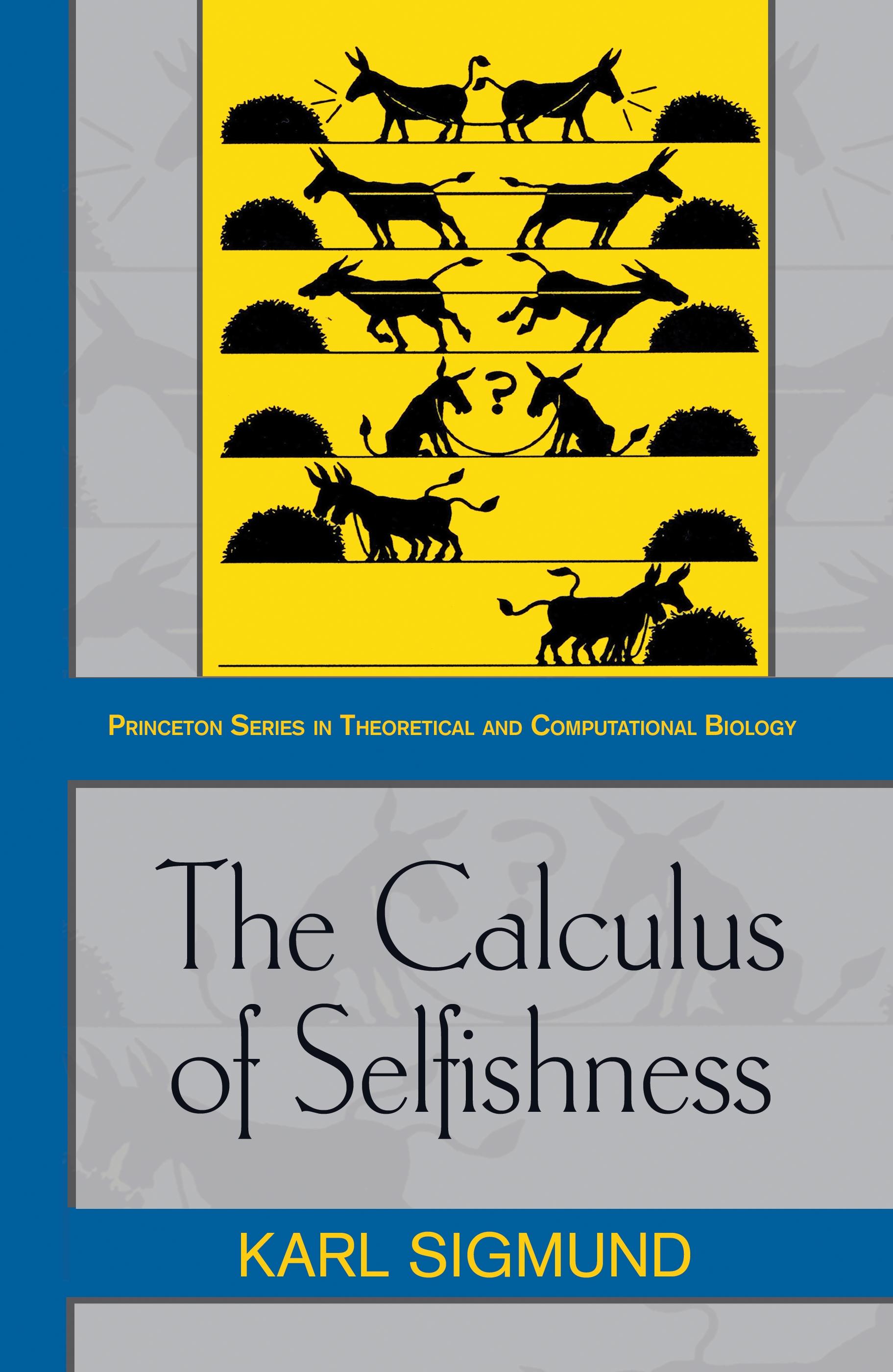
A pioneer in evolutionary game theory looks at selfishness and cooperation
How does cooperation emerge among selfish individuals? When do people share resources, punish those they consider unfair, and engage in joint enterprises? These questions fascinate philosophers, biologists, and economists alike, for the "invisible hand" that should turn selfish efforts into public benefit is not always at work. The Calculus of Selfishness looks at social dilemmas where cooperative motivations are subverted and self-interest becomes self-defeating. Karl Sigmund, a pioneer in evolutionary game theory, uses simple and well-known game theory models to examine the foundations of collective action and the effects of reciprocity and reputation.
Focusing on some of the best-known social and economic experiments, including games such as the Prisoner's Dilemma, Trust, Ultimatum, Snowdrift, and Public Good, Sigmund explores the conditions leading to cooperative strategies. His approach is based on evolutionary game dynamics, applied to deterministic and probabilistic models of economic interactions.
Exploring basic strategic interactions among individuals guided by self-interest and caught in social traps, The Calculus of Selfishness analyzes to what extent one key facet of human nature—selfishness—can lead to cooperation.
Maksa helposti kortilla, Klarnalla, Apple Paylla tai Google Paylla. Etkö ole tyytyväinen? Sinulla on aina 14 päivän palautusoikeus. Lue lisää ehdoistamme. Jos sinulla on kysyttävää, lähetä meille sähköpostia osoitteeseen hello@memmo.org.
Memmo tekee opiskelusta helpompaa – missä päin maailmaa ikinä oletkin. Meillä yhdistät kurssikirjat ja fiksut opiskelutyökalut yhteen paikkaan: tiivistelmät, visat, podcastit ja muistikortit. Ja sitten Ted, opiskelukaverisi, joka vastaa kaikkeen, mitä ikinä mietitkin. Yli 50 000 opiskelijaa opiskelee jo täällä – rakennettu auttamaan sinua oppimaan nopeammin ja stressaamaan vähemmän.