
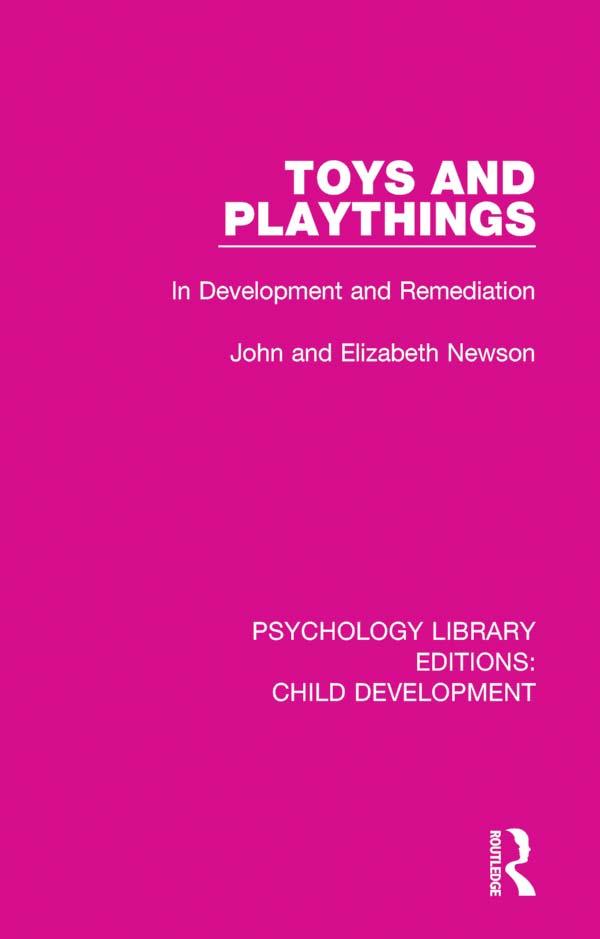
John and Elizabeth Newson were well known for their studies of child rearing, which have combined a rigorous research methodology with sympathetic insights into family life and a lively approach to scientific reporting. ‘Path-breaking’, ‘brilliant’, ‘seminal’, ‘outstanding’, ‘fascinating’, ‘enthralling’ and ‘enchanting’ are some of the adjectives used by critics to describe their previous books.
They now turn their attention to toys, the ‘pegs on which children hang their play’, a study for which they are uniquely qualified. Not only had they long experience in normal child development: they had been actively involved for many years in research and training in remedial play for disabled children, their research unit was a major influence in the phenomenal development of the toy libraries self-help movement, they designed for and advised the toy industry, and they had their own family-run specialist toyshop.
With this background, it is not surprising that their book on toys and playthings is both informative and entertaining on many different fronts. Richly observant, it follows the child’s development in play from using the mother or father as the ‘first and best toy’, through the exploratory and manipulative sequences, to the use of toys in ritual, symbolic or contemplative ways. Against this detailed understanding of ‘ordinary’ children’s growth points in play, the Newsons and their collaborators examine the special needs of disabled children, with a firm emphasis on how parents can help. What is more, in providing an intensely practical guide for the parents and teachers of the disabled child, they draw out comparative insights which are enlightening and absorbing for those whose children do not have such urgent problems.
Once again the Newsons share with the reader the viewpoints and preoccupations of research workers in the field. There is indeed a continual sense of ‘work in progress’, and nowhere more than in the chapter on using toys for developmental assessment, where the reader is given a hot line to a laboratory (i.e. playroom) notes used in their own research unit at the time in a welcome move away from the rigid test-bound assessment of ‘special’ children. The book is enriched by the authors’ sharp awareness that the history of playthings has a far longer perspective than the history of child psychology. They are not basically interested in educational toys as such, but in all the objects, made or found, on which the child hones his skill, his reasoning powers, his imagination, his emotions or his sense of humour. Fairground baubles, joke toys and poppy-head dolls are as much a part of this book as bricks, sorting boxes and teddy bears. In the Newsons’ own words: ‘We hope that people who simply like toys as objects will find something in this book to interest them; we suspect, indeed, that liking toys will be what all readers, whatever their reason for opening the book, have in common’.
Maksa helposti kortilla, Klarnalla, Apple Paylla tai Google Paylla. Etkö ole tyytyväinen? Sinulla on aina 14 päivän palautusoikeus. Lue lisää ehdoistamme. Jos sinulla on kysyttävää, lähetä meille sähköpostia osoitteeseen hello@memmo.org.
Memmo tekee opiskelusta helpompaa – missä päin maailmaa ikinä oletkin. Meillä yhdistät kurssikirjat ja fiksut opiskelutyökalut yhteen paikkaan: tiivistelmät, visat, podcastit ja muistikortit. Ja sitten Ted, opiskelukaverisi, joka vastaa kaikkeen, mitä ikinä mietitkin. Yli 50 000 opiskelijaa opiskelee jo täällä – rakennettu auttamaan sinua oppimaan nopeammin ja stressaamaan vähemmän.